Crab-eating Raccoon

Crab-eating Raccoon

Procyon cancrivorus

Silhouette: Margot Michaud · PhyloPic

LCLeast ConcernNTVUENCR
Daily sighting probability ~10% · With luck
at Rio de Janeiro

In 3 days ~20% in a week ~40%

10 Verified sightings at Rio de Janeiro
7 In 1 park From 2019 to 2026
June Best month
☀️🌙 Day & Night When it's spotted

About the Crab-eating Raccoon

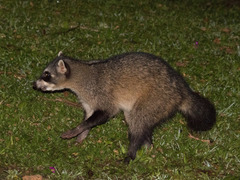
The crab-eating raccoon, southern raccoon, or South American raccoon (Procyon cancrivorus) is a species of raccoon native to marshy and jungle areas of Central and South America (including Trinidad and Tobago). It is found from Costa Rica south through most areas of South America east of the Andes down to northern Argentina and Uruguay. Despite its name, this species does not feed exclusively on crabs, and the common raccoon also seeks and eats crabs where they are available. In the Tupi–Guarani languages, it is known as aguará or agoará popé.

The crab-eating raccoon can be found in South America and parts of Central America. It can be found in Trinidad and Tobago, Costa Rica, Panama, Colombia, Venezuela, Suriname, Guyana, French Guiana, Ecuador, Brazil, Peru, Bolivia, Paraguay, Uruguay, and Argentina.

The crab-eating raccoon eats crabs, lobsters, crayfish, other crustaceans, and shellfish, such as oysters and clams. It is an omnivore and its diet also includes, for example, small amphibians, fish, insects, small turtles, turtle eggs, fruits, nuts, and vegetables. It resembles its northern cousin, the common raccoon, in having a bushy ringed... Wikipedia →

Sounds

Recording0:26

Argentina · 2025

© Eduardo Luis Beltrocco · iNaturalist · CC BY 4.0

Recording0:11

Ecuador · 2025

© ronaldmunoz · iNaturalist · CC BY-NC 4.0

Recording0:20

Colombia · 2024

© Lina Crespo · iNaturalist · CC BY-NC 4.0

Global Distribution

Parks Where Found

# Park Country Daily sighting probability
1 Tijuca National Park 🇧🇷 Brazil
~10%

More parks will be added in future updates.

Cities Where Found

# City Country Daily sighting probability
1 Asuncion 🇵🇾 Paraguay
~20%
2 Rio de Janeiro 🇧🇷 Brazil
~10%

Zoos & Centres Where Found

# Zoo / Centre Country
1 Parque Zoobotânico Getúlio Vargas 🇧🇷 Brazil In captivity
2 Amaru 🇪🇨 Ecuador In captivity
3 Bioparque Los Ocarros 🇨🇴 Colombia In captivity
4 Papiliorama 🇨🇭 Switzerland In captivity
5 Zoológico de Canindé 🇧🇷 Brazil In captivity
6 Amazon Rescue Center 🇵🇪 Peru In captivity
7 Huachipa Zoo Park 🇵🇪 Peru In captivity
8 Wiwa Quito 🇪🇨 Ecuador In captivity

Before you go

What are the chances of seeing a Crab-eating Raccoon in Rio de Janeiro?

With luck

About 10% of wildlife watchers report a Crab-eating Raccoon sighting in Rio de Janeiro on a given day, based on 10 verified sightings from GBIF citizen-science data. It is the 10th most-seen of the 15 mammals we can rate there. Over three days the chance rises to about 20%, and over a week to about 40%, if each day is a fresh chance.

When is the best time to see a Crab-eating Raccoon in Rio de Janeiro?

June and November–April

In those months about 10% of wildlife watchers report a Crab-eating Raccoon in Rio de Janeiro on a given day, against under 5% in May and July–October, the lowest months.

What time of day is best to see a Crab-eating Raccoon?

Between 8 and 11 pm

Across all the parks we cover, that three-hour window holds the most Crab-eating Raccoon sightings with a recorded time, and about 6 in 10 of them come between 6 pm and 6 am: it is seen both by day and at night.

Is Rio de Janeiro the best place to see a Crab-eating Raccoon?

2nd of 2

Of the 2 cities where we can rate Crab-eating Raccoon sightings, Rio de Janeiro ranks 2nd at about 10%. The best odds are in Asuncion (Paraguay, about 20%).

Where does the Crab-eating Raccoon sighting chance come from?

GBIF citizen-science records

It is estimated from how often the Crab-eating Raccoon is recorded against all the mammals logged in Rio de Janeiro (10 verified sightings), calibrated against known sighting rates. Figures are rounded to the nearest 10% because citizen-science data supports honest approximations, not decimals, and months with records from fewer than five people show "—". How it works.

← Back to Rio de Janeiro