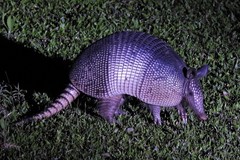


Nine-banded Armadillo

Nine-banded Armadillo

Dasypus novemcinctus

Silhouette: Steven Traver · PhyloPic

LCLeast ConcernNTVUENCR
Daily sighting probability ~10% · With luck
at Rio de Janeiro

In 3 days ~20% in a week ~40%

13 Verified sightings at Rio de Janeiro
102 In all 6 parks From 2019 to 2026
December Best month
☀️🌙 Day & Night When it's spotted

About the Nine-banded Armadillo

The nine-banded armadillo (Dasypus novemcinctus), also called the nine-banded long-nosed armadillo or common armadillo, is a species of armadillo native to South America. The Mexican long-nosed armadillo of North America was formerly treated as a subspecies of the nine-banded armadillo.

The nine-banded armadillo is a solitary, mainly nocturnal animal, found in many kinds of habitats, from mature and secondary rainforests to grassland and dry scrub. It is an insectivore, feeding chiefly on ants, termites, and other small invertebrates. The armadillo can jump 91–120 cm (3–4 ft) straight in the air if sufficiently frightened, making it a particular danger on roads.

They are one of the largest species of armadillos. Head and body length is 38–58 cm (15–23 in), which combines with the 26–53 cm (10–21 in) tail, for a total length of 64–107 cm (25–42 in). They stand 15–25... Wikipedia →

Global Distribution

Parks Where Found

# Park Country Daily sighting probability
1 Iberá National Park 🇦🇷 Argentina
~40%
2 El Palmar National Park 🇦🇷 Argentina
~30%
3 Iguaçu National Park 🇧🇷 Brazil
~10%
4 Iguazú National Park 🇦🇷 Argentina
~10%
5 Manu National Park 🇵🇪 Peru
~10%
6 Tijuca National Park 🇧🇷 Brazil
~10%

Cities Where Found

# City Country Daily sighting probability
1 Campo Grande 🇧🇷 Brazil
~30%
2 São Paulo 🇧🇷 Brazil
~10%
3 Rio de Janeiro 🇧🇷 Brazil
~10%

Zoos & Centres Where Found

# Zoo / Centre Country
1 Bioparque Municipal Vesty Pakos 🇧🇴 Bolivia In captivity
2 Senda Verde (Wildlife Sanctuary) 🇧🇴 Bolivia In captivity
3 Zoológico Municipal de Guarulhos 🇧🇷 Brazil In captivity
4 ZooAmerica 🇺🇸 United States In captivity
5 Pantanal Aquarium 🇧🇷 Brazil In captivity

Before you go

What are the chances of seeing a Nine-banded Armadillo in Rio de Janeiro?

With luck

About 10% of wildlife watchers report a Nine-banded Armadillo sighting in Rio de Janeiro on a given day, based on 13 verified sightings from GBIF citizen-science data. It is the 9th most-seen of the 15 mammals we can rate there. Over three days the chance rises to about 20%, and over a week to about 40%, if each day is a fresh chance.

When is the best time to see a Nine-banded Armadillo in Rio de Janeiro?

February, April–June, September and December

In those months about 10% of wildlife watchers report a Nine-banded Armadillo in Rio de Janeiro on a given day, against under 5% in January, March, July–August and October–November, the lowest months.

What time of day is best to see a Nine-banded Armadillo?

Between 7 and 10 pm

Across all the parks we cover, that three-hour window holds the most Nine-banded Armadillo sightings with a recorded time, and about 6 in 10 of them come between 6 am and 6 pm: it is seen both by day and at night.

Is Rio de Janeiro the best place to see a Nine-banded Armadillo?

3rd of 3

Of the 3 cities where we can rate Nine-banded Armadillo sightings, Rio de Janeiro ranks 3rd at about 10%. The best odds are in Campo Grande (Brazil, about 30%) and São Paulo (Brazil, about 10%).

Where does the Nine-banded Armadillo sighting chance come from?

GBIF citizen-science records

It is estimated from how often the Nine-banded Armadillo is recorded against all the mammals logged in Rio de Janeiro (13 verified sightings), calibrated against known sighting rates. Figures are rounded to the nearest 10% because citizen-science data supports honest approximations, not decimals, and months with records from fewer than five people show "—". How it works.

← Back to Rio de Janeiro