Lagartinho-da-mata

Lagartinho-da-mata

Ecpleopus gaudichaudii

Silhouette: Jose Carlos Arenas-Monroy · PhyloPic

LCLeast ConcernNTVUENCR
Daily sighting probability <5% · Rare
at Rio de Janeiro

In 3 days ~10% in a week ~30%

5 Verified sightings at Rio de Janeiro
March Best month
☀️🌙 Day & Night When it's spotted

About the Lagartinho-da-mata

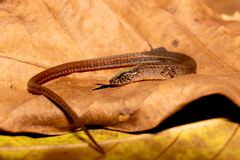
Ecpleopus is a genus of lizard in the family Gymnophthalmidae. The genus contains only one species, Ecpleopus gaudichaudii, which is endemic to Brazil. The specific name, gaudichaudii, is in honor of French botanist Charles Gaudichaud-Beaupré.

E. gaudichaudii is found in the Atlantic Forest in the Brazilian states of Espírito Santo, Minas Gerais, Rio de Janeiro, Santa Catarina, and São Paulo. The preferred natural habitat of E. gaudichaudii is forest, where it lives in the leaf litter on the forest floor.

E. gaudichaudii may attain a snout-to-vent length (SVL) of about 5 cm (2.0 in). Its legs are short, and its tail is laterally compressed. E. gaudichaudii preys upon small invertebrates such as termites, orthopterans, and spiders.

E. gaudichaudii is oviparous. Boulenger GA (1885). Catalogue of the Lizards in the British Museum (Natural History). Second Edition. Volume II.... Teiidæ.... London: Trustees of the British Museum (Natural History). (Taylor and Francis, printers). xiii + 497 pp. + Plates I-XXIV. (Genus Ecpleopus, p. 401; species E. gaudichaudii... Wikipedia →

Global Distribution

Parks Where Found

# Park Country Daily sighting probability

More parks will be added in future updates.

Cities Where Found

# City Country Daily sighting probability
1 Belo Horizonte 🇧🇷 Brazil
~10%
2 Rio de Janeiro 🇧🇷 Brazil
<5%

Closest Relatives at Rio de Janeiro

No species of the same family or order lives in Rio de Janeiro, so these are its closest relatives here: other reptiles.

Before you go

What are the chances of seeing a Lagartinho-da-mata in Rio de Janeiro?

Rare

Under 5% of wildlife watchers report a Lagartinho-da-mata sighting in Rio de Janeiro on a given day, based on 5 verified sightings from GBIF citizen-science data. It is the 14th most-seen of the 16 reptiles we can rate there. Over three days the chance rises to about 10%, and over a week to about 30%, if each day is a fresh chance.

When is the best time to see a Lagartinho-da-mata in Rio de Janeiro?

February–March, May, October and December

In those months about 10% of wildlife watchers report a Lagartinho-da-mata in Rio de Janeiro on a given day, against under 5% in January, April, June–September and November, the lowest months.

What time of day is best to see a Lagartinho-da-mata?

Between 11 am and 2 pm

Across all the parks we cover, that three-hour window holds the most Lagartinho-da-mata sightings with a recorded time, and about 7 in 10 of them come between 6 am and 6 pm: it is seen both by day and at night.

Is Rio de Janeiro the best place to see a Lagartinho-da-mata?

2nd of 2

Of the 2 cities where we can rate Lagartinho-da-mata sightings, Rio de Janeiro ranks 2nd at under 5%. The best odds are in Belo Horizonte (Brazil, about 10%).

Where does the Lagartinho-da-mata sighting chance come from?

GBIF citizen-science records

It is estimated from how often the Lagartinho-da-mata is recorded against all the reptiles logged in Rio de Janeiro (5 verified sightings), calibrated against known sighting rates. Figures are rounded to the nearest 10% because citizen-science data supports honest approximations, not decimals, and months with records from fewer than five people show "—". How it works.

← Back to Rio de Janeiro