Jararacussu

Jararacussu

Bothrops jararacussu

Silhouette: Steven Traver · PhyloPic

LCLeast ConcernNTVUENCR
Daily sighting probability <5% · Rare
at Rio de Janeiro

In 3 days ~10% in a week ~30%

5 Verified sightings at Rio de Janeiro
23 In all 4 parks From 2019 to 2026
January Best month
☀️🌙 Day & Night When it's spotted

About the Jararacussu

Bothrops jararacussu, commonly known in English as the jararacussu, is a highly venomous pit viper species endemic to South America. It is one of the most dreaded snakes in South America and can grow up to 2.2 metres (7.2 ft).

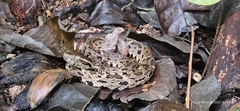
The jararacussu is a fairly large pit viper, growing up to 2.2 meters long, with a robust body and head and very aggressive behavior. The color of the body and head varies widely; the background color can be brown or yellow, almost black, the pattern of dark and light scales are constituted in a series of dark arches. The spots form on the dorsal midline, which look like the letter x. It has medium-sized eyes, with elliptical pupils vertically. With dorsal scales strongly keeled.

They have large fangs of 2.5 cm, and can inject a lot of venom. They usually feed on amphibians and rodents. They are ovoviviparous, giving birth to between 16 and 20 young, in the rainy season. Mainly diurnal and nocturnal, they usually warm up in the morning sun and venture forth to hunt at night.

It is found in South America in coastal Brazil (from Bahia to Santa Catarina), Paraguay, southeastern Bolivia, and northeastern Argentina... Wikipedia →

Global Distribution

Parks Where Found

# Park Country Daily sighting probability
1 Serra dos Órgãos National Park 🇧🇷 Brazil
~20%
2 Iguazú National Park 🇦🇷 Argentina
~10%
3 Iguaçu National Park 🇧🇷 Brazil
~10%
4 Tijuca National Park 🇧🇷 Brazil
~10%

Cities Where Found

# City Country Daily sighting probability
1 Rio de Janeiro 🇧🇷 Brazil
<5%

Zoos & Centres Where Found

# Zoo / Centre Country
1 São Paulo Zoo 🇧🇷 Brazil In captivity

Before you go

What are the chances of seeing a Jararacussu in Rio de Janeiro?

Rare

Under 5% of wildlife watchers report a Jararacussu sighting in Rio de Janeiro on a given day, based on 5 verified sightings from GBIF citizen-science data. It is the 14th most-seen of the 16 reptiles we can rate there. Over three days the chance rises to about 10%, and over a week to about 30%, if each day is a fresh chance.

When is the best time to see a Jararacussu in Rio de Janeiro?

January and June–July

In those months about 10% of wildlife watchers report a Jararacussu in Rio de Janeiro on a given day, against under 5% in February–May and August–December, the lowest months.

What time of day is best to see a Jararacussu?

Between 9 am and noon

Across all the parks we cover, that three-hour window holds the most Jararacussu sightings with a recorded time, and about 7 in 10 of them come between 6 am and 6 pm: it is seen both by day and at night.

Where else can you see a Jararacussu?

Only Rio de Janeiro, in our data

Rio de Janeiro is the only city on Wallace's Line with enough records to rate Jararacussu sightings: under 5% of wildlife watchers there report one on a given day.

Where does the Jararacussu sighting chance come from?

GBIF citizen-science records

It is estimated from how often the Jararacussu is recorded against all the reptiles logged in Rio de Janeiro (5 verified sightings), calibrated against known sighting rates. Figures are rounded to the nearest 10% because citizen-science data supports honest approximations, not decimals, and months with records from fewer than five people show "—". How it works.

← Back to Rio de Janeiro