Atlantic Forest Naked-toed Gecko

Atlantic Forest Naked-toed Gecko

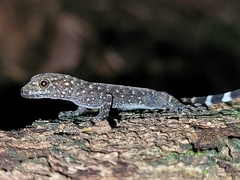
Gymnodactylus darwinii

Silhouette: Jose Carlos Arenas-Monroy · PhyloPic

LCLeast ConcernNTVUENCR
Daily sighting probability ~10% · With luck
at Rio de Janeiro

In 3 days ~20% in a week ~40%

11 Verified sightings at Rio de Janeiro
13 In all 2 parks From 2019 to 2026
February Best month
☀️ Diurnal When it's spotted

About the Atlantic Forest Naked-toed Gecko

Gymnodactylus darwinii is a species of gecko in the family Phyllodactylidae. The species is endemic to Brazil. The specific name, darwinii, is in honor of English naturalist Charles Darwin. G. darwinii is found in eastern Brazil.

The preferred natural habitats of G. darwinii are forest and shrubland. Adults of G. darwinii have a snout-to-vent length of about 3.5 cm (1.4 in). G. darwinii preys upon isopods, orthopterans, and other small arthropods.

G. darwinii is oviparous. Communal nesting has been observed. Freire EMX (1998). "Diferençião geografica em Gymnodactylus darwinii (Gray, 1845) (Sauria, Gekkonidae)". Papéis Avulsos de Zoologia, Museu de Zoologia da Universidade de São Paulo 40 (20): 311–322. (in Portuguese).

Gray JE (1845). Catalogue of the Specimens of Lizards in the Collection of the British Museum. London: Trustees of the British Museum. (Edward Newman, printer). xxviii + 289 pp. (Cubinia darwinii, new species, p. 274). Wikipedia →

Global Distribution

Parks Where Found

# Park Country Daily sighting probability
1 Serra dos Órgãos National Park 🇧🇷 Brazil
~20%
2 Tijuca National Park 🇧🇷 Brazil
~10%

Cities Where Found

# City Country Daily sighting probability
1 Rio de Janeiro 🇧🇷 Brazil
~10%

Closest Relatives at Rio de Janeiro

No species of the same family or order lives in Rio de Janeiro, so these are its closest relatives here: other reptiles.

Before you go

What are the chances of seeing an Atlantic Forest Naked-toed Gecko in Rio de Janeiro?

With luck

About 10% of wildlife watchers report an Atlantic Forest Naked-toed Gecko sighting in Rio de Janeiro on a given day, based on 11 verified sightings from GBIF citizen-science data. It is the 10th most-seen of the 16 reptiles we can rate there. Over three days the chance rises to about 20%, and over a week to about 40%, if each day is a fresh chance.

When is the best time to see an Atlantic Forest Naked-toed Gecko in Rio de Janeiro?

February–April and September–December

In those months about 10% of wildlife watchers report an Atlantic Forest Naked-toed Gecko in Rio de Janeiro on a given day, against under 5% in January and May–August, the lowest months.

What time of day is best to see an Atlantic Forest Naked-toed Gecko?

Between 1 and 4 pm

Across all the parks we cover, that three-hour window holds the most Atlantic Forest Naked-toed Gecko sightings with a recorded time, and about 7 in 10 of them come between 6 am and 6 pm: it is a daytime animal.

Where else can you see an Atlantic Forest Naked-toed Gecko?

Only Rio de Janeiro, in our data

Rio de Janeiro is the only city on Wallace's Line with enough records to rate Atlantic Forest Naked-toed Gecko sightings: about 10% of wildlife watchers there report one on a given day.

Where does the Atlantic Forest Naked-toed Gecko sighting chance come from?

GBIF citizen-science records

It is estimated from how often the Atlantic Forest Naked-toed Gecko is recorded against all the reptiles logged in Rio de Janeiro (11 verified sightings), calibrated against known sighting rates. Figures are rounded to the nearest 10% because citizen-science data supports honest approximations, not decimals, and months with records from fewer than five people show "—". How it works.

← Back to Rio de Janeiro