Calleta Silkmoth

Calleta Silkmoth

Eupackardia calleta

Daily sighting probability ~10% · With luck
at San Antonio

In 3 days ~20% in a week ~30%

61 Verified sightings at San Antonio
September Best month

About the Calleta Silkmoth

Eupackardia is a monotypic moth genus in the family Saturniidae erected by Theodore Dru Alison Cockerell in 1912. Its only species, Eupackardia calleta, the calleta silkmoth, was described by John O. Westwood in 1853. It is found in Mexico, Guatemala, as well as in the states such as; Arizona, New Mexico, and Texas.

The wingspan is normally 8–11 cm (3.1–4.3 in), however, some specimens have been reported to exceed 5 inches. The larvae mainly feed on Fraxinus species, Leucophyllum frutescens, Sapium biloculare and Fouquieria splendens.

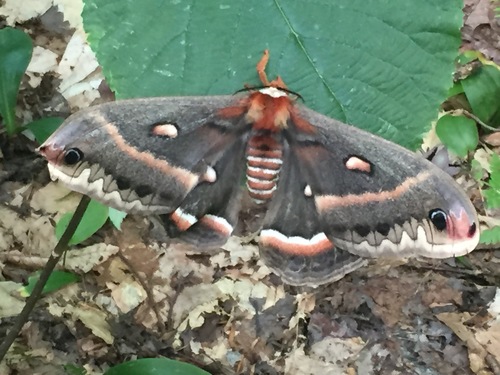
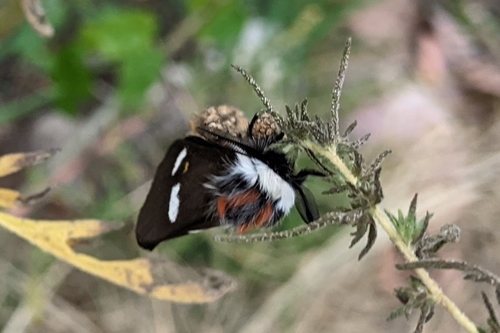
The adult calleta silkmoth has a black body with a red collar and red on the back of the thorax. The wings, which normally span 8-11 centimetres, are black with conspicuous white post-median lines which happen to be wider in females. They can also have large triangular white spots on their wings however, some may not.

Caterpillars or larvae are normally bright green in colour with white stripes as well as have black scoli sets (spike-like projections) with blue and orange bases, though these colours may vary. These larvae are normally very brightly coloured because they contain biogenetic chemicals that help to repel predators.

��2... Wikipedia →

Global Distribution

Parks Where Found

# Park Country Daily sighting probability

More parks will be added in future updates.

Cities Where Found

# City Country Daily sighting probability
1 Puebla 🇲🇽 México
~10%
2 Mexico City 🇲🇽 México
~10%
3 San Antonio 🇺🇸 United States
~10%

Before you go

What are the chances of seeing a Calleta Silkmoth in San Antonio?

With luck

About 10% of wildlife watchers report a Calleta Silkmoth sighting in San Antonio on a given day, based on 61 verified sightings from GBIF citizen-science data. It is the 148th most-seen of the 697 insects we can rate there. Over three days the chance rises to about 20%, and over a week to about 30%, if each day is a fresh chance.

When is the best time to see a Calleta Silkmoth in San Antonio?

February–May, July and September–November

In those months about 10% of wildlife watchers report a Calleta Silkmoth in San Antonio on a given day, against under 5% in June, August and December–January, the lowest months.

Is San Antonio the best place to see a Calleta Silkmoth?

Among the best

Of the 3 cities where we can rate Calleta Silkmoth sightings, San Antonio ranks 3rd at about 10%, level with the leaders once rounded. The best odds are in Puebla (México, about 10%) and Mexico City (México, about 10%).

Which relatives of the Calleta Silkmoth live in San Antonio?

Same family: Saturniidae

The closest relatives of the Calleta Silkmoth that you can see in San Antonio (family Saturniidae, Emperor and Giant Silk Moths) are Polyphemus Moth (about 10%) and Texas Buck Moth (about 10%), with each one's daily chance of a sighting.

Where does the Calleta Silkmoth sighting chance come from?

GBIF citizen-science records

It is estimated from how often the Calleta Silkmoth is recorded against all the insects logged in San Antonio (61 verified sightings), calibrated against known sighting rates. Figures are rounded to the nearest 10% because citizen-science data supports honest approximations, not decimals, and months with records from fewer than five people show "—". How it works.

← Back to San Antonio