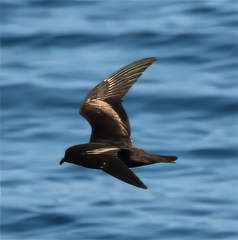
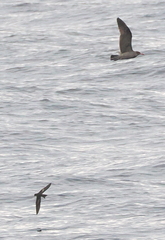
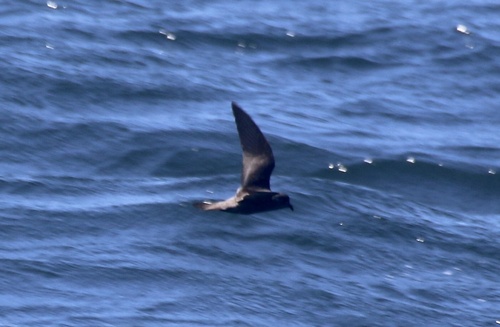
Black Storm-Petrel

Black Storm-Petrel

Hydrobates melania

Silhouette: Rachel Shoop · PhyloPic

LCLeast ConcernNTVUENCR
Daily sighting probability <5% · Rare
at San Diego

In 3 days <5%

17 Verified sightings at San Diego
128 In all 4 parks From 2019 to 2026
August Best month
☀️ Diurnal When it's spotted

About the Black Storm-Petrel

The black storm petrel (Hydrobates melania) is a small seabird of the storm petrel family Hydrobatidae. It is 23 cm in length, with a wingspan of 46–51 cm. The species breeds colonially on islands off the southern California coast of the United States and off the Baja Peninsula and Gulf of California of Mexico. Nesting sites are usually in rock crevices, occasionally in small burrows in soft earth. It also uses unused burrows from auklets. Colonies are attended nocturnally in order to avoid predatory birds such as gulls, hawks and owls. Like most petrels, its walking ability is limited to a short shuffle to the burrow. The female lays a single white egg per breeding season, if the egg is lost then it is replaced only rarely. Both parents share incubation duties, incubation lasting around 50 days. The chick is brooded for a few days after hatching until it is able to thermoregulate by itself, after which both parents forage to provide food. Chicks fledge 10 weeks after hatching.

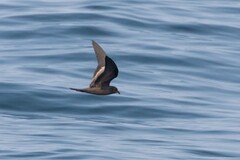
The black storm petrel spends the rest of the year at sea, but occurring closer to shore than most other storm-petrels. Because of this, it sometimes can be seen from the mainland. It undertakes... Wikipedia →

Global Distribution

Parks Where Found

# Park Country Daily sighting probability
1 Cabo Blanco Absolute Nature Reserve 🇨🇷 Costa Rica
~10%
2 Coiba National Park 🇵🇦 Panama
~10%
3 Cabo Pulmo National Park 🇲🇽 Mexico
<5%
4 Manuel Antonio National Park 🇨🇷 Costa Rica
<5%

Cities Where Found

# City Country Daily sighting probability
1 San Diego 🇺🇸 United States
<5%
2 Los Angeles 🇺🇸 United States
<5%

Before you go

What are the chances of seeing a Black Storm-Petrel in San Diego?

Rare

Under 5% of wildlife watchers report a Black Storm-Petrel sighting in San Diego on a given day, based on 17 verified sightings from GBIF citizen-science data. It is the 363rd most-seen of the 386 birds we can rate there. Over three days the chance rises to under 5%, if each day is a fresh chance.

When is the best time to see a Black Storm-Petrel in San Diego?

Any time of year

In every month with enough records, under 5% of wildlife watchers report a Black Storm-Petrel in San Diego on a given day, so our monthly data shows no clear season.

What time of day is best to see a Black Storm-Petrel?

Between 11 am and 2 pm

Across all the parks we cover, that three-hour window holds the most Black Storm-Petrel sightings with a recorded time, and about 9 in 10 of them come between 6 am and 6 pm: it is a daytime animal.

Is San Diego the best place to see a Black Storm-Petrel?

Yes

Of the 2 cities where we can rate Black Storm-Petrel sightings, San Diego has the highest daily chance: under 5%. Next come Los Angeles (United States, under 5%).

Where does the Black Storm-Petrel sighting chance come from?

GBIF citizen-science records

It is estimated from how often the Black Storm-Petrel is recorded against all the birds logged in San Diego (17 verified sightings), calibrated against known sighting rates. Figures are rounded to the nearest 10% because citizen-science data supports honest approximations, not decimals, and months with records from fewer than five people show "—". How it works.

← Back to San Diego