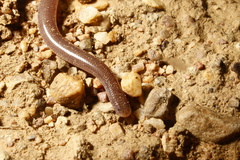
Khorat Blind Snake

Khorat Blind Snake

Indotyphlops braminus

Silhouette: SeismicShrimp · PhyloPic

LCLeast ConcernNTVUENCR
Daily sighting probability <5% · Rare
at San Diego

In 3 days ~10% in a week ~20%

48 Verified sightings at San Diego
81 In all 4 parks From 2019 to 2026
November Best month
☀️🌙 Day & Night When it's spotted

About the Khorat Blind Snake

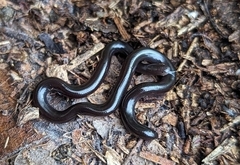
Indotyphlops braminus, commonly known as the brahminy blind snake, is a non-venomous blind snake species, found mostly in Africa and Asia, and has been introduced in many other parts of the world. It is a completely fossorial (i.e., burrowing) reptile, with habits and appearance similar to an earthworm, for which it is often mistaken and shares convergent evolution with, although close examination reveals tiny scales and eyes rather than the annular segments characteristic of a true earthworm. The species is parthenogenetic and all known specimens have been female. The specific name is a Latinized form of the word Brahmin. No subspecies are currently recognized as being valid.

Adults of I. braminus measure 2–4 inches (5.1–10.2 cm) long, uncommonly to 6 inches (15 cm). The head and tail are superficially similar as the head and neck are indistinct. Unlike other snakes, the head scales resemble the body scales. The eyes are barely discernible as small dots under the head scales. The tip of the tail has a small, pointed spur. Along the body are fourteen rows of dorsal scales. Coloration ranges from charcoal gray, silver-gray, light yellow-beige, purplish, or infrequently... Wikipedia →

Sounds

Recording0:06

Mexico · 2020

© aharhel · iNaturalist · CC BY-NC 4.0

Recording0:01

Taiwan · 2025

© Előd Kondorosy · iNaturalist · CC BY-NC 4.0

Recording0:11

Taiwan · 2024

© 新北市生態服務給付(上傳) · iNaturalist · CC BY-NC 4.0

Global Distribution

Parks Where Found

# Park Country Daily sighting probability
1 Big Cypress National Preserve 🇺🇸 United States
~10%
2 Everglades National Park 🇺🇸 United States
~10%
3 Table Mountain National Park 🇿🇦 South Africa
<5%
4 Cumbres de Monterrey National Park 🇲🇽 Mexico
<5%

Cities Where Found

# City Country Daily sighting probability
1 Chhatrapati Sambhajinagar 🇮🇳 India
~40%
2 Lucknow 🇮🇳 India
~40%
3 Vadodara 🇮🇳 India
~30%
4 San Pedro Sula 🇭🇳 Honduras
~30%
5 Dehradun 🇮🇳 India
~30%
6 Bengaluru 🇮🇳 India
~20%
7 Yogyakarta 🇮🇩 Indonesia
~20%
8 Jakarta 🇮🇩 Indonesia
~20%
9 Manila 🇵🇭 Philippines
~20%
10 Pune 🇮🇳 India
~20%

Closest Relatives at San Diego

No species of the same family or order lives in San Diego, so these are its closest relatives here: other reptiles.

Before you go

What are the chances of seeing a Khorat Blind Snake in San Diego?

Rare

Under 5% of wildlife watchers report a Khorat Blind Snake sighting in San Diego on a given day, based on 48 verified sightings from GBIF citizen-science data. It is the 18th most-seen of the 29 reptiles we can rate there. Over three days the chance rises to about 10%, and over a week to about 20%, if each day is a fresh chance.

When is the best time to see a Khorat Blind Snake in San Diego?

November and December

In those months about 10% of wildlife watchers report a Khorat Blind Snake in San Diego on a given day, against under 5% in January to October, the lowest months. Those are among San Diego's wettest months, with about 40 mm of rain a month against almost none in July.

What time of day is best to see a Khorat Blind Snake?

Between 10 am and 1 pm

Across all the parks we cover, that three-hour window holds the most Khorat Blind Snake sightings with a recorded time, and about 6 in 10 of them come between 6 am and 6 pm: it is seen both by day and at night.

Is San Diego the best place to see a Khorat Blind Snake?

45th of 46

Of the 46 cities where we can rate Khorat Blind Snake sightings, San Diego ranks 45th at under 5%. The best odds are in Chhatrapati Sambhajinagar (India, about 40%), Lucknow (India, about 40%) and Vadodara (India, about 30%).

Where does the Khorat Blind Snake sighting chance come from?

GBIF citizen-science records

It is estimated from how often the Khorat Blind Snake is recorded against all the reptiles logged in San Diego (48 verified sightings), calibrated against known sighting rates. Figures are rounded to the nearest 10% because citizen-science data supports honest approximations, not decimals, and months with records from fewer than five people show "—". How it works.

← Back to San Diego