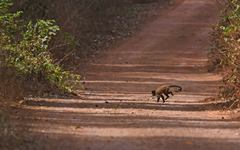
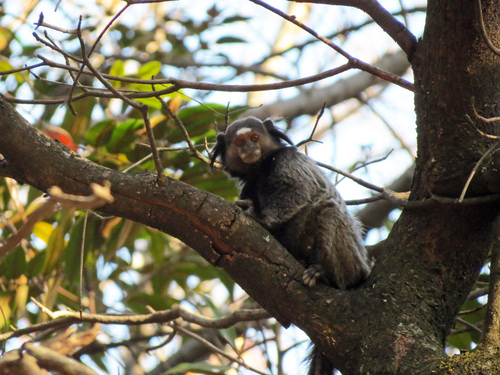
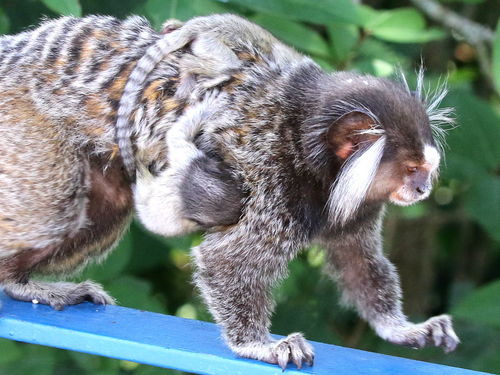
Black-striped Capuchin

Black-striped Capuchin

Sapajus libidinosus

Silhouette: Kai R. Caspar · PhyloPic

LCNTNear ThreatenedVUENCR Endemic
Daily sighting probability <5% · Rare
at São Paulo

In 3 days ~10% in a week ~30%

11 Verified sightings at São Paulo
February Best month
☀️ Diurnal When it's spotted

About the Black-striped Capuchin

The black-striped capuchin (Sapajus libidinosus), also known as the bearded capuchin, is a New World monkey in the family Cebidae. They are native to northern and central Brazil. These capuchins mostly live in dry forests, and savannah landscapes between the Rio Araguaia and the Rio Grande. Known for its tool use, the black-striped capuchin has been shown to use tools in a wide variety of situations, ranging from using rocks for nut cracking to using sticks for digging. They were, until recently, considered a subspecies of the tufted capuchin, but because of more research and insights, they are considered their own species by many.

They often live in highly social groups ranging from 6-20 individuals. Females are philopatric, show coalition, and linear dominance hierarchy. Females reach sexual maturity around 5 years of age and give birth about every 24 months to a single infant.

The black-striped capuchin is a New World monkey and a member of the Cebidae family, which contains both capuchins and squirrel monkeys. Until the past few decades, the black-striped capuchin was considered a subspecies of the tufted capuchin but has slowly become accepted as a separate species... Wikipedia →

Sounds

Recording1:36

Brazil · 2025

© José Weslley de Lima Silva · iNaturalist · CC BY-NC 4.0

Recording0:09

Brazil · 2026

© Matheus M. Santos · iNaturalist · CC BY-NC 4.0

Global Distribution

Parks Where Found

# Park Country Daily sighting probability

More parks will be added in future updates.

Cities Where Found

# City Country Daily sighting probability
1 Goiânia 🇧🇷 Brazil
~30%
2 Brasilia 🇧🇷 Brazil
~20%
3 São Paulo 🇧🇷 Brazil
<5%

Zoos & Centres Where Found

# Zoo / Centre Country
1 Centro de Reeducación de los Monos Carayá 🇦🇷 Argentina In captivity
2 Zoológico de Brasília 🇧🇷 Brazil In captivity
3 Brookfield Zoo 🇺🇸 United States In captivity
4 Parque Zoológico de León - Zooleón 🇲🇽 Mexico In captivity
5 Leofoo Village Theme Park 🇹🇼 Taiwan In captivity
6 Zoológico de Goiânia 🇧🇷 Brazil In captivity
7 Parque Zoobotânico Getúlio Vargas 🇧🇷 Brazil In captivity
8 Parque Zoobotânico Arruda Câmara (BICA) 🇧🇷 Brazil In captivity
9 Allwetterzoo Münster 🇩🇪 Germany In captivity
10 Münster Zoo 🇩🇪 Germany In captivity
11 Zoológico Dois Irmãos 🇧🇷 Brazil In captivity
12 Bioparque Municipal Vesty Pakos 🇧🇴 Bolivia In captivity
13 Monkey World 🇬🇧 United Kingdom In captivity
14 Chapultepec Zoo 🇲🇽 Mexico In captivity
15 Ecopark 🇦🇷 Argentina In captivity
16 Zagreb Zoo 🇭🇷 Croatia In captivity
17 Willowbank Wildlife Reserve 🇳🇿 New Zealand In captivity
18 Granja los Pibes 🇦🇷 Argentina In captivity
19 Cóndor 🇧🇴 Bolivia In captivity
20 Monkey Sanctuary 🇿🇦 South Africa In captivity
21 The Elephant Sanctuary Hartbeespoort Dam 🇿🇦 South Africa In captivity

Before you go

What are the chances of seeing a Black-striped Capuchin in São Paulo?

Rare

Under 5% of wildlife watchers report a Black-striped Capuchin sighting in São Paulo on a given day, based on 11 verified sightings from GBIF citizen-science data. It is the 14th most-seen of the 19 mammals we can rate there. Over three days the chance rises to about 10%, and over a week to about 30%, if each day is a fresh chance.

When is the best time to see a Black-striped Capuchin in São Paulo?

February, April and September

In those months about 10% of wildlife watchers report a Black-striped Capuchin in São Paulo on a given day, against under 5% in March, May–August and October–January, the lowest months.

What time of day is best to see a Black-striped Capuchin?

Between 10 am and 1 pm

Across all the parks we cover, that three-hour window holds the most Black-striped Capuchin sightings with a recorded time, and about 9 in 10 of them come between 6 am and 6 pm: it is a daytime animal.

Is São Paulo the best place to see a Black-striped Capuchin?

3rd of 3

Of the 3 cities where we can rate Black-striped Capuchin sightings, São Paulo ranks 3rd at under 5%. The best odds are in Goiânia (Brazil, about 30%) and Brasilia (Brazil, about 20%).

Which relatives of the Black-striped Capuchin live in São Paulo?

Same order: Primates

The closest relatives of the Black-striped Capuchin that you can see in São Paulo (order Primates) are Black-pencilled Marmoset (about 30%), Brown Howler Monkey (about 30%) and Common Marmoset (about 20%), with each one's daily chance of a sighting.

Where does the Black-striped Capuchin sighting chance come from?

GBIF citizen-science records

It is estimated from how often the Black-striped Capuchin is recorded against all the mammals logged in São Paulo (11 verified sightings), calibrated against known sighting rates. Figures are rounded to the nearest 10% because citizen-science data supports honest approximations, not decimals, and months with records from fewer than five people show "—". How it works.

← Back to São Paulo