


Completed


Collared Peccary
Pecari tajacu
Silhouette: Steven Traver · PhyloPic
- KingdomAnimalia (Animals)
- PhylumChordata (Chordates)
- ClassMammalia (Mammals)
- OrderArtiodactyla (Even-toed Ungulates and Cetaceans)
- FamilyTayassuidae (Peccaries)
- GenusPecari (Javelinas)
- SpeciesPecari tajacu (Collared Peccary)
In 3 days ~20% in a week ~30%
23 Verified sightings at São Paulo
1,644 In all 25 parks From 2019 to 2026
June Best month
☀️🌙 Day & Night When it's spotted
About the Collared Peccary
The collared peccary (Dicotyles tajacu) is a peccary, a species of artiodactyl (even-toed) mammal in the family Tayassuidae. It is the only extant member of the genus Dicotyles. They are commonly referred to as javelina, saíno, taitetu, or báquiro, although these terms are also used to describe other species in the family. The species is also known as the musk hog. In Trinidad, it is colloquially known as quenk.
The species is found in the tropical and subtropical Americas. In the Miocene, the first Tayassuids appeared, which would give rise to the modern collared peccary, with these species belonging to the same genus and often being larger than it. It is believed that many of its ancestors initially appeared in North America, later migrating to South America and eventually giving rise to the modern Tayassu (Tayassu tajacu).
The collared peccary stands around 51–61 cm (20–24 in) tall at the shoulder and is about 1.0–1.5 m (3 ft 3 in – 4 ft 11 in) long. It weighs between 16 and 27 kg (35 and 60 lb). The dental formula is: 2/3,1/1,3/3,3/3. The collared peccary has small tusks that point toward the ground when the animal is upright. It has slender legs with a robust... Wikipedia →
Sounds
Call0:27
Ecuador · 2020
© Manuel Sánchez-Nivicela · XC1027030 · CC BY-NC-ND 4.0
Recording0:15
Colombia · 2025
© Núcleo Palmero Aceites Morichal S.A.S. · iNaturalist · CC BY-NC 4.0
Recording0:16
Brazil · 2022
© Matheus M. Santos · iNaturalist · CC BY-NC 4.0
Recent sightings of Collared Peccary in São Paulo
LIVEiNaturalistGlobal Distribution
Parks Where Found
Zoos & Centres Where Found
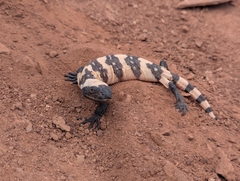
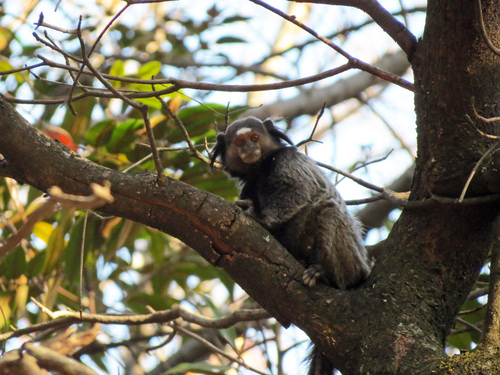
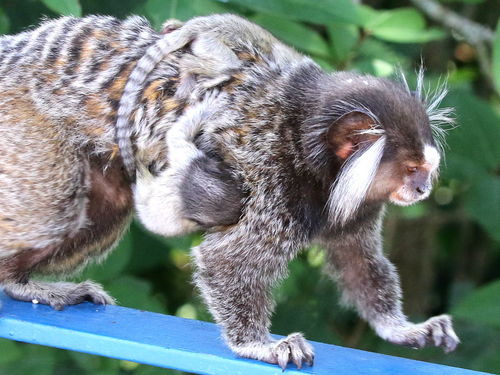
Closest Relatives at São Paulo
No species of the same family or order lives in São Paulo, so these are its closest relatives here: other mammals.




Before you go
What are the chances of seeing a Collared Peccary in São Paulo?
With luck
About 10% of wildlife watchers report a Collared Peccary sighting in São Paulo on a given day, based on 23 verified sightings from GBIF citizen-science data. It is the 11th most-seen of the 19 mammals we can rate there. Over three days the chance rises to about 20%, and over a week to about 30%, if each day is a fresh chance.
When is the best time to see a Collared Peccary in São Paulo?
April–June, August and November
In those months about 10% of wildlife watchers report a Collared Peccary in São Paulo on a given day, against under 5% in July, September–October and December–March, the lowest months.
What time of day is best to see a Collared Peccary?
Between 7 and 10 am
Across all the parks we cover, that three-hour window holds the most Collared Peccary sightings with a recorded time, and about half of them come between 6 am and 6 pm: it is seen both by day and at night.
Is São Paulo the best place to see a Collared Peccary?
Among the best
Of the 4 cities where we can rate Collared Peccary sightings, São Paulo ranks 4th at about 10%, level with the leaders once rounded. The best odds are in Monterrey (México, about 10%), Phoenix (United States, about 10%) and Mesa (United States, about 10%).
Where does the Collared Peccary sighting chance come from?
GBIF citizen-science records
It is estimated from how often the Collared Peccary is recorded against all the mammals logged in São Paulo (23 verified sightings), calibrated against known sighting rates. Figures are rounded to the nearest 10% because citizen-science data supports honest approximations, not decimals, and months with records from fewer than five people show "—". How it works.
