Glaucous-blue Grosbeak

Glaucous-blue Grosbeak

Cyanoloxia glaucocaerulea

Silhouette: Sheatherius · PhyloPic

LCLeast ConcernNTVUENCR
Daily sighting probability <5% · Rare
at São Paulo

In 3 days <5%

8 Verified sightings at São Paulo
120 In all 3 parks From 2019 to 2026
October Best month
☀️ Diurnal When it's spotted

About the Glaucous-blue Grosbeak

The glaucous-blue grosbeak (Cyanoloxia glaucocaerulea), also known as the indigo grosbeak, is a species of bird in the family Cardinalidae, the cardinals or cardinal grosbeaks. It is found in Brazil, Argentina, Paraguay, and Uruguay.

The glaucous-blue grosbeak is monotypic. For much of its history, the glaucous-blue grosbeak was the only member of genus Cyanoloxia. Following a 2004 publication, the blue-black grosbeak (now Cyanoloxia cyanoides) and ultramarine grosbeak (now Cyanoloxia brissonii) were moved from genus Cyanocompsa. What is now Amazonian grosbeak (Cyanoloxia cyanoides) was later split from blue-black grosbeak.

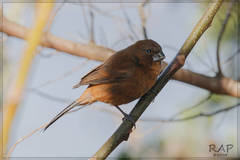
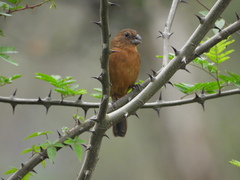
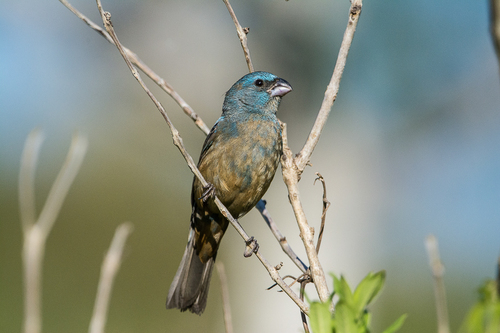
The glaucous-blue grosbeak is approximately 14 cm (5.5 in) long. Three birds weighed from 16 to 19.5 g (0.56 to 0.69 oz). The male is generally dark sky blue that is lighter on the forehead and rump and is grayish on the lower belly. It has a small black "mask". The female is brown overall, warm and dark above and orange-tinged below. The immature is orange-brown that is darker on the back, and it has a hint of blue on the forehead and cheek.

The glaucous-blue grosbeak nests in northeastern... Wikipedia →
Sounds

Call0:57

Brazil · 2021

© JAYRSON ARAUJO DE OLIVEIRA · XC686573 · CC BY-NC-SA 4.0

Song0:41

Brazil · 2008

© Fernando Jacobs · XC200400 · CC BY-NC-SA 4.0

Recording0:14

Argentina

© Dante Gabriel Moresco · XC658069 · CC BY-NC-SA 4.0

Global Distribution

Parks Where Found

# Park Country Daily sighting probability
1 El Palmar National Park 🇦🇷 Argentina
~20%
2 Iguaçu National Park 🇧🇷 Brazil
<5%
3 Iguazú National Park 🇦🇷 Argentina
<5%

Cities Where Found

# City Country Daily sighting probability
1 Buenos Aires 🇦🇷 Argentina
<5%
2 São Paulo 🇧🇷 Brazil
<5%

Before you go

What are the chances of seeing a Glaucous-blue Grosbeak in São Paulo?

Rare

Under 5% of wildlife watchers report a Glaucous-blue Grosbeak sighting in São Paulo on a given day, based on 8 verified sightings from GBIF citizen-science data. It is the 319th most-seen of the 353 birds we can rate there. Over three days the chance rises to under 5%, if each day is a fresh chance.

When is the best time to see a Glaucous-blue Grosbeak in São Paulo?

Any time of year

In every month with enough records, under 5% of wildlife watchers report a Glaucous-blue Grosbeak in São Paulo on a given day, so our monthly data shows no clear season.

What time of day is best to see a Glaucous-blue Grosbeak?

Between 8 and 11 am

Across all the parks we cover, that three-hour window holds the most Glaucous-blue Grosbeak sightings with a recorded time, and about 8 in 10 of them come between 6 am and 6 pm: it is a daytime animal.

Is São Paulo the best place to see a Glaucous-blue Grosbeak?

Among the best

Of the 2 cities where we can rate Glaucous-blue Grosbeak sightings, São Paulo ranks 2nd at under 5%, level with the leaders once rounded. The best odds are in Buenos Aires (Argentina, under 5%).

Where does the Glaucous-blue Grosbeak sighting chance come from?

GBIF citizen-science records

It is estimated from how often the Glaucous-blue Grosbeak is recorded against all the birds logged in São Paulo (8 verified sightings), calibrated against known sighting rates. Figures are rounded to the nearest 10% because citizen-science data supports honest approximations, not decimals, and months with records from fewer than five people show "—". How it works.

← Back to São Paulo