Sayaca Tanager

Sayaca Tanager

Thraupis sayaca

Silhouette: Sheatherius · PhyloPic

Daily sighting probability ~90% · Very likely
at São Paulo
18,659 Verified sightings at São Paulo
10,661 In all 14 parks From 2019 to 2026
September Best month
☀️ Diurnal When it's spotted

About the Sayaca Tanager

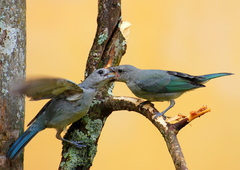
The sayaca tanager (Thraupis sayaca) is a species of bird in the family Thraupidae, the tanagers. It is a common resident in northeastern, central, and southeastern Brazil (Portuguese: sanhaço [sɐ̃ˈɲasu] or sanhaçu [sɐ̃ɲaˈsu]), and Bolivia, Paraguay, Uruguay, and northeastern Argentina (where they are known as celestinos or celestinas). A few are recorded from far southeastern Peru, but its status there is unclear, in part due to the potential of confusion with the very similar juveniles of the blue-grey tanager.

It occurs in a wide range of open to semiopen habitats, but generally avoids the interior of dense forest (such as the Amazon). This tanager visits farmland in search of orchards and adapts readily to urban environment, as long as some arboreal cover and a supply of fruits are available. It feeds on flowers, buds, and insects, and this omnivorous lifestyle has helped it to become perhaps the most — or one of the most — common urban birds in southeastern Brazil, along with the rufous-bellied thrush.

The sayaca tanager was formally described in 1766 by the Swedish naturalist Carl Linnaeus in the 12th edition of his Systema Naturae under the binomial name Tanagra... Wikipedia →

Sounds

Call0:42

Brazil · 2026

© JAYRSON ARAUJO DE OLIVEIRA · XC1136818 · CC BY-NC-SA 4.0

Begging call0:28

Uruguay · 2025

© Pedro Rinaldi · XC972928 · CC BY-NC-SA 4.0

Song0:49

Brazil · 2024

© Ricardo José Mitidieri · XC941381 · CC BY-NC-SA 4.0

Global Distribution

Parks Where Found

# Park Country Daily sighting probability
1 El Palmar National Park 🇦🇷 Argentina
~70%
2 Chapada dos Guimarães National Park 🇧🇷 Brazil
~60%
3 Tijuca National Park 🇧🇷 Brazil
~60%
4 Serra dos Órgãos National Park 🇧🇷 Brazil
~60%
5 Itatiaia National Park 🇧🇷 Brazil
~60%
6 Iberá National Park 🇦🇷 Argentina
~60%
7 Serra da Canastra National Park 🇧🇷 Brazil
~60%
8 Chapada Diamantina National Park 🇧🇷 Brazil
~50%
9 Iguazú National Park 🇦🇷 Argentina
~40%
10 El Impenetrable National Park 🇦🇷 Argentina
~40%
11 Amboró National Park 🇧🇴 Bolivia
~40%
12 Iguaçu National Park 🇧🇷 Brazil
~30%
13 Parque Estadual Encontro das Águas 🇧🇷 Brazil
~20%
14 Emas National Park 🇧🇷 Brazil
~20%

Cities Where Found

# City Country Daily sighting probability
1 São Paulo 🇧🇷 Brazil
~90%
2 Salvador 🇧🇷 Brazil
~90%
3 Fortaleza 🇧🇷 Brazil
~80%
4 Asuncion 🇵🇾 Paraguay
~80%
5 Campinas 🇧🇷 Brazil
~80%
6 Campo Grande 🇧🇷 Brazil
~80%
7 Porto Alegre 🇧🇷 Brazil
~80%
8 Santa Cruz de la Sierra 🇧🇴 Bolivia
~80%
9 João Pessoa 🇧🇷 Brazil
~70%
10 Belo Horizonte 🇧🇷 Brazil
~70%

Zoos & Centres Where Found

# Zoo / Centre Country
1 Bioparque Municipal Vesty Pakos 🇧🇴 Bolivia In captivity

Before you go

What are the chances of seeing a Sayaca Tanager in São Paulo?

Very likely

About 90% of wildlife watchers report a Sayaca Tanager sighting in São Paulo on a given day, based on 18,659 verified sightings from GBIF citizen-science data. It is the 2nd most-seen of the 353 birds we can rate there.

When is the best time to see a Sayaca Tanager in São Paulo?

Any time of year

In every month with enough records, about 90% of wildlife watchers report a Sayaca Tanager in São Paulo on a given day, so our monthly data shows no clear season.

What time of day is best to see a Sayaca Tanager?

Between 9 am and noon

Across all the parks we cover, that three-hour window holds the most Sayaca Tanager sightings with a recorded time, and about 9 in 10 of them come between 6 am and 6 pm: it is a daytime animal.

Is São Paulo the best place to see a Sayaca Tanager?

Yes

Of the 28 cities where we can rate Sayaca Tanager sightings, São Paulo has the highest daily chance: about 90%. Next come Salvador (Brazil, about 90%) and Fortaleza (Brazil, about 80%).

Where does the Sayaca Tanager sighting chance come from?

GBIF citizen-science records

It is estimated from how often the Sayaca Tanager is recorded against all the birds logged in São Paulo (18,659 verified sightings), calibrated against known sighting rates. Figures are rounded to the nearest 10% because citizen-science data supports honest approximations, not decimals, and months with records from fewer than five people show "—". How it works.

← Back to São Paulo

