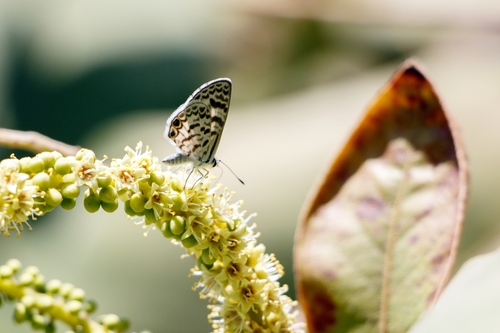
Thecla azia silhouette

Silhouette: Michael Day · PhyloPic

Daily sighting probability <5% · Rare
at São Paulo

In 3 days ~10% in a week ~20%

19 Verified sightings at São Paulo
November Best month

About the Thecla azia

Ministrymon azia, the gray ministreak, is a butterfly in the family Lycaenidae. It is found from the southern United States to southern Brazil, Paraguay and Argentina. It is found in virtually all lowland habitats, ranging from deserts in coastal Peru and Chile to rainforests in the Amazon basin.

The wingspan is 16–24 mm. Adults are on wing from March to September in Florida and Texas, but year-round in most of the tropics. Adults feed on the nectar of various flowers, including Leucaena leucocephala, Melilotus alba, Cynoglossum amabile, Bidens alba, Turnera ulmifolia, Mimosa pudica and Acacia species.

The larvae feed on the flowers of a wide variety of Fabaceae, including Acacia, Mimosa (including M. malacophylla) and Leucaena species (including L. leucocephala), as well as Lysiloma bahamensis. Wikipedia →

Global Distribution

Parks Where Found

# Park Country Daily sighting probability

More parks will be added in future updates.

Cities Where Found

# City Country Daily sighting probability
1 São Paulo 🇧🇷 Brazil
<5%

Before you go

What are the chances of seeing a Thecla azia in São Paulo?

Rare

Under 5% of wildlife watchers report a Thecla azia sighting in São Paulo on a given day, based on 19 verified sightings from GBIF citizen-science data. It is the 402nd most-seen of the 832 insects we can rate there. Over three days the chance rises to about 10%, and over a week to about 20%, if each day is a fresh chance.

When is the best time to see a Thecla azia in São Paulo?

November

In that month about 10% of wildlife watchers report a Thecla azia in São Paulo on a given day, against under 5% in December to October, the lowest months.

Where else can you see a Thecla azia?

Only São Paulo, in our data

São Paulo is the only city on Wallace's Line with enough records to rate Thecla azia sightings: under 5% of wildlife watchers there report one on a given day.

Where does the Thecla azia sighting chance come from?

GBIF citizen-science records

It is estimated from how often the Thecla azia is recorded against all the insects logged in São Paulo (19 verified sightings), calibrated against known sighting rates. Figures are rounded to the nearest 10% because citizen-science data supports honest approximations, not decimals, and months with records from fewer than five people show "—". How it works.

← Back to São Paulo