Japanese Green Woodpecker

Japanese Green Woodpecker

Picus awokera

Silhouette: Martin Bulla, based on John Cox's illustration · PhyloPic

LCLeast ConcernNTVUENCR Endemic
Daily sighting probability ~30% · Possible
at Sendai

In 3 days ~70% in a week ~90%

185 Verified sightings at Sendai
120 In 1 park From 2019 to 2026
October Best month
☀️ Diurnal When it's spotted

About the Japanese Green Woodpecker

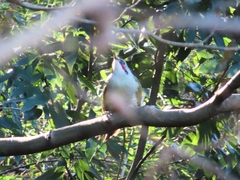
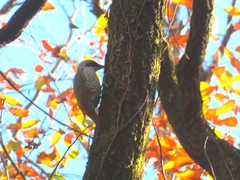
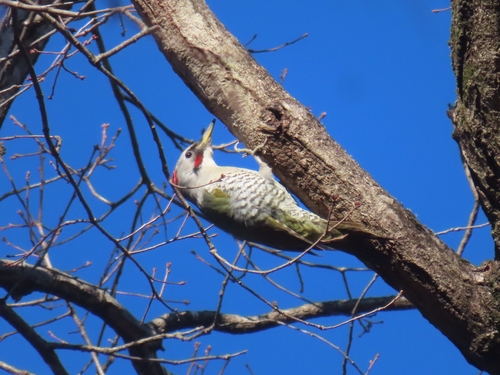
Japanese green woodpecker or Japanese woodpecker (Picus awokera) is a medium-sized woodpecker similar and closely related to the European green woodpecker, but endemic to Japan. This species reaches about 30 cm in length, with bright green wings and tail, a red or black mustache and crown (as opposed to the black face of the green woodpecker), gray head, neck, and chest, and white underparts with black markings.

The bill is yellow, the legs and feet are light gray colored. The iris is red. This woodpecker is loudly before and after the breeding season. Their known calls are an individually, loud and whip-crack-similar pijo, and a ket, ket with two syllables. They also drum, and these drumrolls are very fast and long.

This woodpecker is found in most big islands of Japan, and also smaller islands like Tobishima, Awashima, Sado and Tsushima. The total distribution area is as big as 281.000 km2. Japanese green woodpeckers live in the north in open mixed forests, in the south in warm-temperate evergreen forests, but also in parks and gardens. They avoid older coniferous monocultures. The species is in their occurrence... Wikipedia →
Sounds

Call0:06

Japan · 2019

© Okamoto Keita Sin · XC578823 · CC BY-NC-SA 4.0

Alarm call1:13

Japan · 2018

© Gerbenth · XC747217 · CC BY-NC-SA 4.0

Flight call0:07

Japan · 2015

© Peter Boesman · XC285652 · CC BY-NC-ND 4.0

Global Distribution

Parks Where Found

# Park Country Daily sighting probability
1 Nikko National Park 🇯🇵 Japan
~30%

More parks will be added in future updates.

Cities Where Found

# City Country Daily sighting probability
1 Sendai 🇯🇵 Japan
~30%
2 Tokyo 🇯🇵 Japan
~10%
3 Fukuoka 🇯🇵 Japan
<5%
4 Nagoya 🇯🇵 Japan
<5%
5 Osaka 🇯🇵 Japan
<5%

Before you go

What are the chances of seeing a Japanese Green Woodpecker in Sendai?

Possible

About 30% of wildlife watchers report a Japanese Green Woodpecker sighting in Sendai on a given day, based on 185 verified sightings from GBIF citizen-science data. It is the 31st most-seen of the 107 birds we can rate there. Over three days the chance rises to about 70%, and over a week to about 90%, if each day is a fresh chance.

When is the best time to see a Japanese Green Woodpecker in Sendai?

October

In that month about 50% of wildlife watchers report a Japanese Green Woodpecker in Sendai on a given day, against about 20% in January, May–June and August, the lowest months.

What time of day is best to see a Japanese Green Woodpecker?

Between 7 and 10 am

Across all the parks we cover, that three-hour window holds the most Japanese Green Woodpecker sightings with a recorded time, and about 9 in 10 of them come between 6 am and 6 pm: it is a daytime animal.

Is Sendai the best place to see a Japanese Green Woodpecker?

Yes

Of the 5 cities where we can rate Japanese Green Woodpecker sightings, Sendai has the highest daily chance: about 30%. Next come Tokyo (Japan, about 10%) and Fukuoka (Japan, under 5%).

Which relatives of the Japanese Green Woodpecker live in Sendai?

Same family: Picidae

The closest relatives of the Japanese Green Woodpecker that you can see in Sendai (family Picidae, Woodpeckers) are Pygmy Woodpecker (about 60%) and Great Spotted Woodpecker (about 20%), with each one's daily chance of a sighting.

Where does the Japanese Green Woodpecker sighting chance come from?

GBIF citizen-science records

It is estimated from how often the Japanese Green Woodpecker is recorded against all the birds logged in Sendai (185 verified sightings), calibrated against known sighting rates. Figures are rounded to the nearest 10% because citizen-science data supports honest approximations, not decimals, and months with records from fewer than five people show "—". How it works.

← Back to Sendai