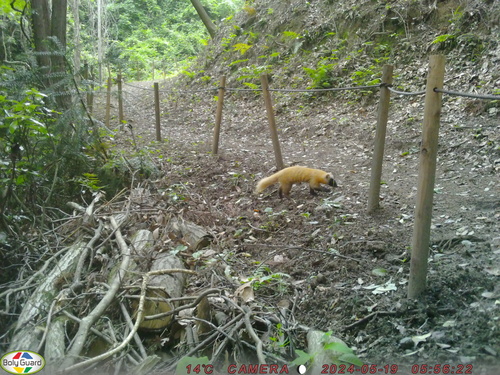
Japanese Squirrel

Japanese Squirrel

Sciurus lis

Silhouette: Ferran Sayol · PhyloPic

LCLeast ConcernNTVUENCR Endemic
Daily sighting probability ~80% · Very likely
at Sendai

In 3 days >90%

1,534 Verified sightings at Sendai
August Best month
☀️ Diurnal When it's spotted

About the Japanese Squirrel

The Japanese squirrel (Sciurus lis) is a tree squirrel in the genus Sciurus endemic to Japan. It is closely related to and similar to the red squirrel. The Japanese squirrel was described by Dutch zoologist Coenraad Jacob Temminck in 1844. It was historically classified as a subspecies of Sciurus vulgaris, the Eurasian red squirrel, although scientific opinion shifted towards classifying it as a distinct species beginning in the 1960s. The Japanese squirrel is nonetheless closely related to the red squirrel, and originated from a population of red squirrels that colonized the Japanese archipelago in the Pleistocene and speciated into a distinct population due to the isolation of the islands from the Eurasian mainland. Recognizable Sciurus lis remains appear in the fossil record beginning in the Middle Pleistocene.

Japanese squirrels range from 16–22 centimetres (6.3–8.7 in) in body length from the head to the base of the tail, which makes up a further 13–17 centimetres (5.1–6.7 in). Their typical body weight is 250–310 grams (8.8–10.9 oz).

Japanese squirrels have red-brown fur on their bodies and tails, with orange patches sometimes present... Wikipedia →

Global Distribution

Parks Where Found

# Park Country Daily sighting probability

More parks will be added in future updates.

Cities Where Found

# City Country Daily sighting probability
1 Sendai 🇯🇵 Japan
~80%

Zoos & Centres Where Found

# Zoo / Centre Country
1 Nasu Animal Kingdom 🇯🇵 Japan In captivity
2 Sapporo Maruyama Zoo 🇯🇵 Japan In captivity
3 Ueno Zoo 🇯🇵 Japan In captivity
4 Inokashira Park Zoo 🇯🇵 Japan In captivity
5 Ueno Zoological Gardens (West Garden) 🇯🇵 Japan In captivity
6 Ōmiya Park Zoo 🇯🇵 Japan In captivity
7 Sendai Umino-Mori Aquarium 🇯🇵 Japan In captivity
8 Okinawa Zoo & Museum 🇯🇵 Japan In captivity

Before you go

What are the chances of seeing a Japanese Squirrel in Sendai?

Very likely

About 80% of wildlife watchers report a Japanese Squirrel sighting in Sendai on a given day, based on 1,534 verified sightings from GBIF citizen-science data. It is the most-seen of the 11 mammals we can rate there. Over three days the chance rises to over 90%, if each day is a fresh chance.

When is the best time to see a Japanese Squirrel in Sendai?

August to October

In those months about 90% of wildlife watchers report a Japanese Squirrel in Sendai on a given day, against about 50% in July, the lowest month.

What time of day is best to see a Japanese Squirrel?

Between 8 and 11 am

Across all the parks we cover, that three-hour window holds the most Japanese Squirrel sightings with a recorded time, and nearly all of them come between 6 am and 6 pm: it is a daytime animal.

Where else can you see a Japanese Squirrel?

Only Sendai, in our data

Sendai is the only city on Wallace's Line with enough records to rate Japanese Squirrel sightings: about 80% of wildlife watchers there report one on a given day.

Which relatives of the Japanese Squirrel live in Sendai?

Same order: Rodentia

The closest relatives of the Japanese Squirrel that you can see in Sendai (order Rodentia, Rodents) are Large Japanese Field Mouse (about 10%) and Brown Rat (about 10%), with each one's daily chance of a sighting.

Where does the Japanese Squirrel sighting chance come from?

GBIF citizen-science records

It is estimated from how often the Japanese Squirrel is recorded against all the mammals logged in Sendai (1,534 verified sightings), calibrated against known sighting rates. Figures are rounded to the nearest 10% because citizen-science data supports honest approximations, not decimals, and months with records from fewer than five people show "—". How it works.

← Back to Sendai