White-cheeked Starling

White-cheeked Starling

Spodiopsar cineraceus

Silhouette: Rafael Maia · PhyloPic

LCLeast ConcernNTVUENCR
Daily sighting probability ~10% · With luck
at Sendai

In 3 days ~30% in a week ~60%

69 Verified sightings at Sendai
51 In all 3 parks From 2019 to 2026
October Best month
☀️ Diurnal When it's spotted

About the White-cheeked Starling

The white-cheeked starling or grey starling (Spodiopsar cineraceus) is a passerine bird of the starling family. It is native to eastern Asia where it is a common and well-known bird in much of its range. The white-cheeked starling was formerly placed in the genus Sturnus. A molecular phylogenetic study published in 2008 found that the genus was polyphyletic. In the reoganization to create monotypic genera, the white-cheeked starling and the red-billed starling were moved to the resurrected genus Spodiopsar that had been introduced in 1889 by Richard Bowdler Sharpe. The species is monotypic: no subspecies are recognised.

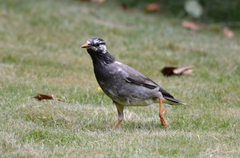
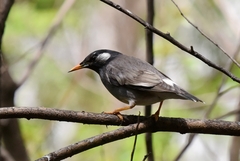
White-cheeked starlings are 24 cm in length. The adult male is mainly dark grey-brown with a paler belly and a whitish band across the rump. The head is blackish with whitish cheeks and forehead. There is a white border to the tail and white markings on the secondary wing feathers. The legs are pale orange and the bill is orange with a black tip. Adult females are similar to the males but paler and duller.

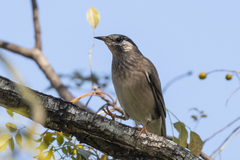
The juvenile is brown with pale cheeks and rump and no black tip to the bill. The loud, monotonous call is a series of harsh, creaking... Wikipedia →

Sounds

Call0:29

China · 2024

© Bo Shunqi 薄顺奇 · XC1174983 · CC BY-NC-SA 4.0

Alarm call0:45

China · 2025

© Dave Guo · XC1015975 · CC BY-NC-SA 4.0

Flight call0:14

China · 2024

© Ding Li Yong · XC915153 · CC BY-NC-ND 4.0

Global Distribution

Parks Where Found

# Park Country Daily sighting probability
1 Nikko National Park 🇯🇵 Japan
~10%
2 Gobi Gurvansaikhan National Park 🇲🇳 Mongolia
<5%
3 Namdapha National Park 🇮🇳 India
<5%

Cities Where Found

# City Country Daily sighting probability
1 Tianjin 🇨🇳 China
~70%
2 Tokyo 🇯🇵 Japan
~70%
3 Nagoya 🇯🇵 Japan
~70%
4 Osaka 🇯🇵 Japan
~50%
5 Hiroshima 🇯🇵 Japan
~50%
6 Beijing 🇨🇳 China
~40%
7 Jinan 🇨🇳 China
~40%
8 Hefei 🇨🇳 China
~40%
9 Xi'an 🇨🇳 China
~40%
10 Shijiazhuang 🇨🇳 China
~40%

Zoos & Centres Where Found

# Zoo / Centre Country
1 Ueno Zoo 🇯🇵 Japan In captivity

Before you go

What are the chances of seeing a White-cheeked Starling in Sendai?

With luck

About 10% of wildlife watchers report a White-cheeked Starling sighting in Sendai on a given day, based on 69 verified sightings from GBIF citizen-science data. It is the 52nd most-seen of the 107 birds we can rate there. Over three days the chance rises to about 30%, and over a week to about 60%, if each day is a fresh chance.

When is the best time to see a White-cheeked Starling in Sendai?

August to October

In those months about 30% of wildlife watchers report a White-cheeked Starling in Sendai on a given day, against under 5% in April, the lowest month.

What time of day is best to see a White-cheeked Starling?

Between 8 and 11 am

Across all the parks we cover, that three-hour window holds the most White-cheeked Starling sightings with a recorded time, and about 9 in 10 of them come between 6 am and 6 pm: it is a daytime animal.

Is Sendai the best place to see a White-cheeked Starling?

27th of 39

Of the 39 cities where we can rate White-cheeked Starling sightings, Sendai ranks 27th at about 10%. The best odds are in Tianjin (China, about 70%), Tokyo (Japan, about 70%) and Nagoya (Japan, about 70%).

Where does the White-cheeked Starling sighting chance come from?

GBIF citizen-science records

It is estimated from how often the White-cheeked Starling is recorded against all the birds logged in Sendai (69 verified sightings), calibrated against known sighting rates. Figures are rounded to the nearest 10% because citizen-science data supports honest approximations, not decimals, and months with records from fewer than five people show "—". How it works.

← Back to Sendai