Turkestan Cockroach

Turkestan Cockroach

Periplaneta lateralis

Silhouette: Thomas Hegna · PhyloPic

Daily sighting probability ~30% · Possible
at Shymkent

In 3 days ~70% in a week ~90%

5 Verified sightings at Shymkent
45 In all 3 parks From 2019 to 2026
July Best month
🌙 Nocturnal When it's spotted

About the Turkestan Cockroach

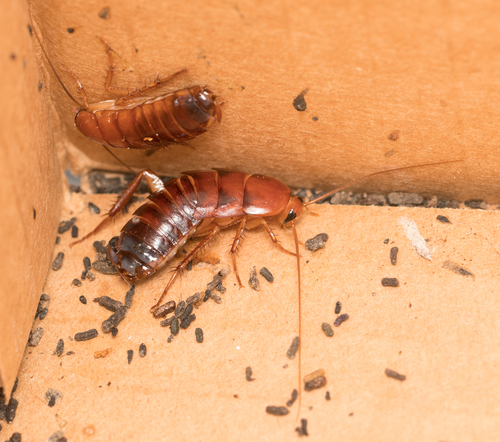
Periplaneta lateralis (also Shelfordella lateralis, Blatta lateralis), commonly known as the Turkestan cockroach, red runner cockroach, or rusty red cockroach, is a primarily outdoor-dwelling cockroach native to an area stretching from northern Africa to Central Asia.

The species is found in Central Asia, the Caucasus Mountains, and northeastern Africa. It can be found throughout the area of Afghanistan, Azerbaijan, Egypt, India, Iran, Iraq, Israel, Jordan, Kashmir, Libya, Palestine, Pakistan, Saudi Arabia, Sudan, the United Arab Emirates, Russia (adventive) and the United States (adventive).

The Turkestan cockroach was first noticed in the US in 1978, around the former Sharpe Army Depot in California, followed shortly after by appearances at Fort Bliss in Texas and several other military bases. Researchers believe the species arrived on military equipment returning from Central Asia, perhaps Afghanistan. Since then the species has been rapidly replacing the common oriental cockroach (Blatta orientalis) in urban areas of the Southwestern United States “as the most important peri-domestic species”, with advantages of laying more eggs and maturing... Wikipedia →
Global Distribution

Parks Where Found

# Park Country Daily sighting probability
1 Zion National Park 🇺🇸 United States
~20%
2 Joshua Tree National Park 🇺🇸 United States
~10%
3 Saguaro National Park 🇺🇸 United States
<5%

Cities Where Found

# City Country Daily sighting probability
1 Shymkent 🇰🇿 Kazakhstan
~30%
2 Tashkent 🇺🇿 Uzbekistan
~30%
3 Yerevan 🇦🇲 Armenia
~20%
4 Las Vegas 🇺🇸 United States
~10%
5 Sacramento 🇺🇸 United States
~10%
6 Mesa 🇺🇸 United States
~10%
7 Tel Aviv 🇮🇱 Israel
~10%
8 Phoenix 🇺🇸 United States
~10%
9 Rome 🇮🇹 Italy
~10%
10 Los Angeles 🇺🇸 United States
<5%

Before you go

What are the chances of seeing a Turkestan Cockroach in Shymkent?

Possible

About 30% of wildlife watchers report a Turkestan Cockroach sighting in Shymkent on a given day, based on 5 verified sightings from GBIF citizen-science data. Over three days the chance rises to about 70%, and over a week to about 90%, if each day is a fresh chance.

When is the best time to see a Turkestan Cockroach in Shymkent?

July

In that month about 50% of wildlife watchers report a Turkestan Cockroach in Shymkent on a given day, against about 10% in March, June, August and October–January, the lowest months. That is one of Shymkent's driest months, with about 5 mm of rain against 75 mm in March. February has too few records to rate.

What time of day is best to see a Turkestan Cockroach?

Between 8 and 11 pm

Across all the parks we cover, that three-hour window holds the most Turkestan Cockroach sightings with a recorded time, and about 7 in 10 of them come between 6 pm and 6 am: it is mostly seen at night.

Is Shymkent the best place to see a Turkestan Cockroach?

Yes

Of the 14 cities where we can rate Turkestan Cockroach sightings, Shymkent has the highest daily chance: about 30%. Next come Tashkent (Uzbekistan, about 30%) and Yerevan (Armenia, about 20%).

Where does the Turkestan Cockroach sighting chance come from?

GBIF citizen-science records

It is estimated from how often the Turkestan Cockroach is recorded against all the insects logged in Shymkent (5 verified sightings), calibrated against known sighting rates. Figures are rounded to the nearest 10% because citizen-science data supports honest approximations, not decimals, and months with records from fewer than five people show "—". How it works.

← Back to Shymkent
