Rockwarbler

Rockwarbler

Origma solitaria

Silhouette: Sheatherius · PhyloPic

LCLeast ConcernNTVUENCR Endemic
Daily sighting probability <5% · Rare
at Sydney

In 3 days <5%

40 Verified sightings at Sydney
700 In all 2 parks From 2019 to 2026
May Best month
☀️ Diurnal When it's spotted

About the Rockwarbler

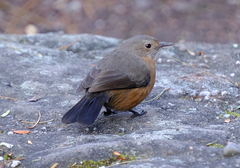
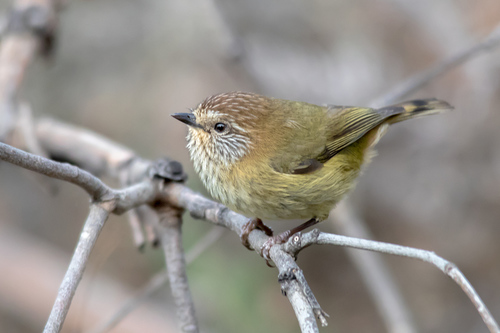
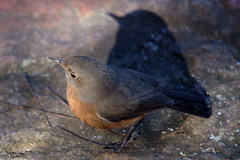
The rockwarbler (Origma solitaria), is a bird in the family Acanthizidae. It is the only bird species endemic to the mainland of the state of New South Wales in Australia. The rockwarbler was described and illustrated in 1808 by the English artist and naturalist John Lewin under the binomial name Sylvia solitaria. For many years it was the only member of the genus Origma until genetic work showed that it was related to two species of mousewarblers from New Guinea. The rockwarbler diverged from the common ancestor of the other two species around 9 million years ago. Rockwarbler has been designated the official name by the International Ornithologists' Union (IOC). Common names also include cataract-bird, cave-bird, origma, rock-robin, and sandstone robin. A former common name, hanging dick, came about from its nest, which hangs suspended in a cave. It has no subspecies.

The rockwarbler is 14 cm (5.5 in) in length and weighs around 14 g (0.5 oz), with predominantly dark grey-brown plumage, darker wings and more red-brown underparts, cinnamon-tinged face and forehead, and whitish throat. Its tail is black. Adult males and females have similar... Wikipedia →

Sounds

Call0:35

Australia · 2021

© Marc Anderson · XC733301 · CC BY-NC-ND 4.0

Song0:53

Australia · 2020

© Mike FitzGerald · XC680800 · CC BY-NC-SA 4.0

Call0:13

Australia · 2017

© Greg McLachlan · XC380577 · CC BY-NC-SA 4.0

Global Distribution

Parks Where Found

# Park Country Daily sighting probability
1 Royal National Park 🇦🇺 Australia
~10%
2 Blue Mountains National Park 🇦🇺 Australia
~10%

Cities Where Found

# City Country Daily sighting probability
1 Sydney 🇦🇺 Australia
<5%

Before you go

What are the chances of seeing a Rockwarbler in Sydney?

Rare

Under 5% of wildlife watchers report a Rockwarbler sighting in Sydney on a given day, based on 40 verified sightings from GBIF citizen-science data. It is the 176th most-seen of the 243 birds we can rate there. Over three days the chance rises to under 5%, if each day is a fresh chance.

When is the best time to see a Rockwarbler in Sydney?

Any time of year

In every month with enough records, under 5% of wildlife watchers report a Rockwarbler in Sydney on a given day, so our monthly data shows no clear season.

What time of day is best to see a Rockwarbler?

Between noon and 3 pm

Across all the parks we cover, that three-hour window holds the most Rockwarbler sightings with a recorded time, and about 9 in 10 of them come between 6 am and 6 pm: it is a daytime animal.

Where else can you see a Rockwarbler?

Only Sydney, in our data

Sydney is the only city on Wallace's Line with enough records to rate Rockwarbler sightings: under 5% of wildlife watchers there report one on a given day.

Which relatives of the Rockwarbler live in Sydney?

Same family: Acanthizidae

The closest relatives of the Rockwarbler that you can see in Sydney (family Acanthizidae, Thornbills and Allies) are White-browed Scrubwren (about 20%), Brown Thornbill (about 10%) and Yellow Thornbill (about 10%), with each one's daily chance of a sighting.

Where does the Rockwarbler sighting chance come from?

GBIF citizen-science records

It is estimated from how often the Rockwarbler is recorded against all the birds logged in Sydney (40 verified sightings), calibrated against known sighting rates. Figures are rounded to the nearest 10% because citizen-science data supports honest approximations, not decimals, and months with records from fewer than five people show "—". How it works.

← Back to Sydney