Yellow-rumped Thornbill

Yellow-rumped Thornbill

Acanthiza chrysorrhoa

Silhouette: Matt Wilkins (photo by Patrick Kavanagh) · PhyloPic

LCLeast ConcernNTVUENCR Endemic
Daily sighting probability <5% · Rare
at Sydney

In 3 days <5% in a week ~10%

225 Verified sightings at Sydney
896 In all 10 parks From 2019 to 2026
September Best month
☀️ Diurnal When it's spotted

About the Yellow-rumped Thornbill

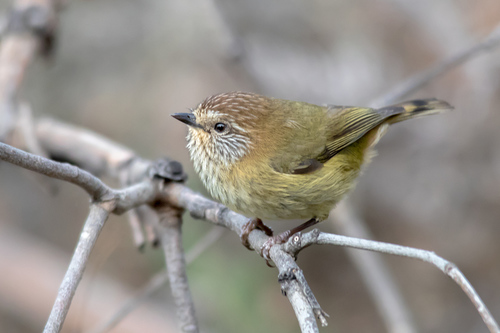
The yellow-rumped thornbill (Acanthiza chrysorrhoa) is a species of passerine bird from the genus Acanthiza. The genus was once placed in the family Pardalotidae but that family was split and it is now in the family Acanthizidae. There are four subspecies of yellow-rumped thornbill. It is a small, brownish bird with a distinctive yellow rump and thin dark bill. It inhabits savannah, scrub and forests across most of Australia and eats insects. The species engages in cooperative breeding.

The yellow-rumped thornbill was described as Saxicola chrysorrhoa by the French naturalists Jean René Constant Quoy and Joseph Paul Gaimard in 1830, from a specimen collected in King George Sound. The specific epithet derives from Ancient Greek khrysos 'gold' and orrhos 'rump'. Four subspecies are recognised: the nominate chrysorrhoa of Western Australia, leachi of Tasmania, leighi of eastern Australia, and normantoni of central and northern Australia. Butterbum is a colloquial name used by Australian birdwatchers.

A 2017 genetic study using both mitochondrial and nuclear DNA found the yellow-rumped thornbill was an early offshoot within the thornbill genus, its ancestor diverging from... Wikipedia →

Sounds

Call0:41

Australia · 2024

© Romuald Mikusek · XC1172238 · CC BY-NC-SA 4.0

Song0:27

Australia · 2023

© Peter Boesman · XC859562 · CC BY-NC-ND 4.0

Call0:25

Australia · 2023

© Drew Davison · XC809290 · CC BY-NC-ND 4.0

Global Distribution

Parks Where Found

# Park Country Daily sighting probability
1 Maria Island National Park 🇦🇺 Australia
~60%
2 Flinders Ranges National Park 🇦🇺 Australia
~30%
3 Grampians National Park 🇦🇺 Australia
~20%
4 Kosciuszko National Park 🇦🇺 Australia
~10%
5 Hattah-Kulkyne National Park 🇦🇺 Australia
~10%
6 Uluru-Kata Tjuta National Park 🇦🇺 Australia
<5%
7 Freycinet National Park 🇦🇺 Australia
<5%
8 Great Otway National Park 🇦🇺 Australia
<5%
9 Blue Mountains National Park 🇦🇺 Australia
<5%
10 Lamington National Park 🇦🇺 Australia
<5%

Cities Where Found

# City Country Daily sighting probability
1 Perth 🇦🇺 Australia
~10%
2 Melbourne 🇦🇺 Australia
<5%
3 Sydney 🇦🇺 Australia
<5%

Before you go

What are the chances of seeing a Yellow-rumped Thornbill in Sydney?

Rare

Under 5% of wildlife watchers report a Yellow-rumped Thornbill sighting in Sydney on a given day, based on 225 verified sightings from GBIF citizen-science data. It is the 126th most-seen of the 243 birds we can rate there. Over three days the chance rises to under 5%, and over a week to about 10%, if each day is a fresh chance.

When is the best time to see a Yellow-rumped Thornbill in Sydney?

Any time of year

In every month with enough records, under 5% of wildlife watchers report a Yellow-rumped Thornbill in Sydney on a given day, so our monthly data shows no clear season.

What time of day is best to see a Yellow-rumped Thornbill?

Between 1 and 4 pm

Across all the parks we cover, that three-hour window holds the most Yellow-rumped Thornbill sightings with a recorded time, and nearly all of them come between 6 am and 6 pm: it is a daytime animal.

Is Sydney the best place to see a Yellow-rumped Thornbill?

3rd of 3

Of the 3 cities where we can rate Yellow-rumped Thornbill sightings, Sydney ranks 3rd at under 5%. The best odds are in Perth (Australia, about 10%) and Melbourne (Australia, under 5%).

Which relatives of the Yellow-rumped Thornbill live in Sydney?

Same genus: Acanthiza

The closest relatives of the Yellow-rumped Thornbill that you can see in Sydney (genus Acanthiza, Australasian Thornbills) are Brown Thornbill (about 10%) and Yellow Thornbill (about 10%), with each one's daily chance of a sighting.

Where does the Yellow-rumped Thornbill sighting chance come from?

GBIF citizen-science records

It is estimated from how often the Yellow-rumped Thornbill is recorded against all the birds logged in Sydney (225 verified sightings), calibrated against known sighting rates. Figures are rounded to the nearest 10% because citizen-science data supports honest approximations, not decimals, and months with records from fewer than five people show "—". How it works.

← Back to Sydney