Black-faced Bunting

Black-faced Bunting

Emberiza spodocephala

Silhouette: L. Shyamal · PhyloPic

LCLeast ConcernNTVUENCR
Daily sighting probability <5% · Rare
at Taichung

In 3 days <5% in a week ~10%

36 Verified sightings at Taichung
88 In all 4 parks From 2019 to 2026
February Best month
☀️ Diurnal When it's spotted

About the Black-faced Bunting

The black-faced bunting (Emberiza spodocephala) is a passerine bird in the bunting family Emberizidae, a group now separated by most modern authors from the finches, Fringillidae. The genus name Emberiza is from Old German Embritz, a bunting. The specific spodocephala is from Ancient Greek spodos, "ashes", and kephalos, "headed".

It breeds in southern Siberia across to northern China. It is migratory, wintering in north-east India, southern China and northern south-east Asia. It is a very rare vagrant to western Europe. The black-faced bunting breeds in dense undergrowth along streams and rivers in the taiga zone, and lays four or five eggs in a ground or tree nest. Its natural food consists of seeds, and when feeding young, insects. It winters close to water in agricultural or other open bushy habitats.

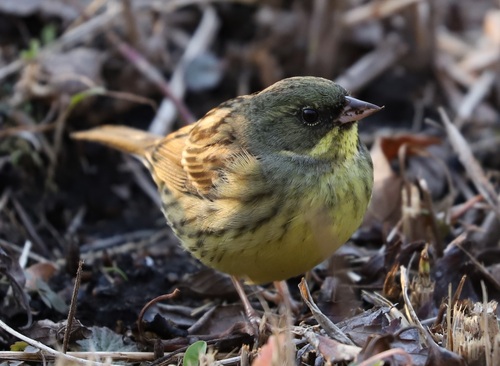
This bird's general appearance and terrestrial feeding habits give the impression of a dunnock with a bunting's bill. It is similar in size to a reed bunting at about 16 cm long. The breeding male has a dark grey head with a mix of yellow green and black between the bill and eye. The upperparts are brown and heavily streaked with black, except on the rump. The rump is brown and the tail is also a dark brown. The underparts are yellowish white with some fine dark brown flank streaks. The stout bill is pink.

Females and young birds have a weaker head pattern, with olive-grey cheeks and a weak creamy white supercilium. The underparts are creamy yellow heavily streaked with dark brown. The bird's call is like a tzii or tzee. It sound very "metallic" and it is a very short and not exactly a song at all. It nests on trees or on the ground and lays about four to five eggs. Wikipedia →
Sounds

Call0:08

China · 2025

© Bo Shunqi 薄顺奇 · XC1175075 · CC BY-NC-SA 4.0

Song1:30

China · 2026

© Peter Boesman · XC1147487 · CC BY-NC-ND 4.0

Alarm call0:18

Russian Federation · 2013

© Vadim Ivushkin · XC805961 · CC BY-NC-SA 4.0

Global Distribution

Parks Where Found

# Park Country Daily sighting probability
1 Gobi Gurvansaikhan National Park 🇲🇳 Mongolia
~10%
2 Wadden Sea National Park 🇩🇪 Germany
~10%
3 Taroko National Park 🇹🇼 Taiwan
<5%
4 Manas National Park 🇮🇳 India
<5%

Cities Where Found

# City Country Daily sighting probability
1 Ningbo 🇨🇳 China
~30%
2 Jinhua 🇨🇳 China
~30%
3 Nanchang 🇨🇳 China
~30%
4 Quanzhou 🇨🇳 China
~30%
5 Shanghai 🇨🇳 China
~20%
6 Hangzhou 🇨🇳 China
~20%
7 Suzhou 🇨🇳 China
~20%
8 Fuzhou 🇨🇳 China
~20%
9 Jinan 🇨🇳 China
~10%
10 Wenzhou 🇨🇳 China
~10%

Zoos & Centres Where Found

# Zoo / Centre Country
1 Ueno Zoo 🇯🇵 Japan In captivity

Before you go

What are the chances of seeing a Black-faced Bunting in Taichung?

Rare

Under 5% of wildlife watchers report a Black-faced Bunting sighting in Taichung on a given day, based on 36 verified sightings from GBIF citizen-science data. It is the 85th most-seen of the 121 birds we can rate there. Over three days the chance rises to under 5%, and over a week to about 10%, if each day is a fresh chance.

When is the best time to see a Black-faced Bunting in Taichung?

Any time of year

In every month with enough records, under 5% of wildlife watchers report a Black-faced Bunting in Taichung on a given day, so our monthly data shows no clear season.

What time of day is best to see a Black-faced Bunting?

Between 8 and 11 am

Across all the parks we cover, that three-hour window holds the most Black-faced Bunting sightings with a recorded time, and about 8 in 10 of them come between 6 am and 6 pm: it is a daytime animal.

Is Taichung the best place to see a Black-faced Bunting?

24th of 26

Of the 26 cities where we can rate Black-faced Bunting sightings, Taichung ranks 24th at under 5%. The best odds are in Ningbo (China, about 30%), Jinhua (China, about 30%) and Nanchang (China, about 30%).

Which relatives of the Black-faced Bunting live in Taichung?

Same order: Passeriformes

The closest relatives of the Black-faced Bunting that you can see in Taichung (order Passeriformes, Perching Birds) are Light-vented Bulbul (over 90%), Javan Myna (about 90%) and Swinhoe’s White-eye (about 90%), with each one's daily chance of a sighting.

Where does the Black-faced Bunting sighting chance come from?

GBIF citizen-science records

It is estimated from how often the Black-faced Bunting is recorded against all the birds logged in Taichung (36 verified sightings), calibrated against known sighting rates. Figures are rounded to the nearest 10% because citizen-science data supports honest approximations, not decimals, and months with records from fewer than five people show "—". How it works.

← Back to Taichung

