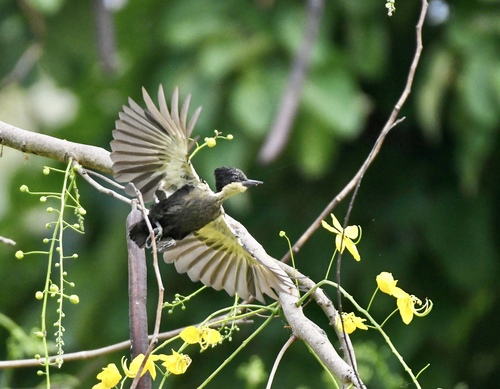
Heart-spotted Woodpecker

Heart-spotted Woodpecker

Hemicircus canente

Silhouette: Pepe Reigada · PhyloPic

LCLeast ConcernNTVUENCR
Daily sighting probability <5% · Rare
at Thrissur

In 3 days <5%

5 Verified sightings at Thrissur
1,396 In all 7 parks From 2019 to 2026
December Best month
🌅 Crepuscular When it's spotted

About the Heart-spotted Woodpecker

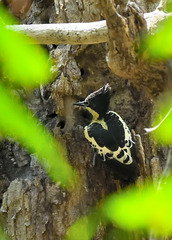
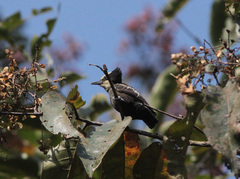
The heart-spotted woodpecker (Hemicircus canente) is a species of bird in the woodpecker family. It has a contrasting black and white plumage, a distinctively stubby body and a large wedge-shaped head making it easy to identify while its frequent calling make it easy to detect as it forage for invertebrates under the bark of the slender outer branches of trees. They move about in pairs or small groups and are often found in mixed-species foraging flocks. They have a wide distribution across Asia with populations in the forests of southwestern and central India which are slightly separated from their ranges in the Himalayas and Southeast Asia.

The heart-spotted woodpecker was described in 1832 by the French naturalist René Lesson from a specimen collected from Bago in Myanmar. He coined the binomial name Picus canente. The specific name is from Roman mythology: Canens was a sweet-voiced nymph, her husband was Picus. The species is now placed in the genus Hemicircus that was introduced in 1837 by the English naturalist William Swainson. The species is monotypic: no subspecies are recognised.

A small, uniquely shaped, black and buff woodpecker with a... Wikipedia →

Sounds

Call0:08

Vietnam · 2026

© Ding Li Yong · XC1107293 · CC BY-NC-ND 4.0

Uncertain0:20

India · 2023

© Sandeep Chakraborty · XC777839 · CC BY-NC-SA 4.0

Flight call0:08

India · 2021

© Sathyan Meppayur · XC665715 · CC BY-NC-SA 4.0

Global Distribution

Parks Where Found

# Park Country Daily sighting probability
1 Periyar National Park 🇮🇳 India
~20%
2 Cat Tien National Park 🇻🇳 Vietnam
~10%
3 Khao Yai National Park 🇹🇭 Thailand
~10%
4 Kaeng Krachan National Park 🇹🇭 Thailand
~10%
5 Nagarhole National Park 🇮🇳 India
~10%
6 Bandipur National Park 🇮🇳 India
<5%
7 Mudumalai National Park 🇮🇳 India
<5%

Cities Where Found

# City Country Daily sighting probability
1 Kozhikode 🇮🇳 India
<5%
2 Thrissur 🇮🇳 India
<5%

Before you go

What are the chances of seeing a Heart-spotted Woodpecker in Thrissur?

Rare

Under 5% of wildlife watchers report a Heart-spotted Woodpecker sighting in Thrissur on a given day, based on 5 verified sightings from GBIF citizen-science data. It is the 216th most-seen of the 217 birds we can rate there. Over three days the chance rises to under 5%, if each day is a fresh chance.

When is the best time to see a Heart-spotted Woodpecker in Thrissur?

Any time of year

In every month with enough records, under 5% of wildlife watchers report a Heart-spotted Woodpecker in Thrissur on a given day, so our monthly data shows no clear season.

What time of day is best to see a Heart-spotted Woodpecker?

Between 4 and 7 am

Across all the parks we cover, that three-hour window holds the most Heart-spotted Woodpecker sightings with a recorded time, and about 6 in 10 of them come between 6 am and 6 pm: it is most active around dawn and dusk.

Is Thrissur the best place to see a Heart-spotted Woodpecker?

Among the best

Of the 2 cities where we can rate Heart-spotted Woodpecker sightings, Thrissur ranks 2nd at under 5%, level with the leaders once rounded. The best odds are in Kozhikode (India, under 5%).

Which relatives of the Heart-spotted Woodpecker live in Thrissur?

Same family: Picidae

The closest relatives of the Heart-spotted Woodpecker that you can see in Thrissur (family Picidae, Woodpeckers) are Black-rumped Flameback (about 40%), Rufous Woodpecker (about 20%) and Malabar Flameback (about 10%), with each one's daily chance of a sighting.

Where does the Heart-spotted Woodpecker sighting chance come from?

GBIF citizen-science records

It is estimated from how often the Heart-spotted Woodpecker is recorded against all the birds logged in Thrissur (5 verified sightings), calibrated against known sighting rates. Figures are rounded to the nearest 10% because citizen-science data supports honest approximations, not decimals, and months with records from fewer than five people show "—". How it works.
← Back to Thrissur