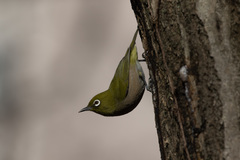
Warbling White-eye

Warbling White-eye

Zosterops japonicus

Silhouette: Ferran Sayol · PhyloPic

LCLeast ConcernNTVUENCR
Daily sighting probability ~50% · Likely
at Tokyo

In 3 days ~90% in a week >90%

12,439 Verified sightings at Tokyo
100 In 1 park From 2019 to 2026
February Best month
🌙 Nocturnal When it's spotted

About the Warbling White-eye

The warbling white-eye (Zosterops japonicus) is a small passerine bird in the white-eye family. The specific epithet is occasionally written japonica, but this is incorrect due to the gender of the genus. Its native range includes much of East Asia, including the Russian Far East, Japan, Indonesia, Korea, and the Philippines. It has been intentionally introduced to other parts of the world as a pet and as pest control, with mixed results. As one of the native species of the Japanese islands, it has been depicted in Japanese art on numerous occasions, and historically was kept as a cage bird.

The warbling white-eye was described by the ornithologists Coenraad Jacob Temminck and Hermann Schlegel in 1847 from a specimen collected in Japan. They coined the binomial name Zosterops japonicus. The English name "Japanese white-eye" was formerly used for Zosterops japonicus and what are now the Philippine subspecies of Z. japonicus were treated as a separate species, the "mountain white-eye" Z. montanus. A molecular phylogenetic study published in 2018 found that Z. montanus and several subspecies of Z. japonicus were conspecific, and they were therefore lumped together. They... Wikipedia →

Sounds

Call0:21

China · 2026

© Bo Shunqi 薄顺奇 · XC1180511 · CC BY-NC-SA 4.0

Song0:25

Indonesia · 2025

© Richard E. Webster · XC1076612 · CC BY-NC-SA 4.0

Dawn song0:28

Philippines · 2020

© Frank Lambert · XC617439 · CC BY-NC-ND 4.0

Global Distribution

Parks Where Found

# Park Country Daily sighting probability
1 Nikko National Park 🇯🇵 Japan
~20%

More parks will be added in future updates.

Cities Where Found

# City Country Daily sighting probability
1 Fukuoka 🇯🇵 Japan
~60%
2 Busan 🇰🇷 South Korea
~60%
3 Naha 🇯🇵 Japan
~60%
4 Nagoya 🇯🇵 Japan
~50%
5 Sendai 🇯🇵 Japan
~50%
6 Tokyo 🇯🇵 Japan
~50%
7 Osaka 🇯🇵 Japan
~50%
8 Hiroshima 🇯🇵 Japan
~40%
9 Gwangju 🇰🇷 South Korea
~40%
10 Kitakyushu 🇯🇵 Japan
~20%

Zoos & Centres Where Found

# Zoo / Centre Country
1 Sedgwick County Zoo 🇺🇸 United States In captivity
2 Ueno Zoo 🇯🇵 Japan In captivity
3 Inokashira Park Zoo 🇯🇵 Japan In captivity
4 Ueno Zoological Gardens (West Garden) 🇯🇵 Japan In captivity
5 Butterfly World 🇺🇸 United States In captivity

Before you go

What are the chances of seeing a Warbling White-eye in Tokyo?

Likely

About 50% of wildlife watchers report a Warbling White-eye sighting in Tokyo on a given day, based on 12,439 verified sightings from GBIF citizen-science data. It is the 13th most-seen of the 229 birds we can rate there. Over three days the chance rises to about 90%, and over a week to over 90%, if each day is a fresh chance.

When is the best time to see a Warbling White-eye in Tokyo?

December to February

In those months about 70% of wildlife watchers report a Warbling White-eye in Tokyo on a given day, against about 20% in August, the lowest month. Those are among Tokyo's driest months, with about 80 mm of rain a month against 250 mm in October.

What time of day is best to see a Warbling White-eye?

Between midnight and 3 am

Across all the parks we cover, that three-hour window holds the most Warbling White-eye sightings with a recorded time, and about 7 in 10 of them come between 6 pm and 6 am: it is mostly seen at night.

Is Tokyo the best place to see a Warbling White-eye?

6th of 12

Of the 12 cities where we can rate Warbling White-eye sightings, Tokyo ranks 6th at about 50%. The best odds are in Fukuoka (Japan, about 60%), Busan (South Korea, about 60%) and Naha (Japan, about 60%).

Where does the Warbling White-eye sighting chance come from?

GBIF citizen-science records

It is estimated from how often the Warbling White-eye is recorded against all the birds logged in Tokyo (12,439 verified sightings), calibrated against known sighting rates. Figures are rounded to the nearest 10% because citizen-science data supports honest approximations, not decimals, and months with records from fewer than five people show "—". How it works.

← Back to Tokyo