Bull-headed Shrike

Bull-headed Shrike

Lanius bucephalus

Silhouette: Andy Wilson · PhyloPic

LCLeast ConcernNTVUENCR
Daily sighting probability ~30% · Possible
at Tokyo

In 3 days ~60% in a week ~90%

6,007 Verified sightings at Tokyo
155 In 1 park From 2019 to 2026
October Best month
🌅 Crepuscular When it's spotted

About the Bull-headed Shrike

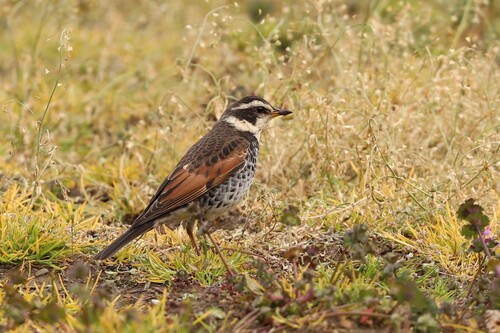
The bull-headed shrike (Lanius bucephalus) is a passerine bird of eastern Asia belonging to the shrike family Laniidae. It is 19–20 cm (approx. 7.48-7.9 inches) long. The male has a brown crown, white eyebrow and black mask. The back is grey-brown while the wings are dark with a white patch. The flanks are rufous and the rest of the underparts are whitish with fine barring. Females are similar but duller and browner with a brown mask and no white wing-patch. The species has harsh grating and chattering calls and will also mimic other birds.

It breeds in north-east China, Korea, Japan and far-eastern Russia (Ussuriland, Sakhalin and the Kuril Islands). Northern birds migrate south for the winter with a few reaching southern China. Vagrants have been recorded in Taiwan, Hong Kong and Vietnam. The isolated race sicarius is found only in the mountains of Gansu Province in west-central China.

Open habitats such as farmland and woodland edges are preferred. It also visits parks and gardens in urban areas. It sits on a prominent perch, waiting for prey to pass by. It feeds mainly on insects such as beetles and crickets but also preys on lizards and crustaceans.

With some other species from the Lanius genus, like the great grey shrike (Lanius excubitor), the bull-headed shrike is known to impale some of its preys upon a sharp point – usually thorns – so the food can be ripped into bite-sized pieces more easily. It may also do this to cache food and to mark a territory boundary.

The nest is built among bushes or bamboo. Two to six eggs are laid. They are incubated for 14 to 15 days and the young birds fledge 14 days after hatching. Wikipedia →

Sounds

Call0:24

China · 2025

© Feather V · XC1052423 · CC BY-NC-SA 4.0

Call0:48

South Korea · 2023

© Ding Li Yong · XC794801 · CC BY-NC-ND 4.0

Call0:40

China · 2019

© Geoff Carey · XC762423 · CC BY-NC-SA 4.0

Global Distribution

Parks Where Found

# Park Country Daily sighting probability
1 Nikko National Park 🇯🇵 Japan
~40%

More parks will be added in future updates.

Cities Where Found

# City Country Daily sighting probability
1 Nagoya 🇯🇵 Japan
~40%
2 Sendai 🇯🇵 Japan
~40%
3 Tokyo 🇯🇵 Japan
~30%
4 Osaka 🇯🇵 Japan
~20%
5 Kitakyushu 🇯🇵 Japan
~20%
6 Fukuoka 🇯🇵 Japan
~20%
7 Daejeon 🇰🇷 South Korea
~20%
8 Daegu 🇰🇷 South Korea
~10%
9 Hiroshima 🇯🇵 Japan
~10%
10 Gwangju 🇰🇷 South Korea
~10%

Before you go

What are the chances of seeing a Bull-headed Shrike in Tokyo?

Possible

About 30% of wildlife watchers report a Bull-headed Shrike sighting in Tokyo on a given day, based on 6,007 verified sightings from GBIF citizen-science data. It is the 24th most-seen of the 229 birds we can rate there. Over three days the chance rises to about 60%, and over a week to about 90%, if each day is a fresh chance.

When is the best time to see a Bull-headed Shrike in Tokyo?

October

In that month about 60% of wildlife watchers report a Bull-headed Shrike in Tokyo on a given day, against under 5% in July, the lowest month. That is one of Tokyo's wettest months, with about 250 mm of rain against 75 mm in February.

What time of day is best to see a Bull-headed Shrike?

Between 1 and 4 am

Across all the parks we cover, that three-hour window holds the most Bull-headed Shrike sightings with a recorded time, and about 7 in 10 of them come between 6 pm and 6 am: it is most active around dawn and dusk.

Is Tokyo the best place to see a Bull-headed Shrike?

3rd of 19

Of the 19 cities where we can rate Bull-headed Shrike sightings, Tokyo ranks 3rd at about 30%. The best odds are in Nagoya (Japan, about 40%) and Sendai (Japan, about 40%).

Where does the Bull-headed Shrike sighting chance come from?

GBIF citizen-science records

It is estimated from how often the Bull-headed Shrike is recorded against all the birds logged in Tokyo (6,007 verified sightings), calibrated against known sighting rates. Figures are rounded to the nearest 10% because citizen-science data supports honest approximations, not decimals, and months with records from fewer than five people show "—". How it works.

← Back to Tokyo