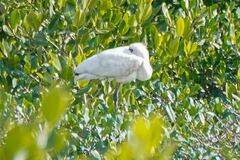
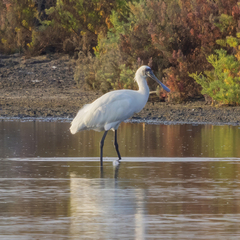
Black-faced Spoonbill

Black-faced Spoonbill

Platalea minor

LCNTVUVulnerableENCR
Daily sighting probability ~20% · Possible
at Tuen Mun

In 3 days ~50% in a week ~80%

265 Verified sightings at Tuen Mun
November Best month

About the Black-faced Spoonbill

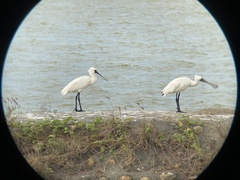
The black-faced spoonbill (Platalea minor) is a species of wading bird in the ibis and spoonbill family Threskiornithidae, found in eastern Asia. This species has the most restricted distribution of the six spoonbill species, and is the only one regarded as endangered. Spoonbills are large water birds with dorso-ventrally flattened, spatulate bills; they use a tactile method of feeding, wading in the water and sweeping their beaks from side-to-side to detect prey.

Confined to the coastal areas of eastern Asia, it seems that it was once common throughout its area of distribution. It currently breeds mostly on a few small rocky islands off the west coast of North Korea and South Korea, with four wintering sites at Macau, Hong Kong, Taiwan and Vietnam, as well as other places where they have been observed in migration. Wintering also occurs in Jeju, South Korea, Kyushu and Okinawa, Japan, and the Red River delta in Vietnam. More recently, sightings were noted in Thailand, the Philippines, and at additional sites in China.

Black-faced spoonbill was internationally classified as an endangered species by the IUCN in 2000. Nearly driven to global extinction in the 1980s, conservation efforts amongst various Asian countries in recent years has helped in bringing its population back onto a steadily increasing trend.

The population in the 2012 census was recorded at 2,693 birds, with an estimation of 1,600 mature birds. Breeding colonies occur between March and August, on small islands. In the 2022 global census, the population was recorded at 6,162 individuals.

Black-faced spoonbill is a crepuscular feeder, dependent on intertidal mudflats. Conservation efforts on protecting breeding sites and wintering sites have been made since, and surveys were taken in order to determine the opinions and awareness of the local residents, residing close to their natural habitats. One survey taken by Jin et al. 2008, inquired upon the 'Willingness-To-Pay" factor in the locals, as well as understanding effects on mandatory surcharges compared to voluntary payments. Wikipedia →

Sounds

Recording0:04

South Korea · 2026

© cloudwindow · iNaturalist · CC BY-NC 4.0

Global Distribution

Parks Where Found

# Park Country Daily sighting probability

More parks will be added in future updates.

Cities Where Found

# City Country Daily sighting probability
1 Naha 🇯🇵 Japan
~60%
2 Tuen Mun 🇨🇳 China
~20%
3 Guangzhou 🇨🇳 China
~10%
4 Seoul 🇰🇷 South Korea
~10%
5 Tainan 🇹🇼 Taiwan
<5%
6 Fukuoka 🇯🇵 Japan
<5%
7 Taipei 🇹🇼 Taiwan
<5%
8 Tokyo 🇯🇵 Japan
<5%
9 Kaohsiung 🇹🇼 Taiwan
<5%
10 Nagoya 🇯🇵 Japan
<5%

Zoos & Centres Where Found

# Zoo / Centre Country
1 Zhuhai Chimelong Ocean Kingdom 🇨🇳 China In captivity
2 Chimelong Spaceship 🇨🇳 China In captivity
3 Zlín-Lešná Zoo 🇨🇿 Czechia In captivity
4 Walsrode World Bird Park 🇩🇪 Germany In captivity
5 Parc des oiseaux 🇫🇷 France In captivity
6 Taipei Zoo 🇹🇼 Taiwan In captivity
7 Kadoorie Farm and Botanic Garden 🇭🇰 Hong Kong SAR China In captivity
8 Omaha’s Henry Doorly Zoo and Aquarium 🇺🇸 United States In captivity
9 Inokashira Park Zoo 🇯🇵 Japan In captivity
10 Hong Kong Zoological and Botanical Gardens 🇨🇳 China In captivity
11 Johor Zoo 🇲🇾 Malaysia In captivity
12 Macau Zoo 🇲🇴 Macao SAR China In captivity
13 Aviary 🇭🇰 Hong Kong SAR China In captivity
14 Ocean Park Hong Kong 🇨🇳 China In captivity

Before you go

What are the chances of seeing a Black-faced Spoonbill in Tuen Mun?

Possible

About 20% of wildlife watchers report a Black-faced Spoonbill sighting in Tuen Mun on a given day, based on 265 verified sightings from GBIF citizen-science data. It is the 45th most-seen of the 183 birds we can rate there. Over three days the chance rises to about 50%, and over a week to about 80%, if each day is a fresh chance.

When is the best time to see a Black-faced Spoonbill in Tuen Mun?

November

In that month about 50% of wildlife watchers report a Black-faced Spoonbill in Tuen Mun on a given day, against under 5% in June to September, the lowest months. That is one of Tuen Mun's driest months, with about 30 mm of rain against 290 mm in June.

Is Tuen Mun the best place to see a Black-faced Spoonbill?

2nd of 11

Of the 11 cities where we can rate Black-faced Spoonbill sightings, Tuen Mun ranks 2nd at about 20%. The best odds are in Naha (Japan, about 60%).

Where does the Black-faced Spoonbill sighting chance come from?

GBIF citizen-science records

It is estimated from how often the Black-faced Spoonbill is recorded against all the birds logged in Tuen Mun (265 verified sightings), calibrated against known sighting rates. Figures are rounded to the nearest 10% because citizen-science data supports honest approximations, not decimals, and months with records from fewer than five people show "—". How it works.

← Back to Tuen Mun