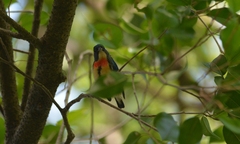

Fire-breasted Flowerpecker

Fire-breasted Flowerpecker

Dicaeum ignipectus

Silhouette: Rachael Joakim · PhyloPic

LCLeast ConcernNTVUENCR
Daily sighting probability <5% · Rare
at Tuen Mun

In 3 days <5%

8 Verified sightings at Tuen Mun
2,827 In all 8 parks From 2019 to 2026
February Best month
🌅 Crepuscular When it's spotted

About the Fire-breasted Flowerpecker

The fire-breasted flowerpecker (Dicaeum ignipectus) is a species of bird in the family Dicaeidae found in the Indian subcontinent and Southeast Asia. Like other flowerpeckers, this tiny bird feeds on fruits and plays an important role in the dispersal of fruiting plants. Unlike many other species in the genus, this species has marked sexual dimorphism with the male having contrasting upper and lower parts with a distinctive bright orange breast patch. The female is dull coloured.

The fire-breasted flowerpecker is a small flowerpecker with a small and dark bill. The male has glossy blue-black upperparts. The underside is buffy but a bright red breast patch. Starting below it and along the middle is a short black stripe going down till the belly. The female is dark olive above and buff below. The sides are olive and the bill has a pale base.

Weighing just 7–9 g (0.25–0.32 oz) and measuring under 7 cm (2.8 in) long, it is one of the smallest flowerpeckers. They are usually found at the tops of the trees especially on mistletoes. They have a shrill call given regularly and has been likened to snipping scissors and a staccato tsit.

The species was first described by Edward... Wikipedia →

Sounds

Call0:50

Laos · 2026

© Bram Piot · XC1074799 · CC BY-NC-SA 4.0

Song0:36

China · 2020

© JJSUN · XC1070096 · CC BY-NC-SA 4.0

Song0:23

China · 2025

© Dave Guo · XC1004697 · CC BY-NC-SA 4.0

Global Distribution

Parks Where Found

# Park Country Daily sighting probability
1 Khao Yai National Park 🇹🇭 Thailand
~30%
2 Taroko National Park 🇹🇼 Taiwan
~30%
3 Doi Inthanon National Park 🇹🇭 Thailand
~30%
4 Royal Manas National Park 🇧🇹 Bhutan
~20%
5 Langtang National Park 🇳🇵 Nepal
~10%
6 Kaeng Krachan National Park 🇹🇭 Thailand
<5%
7 Namdapha National Park 🇮🇳 India
<5%
8 Taman Negara National Park 🇲🇾 Malaysia
<5%

Cities Where Found

# City Country Daily sighting probability
1 Chengdu 🇨🇳 China
~10%
2 Fuzhou 🇨🇳 China
~10%
3 Guangzhou 🇨🇳 China
~10%
4 Kunming 🇨🇳 China
<5%
5 Hanoi 🇻🇳 Vietnam
<5%
6 Kathmandu 🇳🇵 Nepal
<5%
7 Hong Kong 🇨🇳 China
<5%
8 Dehradun 🇮🇳 India
<5%
9 Tuen Mun 🇨🇳 China
<5%

Before you go

What are the chances of seeing a Fire-breasted Flowerpecker in Tuen Mun?

Rare

Under 5% of wildlife watchers report a Fire-breasted Flowerpecker sighting in Tuen Mun on a given day, based on 8 verified sightings from GBIF citizen-science data. It is the 163rd most-seen of the 183 birds we can rate there. Over three days the chance rises to under 5%, if each day is a fresh chance.

When is the best time to see a Fire-breasted Flowerpecker in Tuen Mun?

Any time of year

In every month with enough records, under 5% of wildlife watchers report a Fire-breasted Flowerpecker in Tuen Mun on a given day, so our monthly data shows no clear season.

What time of day is best to see a Fire-breasted Flowerpecker?

Between 3 and 6 am

Across all the parks we cover, that three-hour window holds the most Fire-breasted Flowerpecker sightings with a recorded time, and about half of them come between 6 pm and 6 am: it is most active around dawn and dusk.

Is Tuen Mun the best place to see a Fire-breasted Flowerpecker?

9th of 9

Of the 9 cities where we can rate Fire-breasted Flowerpecker sightings, Tuen Mun ranks 9th at under 5%. The best odds are in Chengdu (China, about 10%), Fuzhou (China, about 10%) and Guangzhou (China, about 10%).

Where does the Fire-breasted Flowerpecker sighting chance come from?

GBIF citizen-science records

It is estimated from how often the Fire-breasted Flowerpecker is recorded against all the birds logged in Tuen Mun (8 verified sightings), calibrated against known sighting rates. Figures are rounded to the nearest 10% because citizen-science data supports honest approximations, not decimals, and months with records from fewer than five people show "—". How it works.

← Back to Tuen Mun