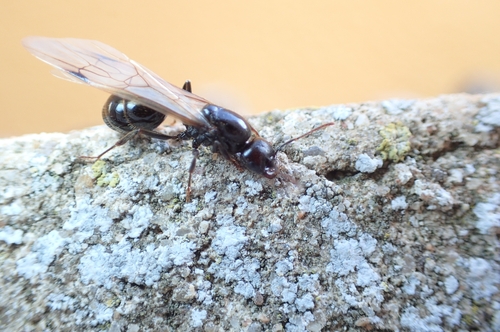
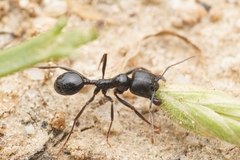
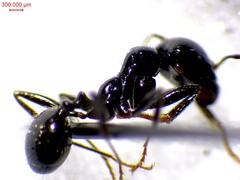
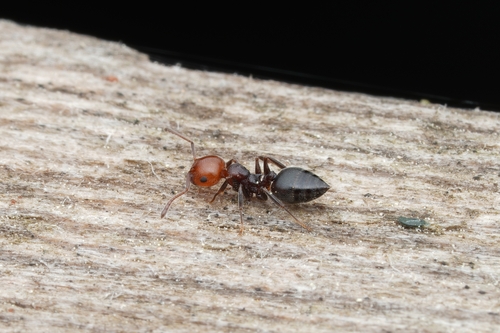
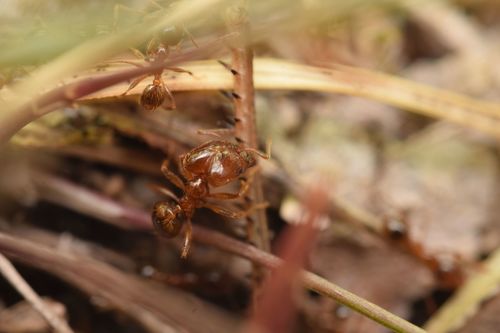

Barbary Harvester Ant

Barbary Harvester Ant

Messor barbarus

Daily sighting probability ~20% · Possible
at Valencia, Spain

In 3 days ~50% in a week ~80%

50 Verified sightings at Valencia, Spain
27 In all 4 parks From 2019 to 2026
September Best month
☀️ Diurnal When it's spotted

About the Barbary Harvester Ant

Messor barbarus is a species of harvester ant in the subfamily Myrmicinae. It is found In Southern Europe and Northern Africa. Messor barbarus causes 50–100% of the seed losses and is the most common ant in arable fields in northeastern Spain (Westerman et al. 2012). These ants in particular made news headlines all over Spain when farmers believed they were stealing their seeds and began a cull, only to realise they actually play a massive part of the ecosystem and benefit the production for crop farmers completely. Messors will carry the seeds on their own roads back to the colony, sometimes up to 100 feet (30 m) away.

Messor barbarus is found to act in accordance with the optimal foraging theory, which predicts that selectivity in ants increases with increasing richness of resources in an area, as well as with increasing distance from starting location. Trails were likewise differentially favored according to the relative abundance of resources provided to the ant populations. Highly frequented trails had a higher mean rate per worker, meaning the harvesters returned higher rates of resources more efficiently... Wikipedia →

Global Distribution

Parks Where Found

# Park Country Daily sighting probability
1 Camargue 🇫🇷 France
~10%
2 Monfragüe National Park 🇪🇸 Spain
~10%
3 Sierra Nevada National Park 🇪🇸 Spain
~10%
4 Sierra de Guadarrama National Park 🇪🇸 Spain
<5%

Cities Where Found

# City Country Daily sighting probability
1 Valencia 🇪🇸 Spain
~20%
2 Madrid 🇪🇸 Spain
~20%
3 Barcelona 🇪🇸 Spain
~20%
4 Algiers 🇩🇿 Algeria
~10%
5 Lisbon 🇵🇹 Portugal
~10%

Before you go

What are the chances of seeing a Barbary Harvester Ant in Valencia, Spain?

Possible

About 20% of wildlife watchers report a Barbary Harvester Ant sighting in Valencia, Spain on a given day, based on 50 verified sightings from GBIF citizen-science data. It is the 18th most-seen of the 147 insects we can rate there. Over three days the chance rises to about 50%, and over a week to about 80%, if each day is a fresh chance.

When is the best time to see a Barbary Harvester Ant in Valencia, Spain?

April–May and September–October

In those months about 30% of wildlife watchers report a Barbary Harvester Ant in Valencia, Spain on a given day, against under 5% in November to March, the lowest months.

What time of day is best to see a Barbary Harvester Ant?

Between 1 and 4 pm

Across all the parks we cover, that three-hour window holds the most Barbary Harvester Ant sightings with a recorded time, and about 9 in 10 of them come between 6 am and 6 pm: it is a daytime animal.

Is Valencia, Spain the best place to see a Barbary Harvester Ant?

Yes

Of the 5 cities where we can rate Barbary Harvester Ant sightings, Valencia, Spain has the highest daily chance: about 20%. Next come Madrid (Spain, about 20%) and Barcelona (Spain, about 20%).

Which relatives of the Barbary Harvester Ant live in Valencia, Spain?

Same family: Formicidae

The closest relatives of the Barbary Harvester Ant that you can see in Valencia, Spain (family Formicidae, Ants) are Mediterranean Acrobat Ant (about 10%) and Pallid Big-Headed Ant (about 10%), with each one's daily chance of a sighting.

Where does the Barbary Harvester Ant sighting chance come from?

GBIF citizen-science records

It is estimated from how often the Barbary Harvester Ant is recorded against all the insects logged in Valencia, Spain (50 verified sightings), calibrated against known sighting rates. Figures are rounded to the nearest 10% because citizen-science data supports honest approximations, not decimals, and months with records from fewer than five people show "—". How it works.

← Back to Valencia, Spain