Lesser Purple Emperor

Lesser Purple Emperor

Apatura ilia

Daily sighting probability ~10% · With luck
at Vienna

In 3 days ~30% in a week ~50%

163 Verified sightings at Vienna
125 In all 7 parks From 2019 to 2026
August Best month
☀️ Diurnal When it's spotted

About the Lesser Purple Emperor

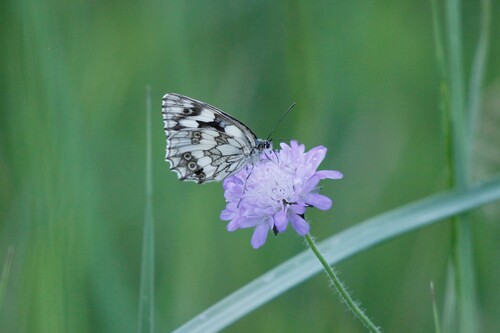
Apatura ilia, the lesser purple emperor, is a species of butterfly native to most of Europe and east across the Palearctic. It is named for its similarity to the purple emperor butterfly. The wingspan is 55–60 mm (2.2–2.4 in) in the female and 60–70 mm (2.4–2.8 in) in the male.

The upper side of the wings is dark brown, with metallic blue-violet hues in the male, and it has a clear postdiscal band on the hind wing and several light spots on the fore wing. These clear areas can be presented in two different aspects; they are white on the butterflies of the nominal form ilia, and clear fawn in the form clytie. For both forms, the fore wing also has an orange-coloured ocellus, which makes differentiating the species from Apatura iris possible. A similar ocellus is present on the hind wing in both species.

The reverse side of the fore wing is brown and the back of the hind wing is dull brown with, as in A. iris, an orange ocellus centered in black. Mounted specimens A. ilia Schiff. ( = Pap. iris Esp.) (50c) is characterized by the distal margin of the forewing being obtusely angulate below the apex; in the anal area of this wing there is an... Wikipedia →


Global Distribution

Parks Where Found

# Park Country Daily sighting probability
1 Białowieża National Park 🇵🇱 Poland
~20%
2 Aigüestortes National Park 🇪🇸 Spain
~20%
3 Fertő-Hanság National Park 🇭🇺 Hungary
~10%
4 Bavarian Forest National Park 🇩🇪 Germany
~10%
5 Ecrins National Park 🇫🇷 France
~10%
6 Cévennes National Park 🇫🇷 France
~10%
7 Pyrénées National Park 🇫🇷 France
~10%

Cities Where Found

# City Country Daily sighting probability
1 Suzhou 🇨🇳 China
~20%
2 Nanjing 🇨🇳 China
~20%
3 Kyiv 🇺🇦 Ukraine
~10%
4 Warsaw 🇵🇱 Poland
~10%
5 Milan 🇮🇹 Italy
~10%
6 Shanghai 🇨🇳 China
~10%
7 Lyon 🇫🇷 France
~10%
8 Kharkiv 🇺🇦 Ukraine
~10%
9 Turin 🇮🇹 Italy
~10%
10 Beijing 🇨🇳 China
~10%

Before you go

What are the chances of seeing a Lesser Purple Emperor in Vienna?

With luck

About 10% of wildlife watchers report a Lesser Purple Emperor sighting in Vienna on a given day, based on 163 verified sightings from GBIF citizen-science data. It is the 93rd most-seen of the 1406 insects we can rate there. Over three days the chance rises to about 30%, and over a week to about 50%, if each day is a fresh chance.

When is the best time to see a Lesser Purple Emperor in Vienna?

August

In that month about 20% of wildlife watchers report a Lesser Purple Emperor in Vienna on a given day, against under 5% in October to April, the lowest months. That is one of Vienna's wettest months, with about 85 mm of rain against 40 mm in February.

What time of day is best to see a Lesser Purple Emperor?

Between 10 am and 1 pm

Across all the parks we cover, that three-hour window holds the most Lesser Purple Emperor sightings with a recorded time, and about 9 in 10 of them come between 6 am and 6 pm: it is a daytime animal.

Is Vienna the best place to see a Lesser Purple Emperor?

11th of 32

Of the 32 cities where we can rate Lesser Purple Emperor sightings, Vienna ranks 11th at about 10%. The best odds are in Suzhou (China, about 20%), Nanjing (China, about 20%) and Kyiv (Ukraine, about 10%).

Which relatives of the Lesser Purple Emperor live in Vienna?

Same family: Nymphalidae

The closest relatives of the Lesser Purple Emperor that you can see in Vienna (family Nymphalidae, Brush-footed Butterflies) are Meadow Brown (about 20%), Red Admiral (about 20%) and Speckled Wood (about 20%), with each one's daily chance of a sighting.

Where does the Lesser Purple Emperor sighting chance come from?

GBIF citizen-science records

It is estimated from how often the Lesser Purple Emperor is recorded against all the insects logged in Vienna (163 verified sightings), calibrated against known sighting rates. Figures are rounded to the nearest 10% because citizen-science data supports honest approximations, not decimals, and months with records from fewer than five people show "—". How it works.

← Back to Vienna