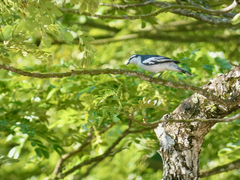
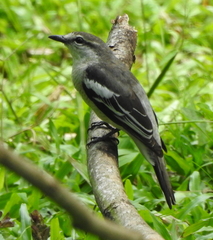
Pied Triller

Pied Triller

Lalage nigra

Silhouette: PhyloPic

LCLeast ConcernNTVUENCR
Daily sighting probability ~10% · With luck
at Yogyakarta

In 3 days ~20% in a week ~50%

13 Verified sightings at Yogyakarta
283 In all 6 parks From 2019 to 2026
March Best month
☀️ Diurnal When it's spotted

About the Pied Triller

The pied triller (Lalage nigra) is a species of bird in the cuckooshrike family Campephagidae. It is found in Brunei, India, Indonesia, Malaysia, the Philippines, Singapore, and Thailand. In 1760 the French zoologist Mathurin Jacques Brisson included a description and an illustration of the pied triller in the second volume of his Ornithologie based on a specimen that had been collected in the East Indies. He used the French name Le Merle des Indes and the Latin name Merula Indica. Although Brisson coined Latin names, these do not conform to the binomial system and are not recognised by the International Commission on Zoological Nomenclature. In a section of a book by Johann Reinhold Forster published in 1781 the Welsh naturalist Thomas Pennant coined the binomial name Turdus niger for the pied triller and cited Brisson's work. In 1922 the type location was restricted to Singapore by the American zoologist Outram Bangs. The pied triller is now one of 20 species placed in the genus Lalage that was introduced in 1826 by the German zoologist Friedrich Boie.

Three subspecies are recognised: Wikipedia →

Sounds

Begging call0:22

Malaysia · 2023

© Joshua Chong · XC811559 · CC BY-NC-SA 4.0

Call0:32

Malaysia · 2026

© Ding Li Yong · XC1175527 · CC BY-NC-ND 4.0

Song0:18

Malaysia · 2021

© Hobart WQH · XC815837 · CC BY-NC-SA 4.0

Global Distribution

Parks Where Found

# Park Country Daily sighting probability
1 Way Kambas National Park 🇮🇩 Indonesia
~30%
2 Bali Barat National Park 🇮🇩 Indonesia
~10%
3 Bako National Park 🇲🇾 Malaysia
~10%
4 Gunung Leuser National Park 🇮🇩 Indonesia
~10%
5 Taman Negara National Park 🇲🇾 Malaysia
<5%
6 Kinabatangan Wildlife Sanctuary 🇲🇾 Malaysia
<5%

Cities Where Found

# City Country Daily sighting probability
1 Cebu City 🇵🇭 Philippines
~70%
2 Davao City 🇵🇭 Philippines
~50%
3 Bandar Lampung 🇮🇩 Indonesia
~30%
4 Manila 🇵🇭 Philippines
~30%
5 Kuching 🇲🇾 Malaysia
~20%
6 Semarang 🇮🇩 Indonesia
~20%
7 Bandung 🇮🇩 Indonesia
~10%
8 Angeles 🇵🇭 Philippines
~10%
9 Yogyakarta 🇮🇩 Indonesia
~10%
10 Kuala Lumpur 🇲🇾 Malaysia
~10%

Before you go

What are the chances of seeing a Pied Triller in Yogyakarta?

With luck

About 10% of wildlife watchers report a Pied Triller sighting in Yogyakarta on a given day, based on 13 verified sightings from GBIF citizen-science data. It is the 31st most-seen of the 42 birds we can rate there. Over three days the chance rises to about 20%, and over a week to about 50%, if each day is a fresh chance.

When is the best time to see a Pied Triller in Yogyakarta?

March

In that month about 20% of wildlife watchers report a Pied Triller in Yogyakarta on a given day, against under 5% in February, April–June, October and December, the lowest months.

What time of day is best to see a Pied Triller?

Between 7 and 10 am

Across all the parks we cover, that three-hour window holds the most Pied Triller sightings with a recorded time, and about 9 in 10 of them come between 6 am and 6 pm: it is a daytime animal.

Is Yogyakarta the best place to see a Pied Triller?

9th of 13

Of the 13 cities where we can rate Pied Triller sightings, Yogyakarta ranks 9th at about 10%. The best odds are in Cebu City (Philippines, about 70%), Davao City (Philippines, about 50%) and Bandar Lampung (Indonesia, about 30%).

Which relatives of the Pied Triller live in Yogyakarta?

Same order: Passeriformes

The closest relatives of the Pied Triller that you can see in Yogyakarta (order Passeriformes, Perching Birds) are Eurasian Tree Sparrow (about 90%), Javan Munia (about 80%) and Yellow-vented Bulbul (about 70%), with each one's daily chance of a sighting.

Where does the Pied Triller sighting chance come from?

GBIF citizen-science records

It is estimated from how often the Pied Triller is recorded against all the birds logged in Yogyakarta (13 verified sightings), calibrated against known sighting rates. Figures are rounded to the nearest 10% because citizen-science data supports honest approximations, not decimals, and months with records from fewer than five people show "—". How it works.

← Back to Yogyakarta