Northern Root Teju

Northern Root Teju

Loxopholis southi

Silhouette: Jose Carlos Arenas-Monroy · PhyloPic

Daily sighting probability ~10% · With luck
at Corcovado National Park

In 3 days ~30% in a week ~50%

9 Verified sightings at Corcovado National Park From 2019 to 2026
22 In all 3 parks
May Best month
☀️🌙 Day & Night When it's spotted

About the Northern Root Teju

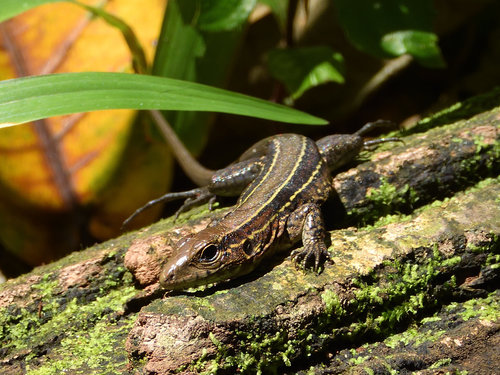
Loxopholis southi, also known commonly as the northern spectacled lizard and the southern leposoma, is a species of lizard in the family Gymnophthalmidae. The species is native to southeastern Central America and northwestern South America. There are two recognized subspecies.

The specific name, southi, is in honor of John Glover South (1873–1940), who was an American physician and diplomat. L. southi is found in Costa Rica, Panama, and Colombia. They inhabit forested environments, particularly tropical moist forest, and are typically found in leaf litter on the forest floor.

L. southi is oviparous. Two subspecies are recognized as being valid, including the nominotypical subspecies: Loxopholis southi orientalis (Taylor, 1955) Loxopholis southi southi (Ruthven & Gaige, 1924) Nota bene: A trinomial authority in parentheses indicates that the subspecies was originally described in a genus other than Loxopholis.

Goicoechea N, Frost DR, De la Riva I, Pelligrino KCM, Sites J Jr, Rodrigues MT, Padial JM (2016). "Molecular systematics of teioid lizards (Teioidea/Gymnophthalmoidea... Wikipedia →

Global Distribution

Parks Where Found

# Park Country Daily sighting probability
1 Piedras Blancas National Park 🇨🇷 Costa Rica
~10%
2 Corcovado National Park 🇨🇷 Costa Rica
~10%
3 Soberanía National Park 🇵🇦 Panama
~10%

Before you go

What are the chances of seeing a Northern Root Teju in Corcovado National Park?

With luck

About 10% of wildlife watchers report a Northern Root Teju sighting in Corcovado National Park on a given day, based on 9 verified sightings from GBIF citizen-science data from 2019 to 2026. It is the 31st most-seen of the 41 reptiles we can rate there. Over three days the chance rises to about 30%, and over a week to about 50%, if each day is a fresh chance.

When is the best time to see a Northern Root Teju in Corcovado National Park?

May

In that month about 30% of wildlife watchers report a Northern Root Teju in Corcovado National Park on a given day, against under 5% in January, April, June, August and October–November, the lowest months.

What time of day is best to see a Northern Root Teju?

Between 9 am and noon

Across all the parks we cover, that three-hour window holds the most Northern Root Teju sightings with a recorded time, and about 6 in 10 of them come between 6 am and 6 pm: it is seen both by day and at night.

Is Corcovado National Park the best place to see a Northern Root Teju?

Among the best

Of the 3 parks where we can rate Northern Root Teju sightings, Corcovado National Park ranks 2nd at about 10%, level with the leaders once rounded. The best odds are in Piedras Blancas National Park (Costa Rica, about 10%).

Where does the Northern Root Teju sighting chance come from?

GBIF citizen-science records

It is estimated from how often the Northern Root Teju is recorded against all the reptiles logged in Corcovado National Park (9 verified sightings from 2019 to 2026), calibrated against known sighting rates. Figures are rounded to the nearest 10% because citizen-science data supports honest approximations, not decimals, and months with records from fewer than five people show "—". How it works.

← Back to Corcovado National Park