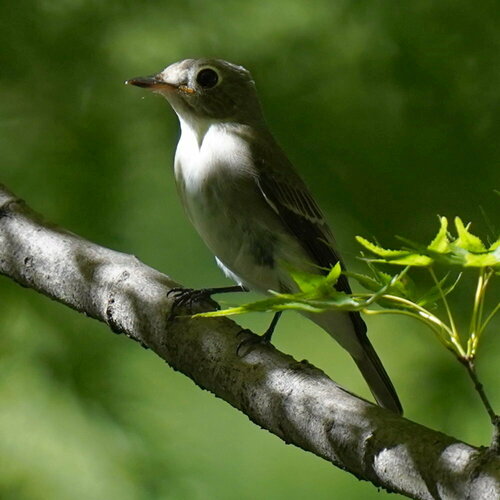
Japanese Robin

Japanese Robin

Erithacus akahige

Silhouette: Rebecca Groom · PhyloPic

Daily sighting probability ~10% · With luck
at Cuc Phuong National Park

In 3 days ~20% in a week ~40%

20 Verified sightings at Cuc Phuong National Park From 2019 to 2026
43 In all 2 parks
February Best month

About the Japanese Robin

The Japanese robin (Larvivora akahige) is a small passerine bird in the family Muscicapidae. This species was formerly named Erithacus akahige, or Komadori. Its range extends from the south of the Kuril and Sakhalin Islands throughout Japan.

The name "Japanese robin" is also sometimes used for the red-billed leiothrix (Leiothrix lutea). The specific name akahige is, somewhat confusingly, the common name of its relative Larvivora komadori in Japanese. The Japanese robin, together with the Ryukyu robin and the European robin, was previously placed in the genus Erithacus. A 2006 molecular phylogenetic study found that the two east Asian species were more similar to the Siberian blue robin, at the time in Luscinia, than to the European robin. In 2010 a large study confirmed this result and also found that Luscinia was non-monophyletic. The genus Larvivora was therefore resurrected to accommodate a clade containing the Japanese robin, the Ryukyu robin, the Siberian blue robin and several other species that had previously been placed in Luscinia.

The Japanese robin is about 14-15 centimeters in size. This bird species is mainly gray and bright orange. The male Japanese... Wikipedia →

Sounds

Recording0:03

Japan · 2025

© Yuki_Wakabayashi · iNaturalist · CC BY-NC 4.0

Recording0:05

Japan · 2026

© ponyomi · iNaturalist · CC BY-NC 4.0

Recording0:29

Taiwan · 2023

© Roger Shaw · iNaturalist · CC BY-NC-SA 4.0

Global Distribution

Parks Where Found

# Park Country Daily sighting probability
1 Cuc Phuong National Park 🇻🇳 Vietnam
~10%
2 Nikko National Park 🇯🇵 Japan
~10%

Cities Where Found

# City Country Daily sighting probability
1 Fuzhou 🇨🇳 China
~10%
2 Busan 🇰🇷 South Korea
<5%
3 Osaka 🇯🇵 Japan
<5%
4 Guangzhou 🇨🇳 China
<5%
5 Hangzhou 🇨🇳 China
<5%
6 Nagoya 🇯🇵 Japan
<5%
7 Tokyo 🇯🇵 Japan
<5%

Zoos & Centres Where Found

# Zoo / Centre Country
1 Ueno Zoo 🇯🇵 Japan In captivity
2 Ueno Zoological Gardens (West Garden) 🇯🇵 Japan In captivity

Before you go

What are the chances of seeing a Japanese Robin in Cuc Phuong National Park?

With luck

About 10% of wildlife watchers report a Japanese Robin sighting in Cuc Phuong National Park on a given day, based on 20 verified sightings from GBIF citizen-science data from 2019 to 2026. It is the 85th most-seen of the 159 birds we can rate there. Over three days the chance rises to about 20%, and over a week to about 40%, if each day is a fresh chance.

When is the best time to see a Japanese Robin in Cuc Phuong National Park?

February

In that month about 20% of wildlife watchers report a Japanese Robin in Cuc Phuong National Park on a given day, against under 5% in April–June and August–December, the lowest months. That is one of Cuc Phuong National Park's driest months, with about 50 mm of rain against 390 mm in August. July has too few records to rate.

Is Cuc Phuong National Park the best place to see a Japanese Robin?

Yes

Of the 2 parks where we can rate Japanese Robin sightings, Cuc Phuong National Park has the highest daily chance: about 10%. Next come Nikko National Park (Japan, about 10%).

Which relatives of the Japanese Robin live in Cuc Phuong National Park?

Same family: Muscicapidae

The closest relatives of the Japanese Robin that you can see in Cuc Phuong National Park (family Muscicapidae, Old World Flycatchers, Robins, and Chats) are White-rumped Shama (about 40%), Rufous-tailed Robin (about 40%) and Fujian Niltava (about 30%), with each one's daily chance of a sighting.

Where does the Japanese Robin sighting chance come from?

GBIF citizen-science records

It is estimated from how often the Japanese Robin is recorded against all the birds logged in Cuc Phuong National Park (20 verified sightings from 2019 to 2026), calibrated against known sighting rates. Figures are rounded to the nearest 10% because citizen-science data supports honest approximations, not decimals, and months with records from fewer than five people show "—". How it works.

← Back to Cuc Phuong National Park