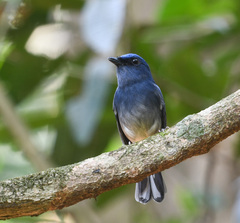
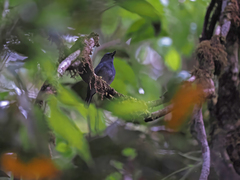
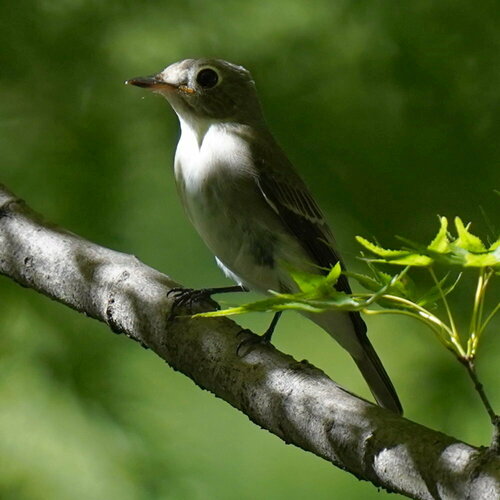
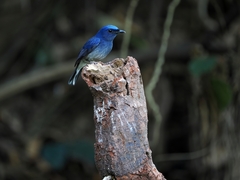
White-Tailed Blue-Flycatcher

White-Tailed Blue-Flycatcher

Cyornis concretus

Silhouette: L. Shyamal · PhyloPic

LCLeast ConcernNTVUENCR
Daily sighting probability ~10% · With luck
at Cuc Phuong National Park

In 3 days ~30% in a week ~60%

43 Verified sightings at Cuc Phuong National Park From 2019 to 2026
490 In all 4 parks
February Best month
🌅 Crepuscular When it's spotted

About the White-Tailed Blue-Flycatcher

The white-tailed flycatcher (Leucoptilon concretum) is a species of bird in the family Muscicapidae. It is the only member of the monotypic genus Leucoptilon. It is found in submountain forests from the eastern Himalayas and northern Myanmar to southern China, western and southern Thailand, the Malay Peninsula, Sumatra and Borneo.

The white-tailed flycatcher was formally described in 1836 by the German naturalist Salomon Müller based on a specimen collected in the interior of the west coast of Sumatra. Müller placed the species in the genus Muscicapa and coined the binomial name Muscicapa concreta. The specific epithet concretum is from Modern Latin concretus meaning "large", "sturdy" or "strong". It comes from Medieval Latin concretus meaning "concrete". The white-tailed flycatcher was previously assigned to the genus Cyornis but based on evidence from molecular phylogenetic studies the species is now placed in its own monotypic genus Leucoptilon that was introduced in 2021 by George Sangster and collaborators. The genus name combines the Ancient Greek λευκος/leukos meaning "white" with πτιλον/ptilon meaning "feather".

Three subspecies are recognised: Wikipedia →

Sounds

Call0:26

Vietnam · 2026

© Tim Dinh / Annambirding · XC1186407 · CC BY-NC-SA 4.0

Song0:48

Malaysia · 2025

© Lim Ying Hien 林勇贤 · XC1053310 · CC BY-NC-ND 4.0

Imitation1:25

Indonesia · 2014

© Stijn Cooleman · XC213827 · CC BY-NC-SA 4.0

Global Distribution

Parks Where Found

# Park Country Daily sighting probability
1 Namdapha National Park 🇮🇳 India
~30%
2 Cuc Phuong National Park 🇻🇳 Vietnam
~10%
3 Kerinci Seblat National Park 🇮🇩 Indonesia
<5%
4 Kinabalu Park 🇲🇾 Malaysia
<5%

Before you go

What are the chances of seeing a White-Tailed Blue-Flycatcher in Cuc Phuong National Park?

With luck

About 10% of wildlife watchers report a White-Tailed Blue-Flycatcher sighting in Cuc Phuong National Park on a given day, based on 43 verified sightings from GBIF citizen-science data from 2019 to 2026. It is the 59th most-seen of the 159 birds we can rate there. Over three days the chance rises to about 30%, and over a week to about 60%, if each day is a fresh chance.

When is the best time to see a White-Tailed Blue-Flycatcher in Cuc Phuong National Park?

February–March, June and December

In those months about 20% of wildlife watchers report a White-Tailed Blue-Flycatcher in Cuc Phuong National Park on a given day, against under 5% in October, the lowest month. Those are among Cuc Phuong National Park's driest months, with about 90 mm of rain a month against 390 mm in August. July has too few records to rate.

What time of day is best to see a White-Tailed Blue-Flycatcher?

Between 7 and 10 am

Across all the parks we cover, that three-hour window holds the most White-Tailed Blue-Flycatcher sightings with a recorded time, and about 7 in 10 of them come between 6 am and 6 pm: it is most active around dawn and dusk.

Is Cuc Phuong National Park the best place to see a White-Tailed Blue-Flycatcher?

2nd of 4

Of the 4 parks where we can rate White-Tailed Blue-Flycatcher sightings, Cuc Phuong National Park ranks 2nd at about 10%. The best odds are in Namdapha National Park (India, about 30%).

Where does the White-Tailed Blue-Flycatcher sighting chance come from?

GBIF citizen-science records

It is estimated from how often the White-Tailed Blue-Flycatcher is recorded against all the birds logged in Cuc Phuong National Park (43 verified sightings from 2019 to 2026), calibrated against known sighting rates. Figures are rounded to the nearest 10% because citizen-science data supports honest approximations, not decimals, and months with records from fewer than five people show "—". How it works.

← Back to Cuc Phuong National Park