Totonacan Rattlesnake

Totonacan Rattlesnake

Crotalus totonacus

Silhouette: Bill Bouton (source photo) & T. Michael Keesey (vectorization) · PhyloPic

LCLeast ConcernNTVUENCR Endemic
Daily sighting probability ~10% · With luck
at Cumbres de Monterrey National Park

In 3 days ~20% in a week ~30%

10 Verified sightings at Cumbres de Monterrey National Park From 2019 to 2026
10 In 1 park
September Best month
☀️🌙 Day & Night When it's spotted

About the Totonacan Rattlesnake

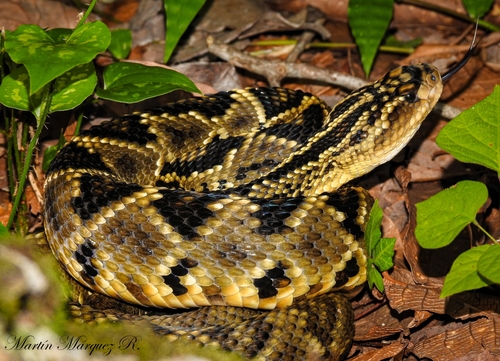
Common name: Totonacan rattlesnake Crotalus totonacus is a venomous pit viper species found in northeastern Mexico. No subspecies are currently recognized. Adults frequently grow to more than 150 cm (4 ft 11 in) in length. The largest recorded specimen was 166.5 cm (5 ft 5+1⁄2 in) in length.

It is found in northeastern Mexico from central Nuevo León through southern Tamaulipas, northern Veracruz, eastern San Luis Potosí and northern Querétaro. The type locality given is "Panaco Island, about 75 miles [120 km] south of Tampico, Veracruz, Mexico, 12 miles [19 km] inland from Cabo Rojo".

Crotalus totonacus is known to prey on small mammals and birds. In addition to mammal hair and bird feathers found in stomachs, specific prey items include cave rats (Neotoma sp.), Allen's tree squirrels (Sciurus alleni), and rock squirrels (Spermophilus [Otospermophilus] variegatus).

This species was previously considered a subspecies of C. durissus. Gloyd, H.K. and C.F. Kauffeld. 1940. A new rattlesnake from Mexico. Bull. Chicago Acad. Sci. 6 (2): 11-14 + one plate. Wikipedia →
Global Distribution

Parks Where Found

# Park Country Daily sighting probability
1 Cumbres de Monterrey National Park 🇲🇽 Mexico
~10%

More parks will be added in future updates.

Before you go

What are the chances of seeing a Totonacan Rattlesnake in Cumbres de Monterrey National Park?

With luck

About 10% of wildlife watchers report a Totonacan Rattlesnake sighting in Cumbres de Monterrey National Park on a given day, based on 10 verified sightings from GBIF citizen-science data from 2019 to 2026. It is the 31st most-seen of the 43 reptiles we can rate there. Over three days the chance rises to about 20%, and over a week to about 30%, if each day is a fresh chance.

When is the best time to see a Totonacan Rattlesnake in Cumbres de Monterrey National Park?

March–May and July–September

In those months about 10% of wildlife watchers report a Totonacan Rattlesnake in Cumbres de Monterrey National Park on a given day, against under 5% in June and October–February, the lowest months.

What time of day is best to see a Totonacan Rattlesnake?

Between noon and 3 pm

Across all the parks we cover, that three-hour window holds the most Totonacan Rattlesnake sightings with a recorded time, and about 7 in 10 of them come between 6 am and 6 pm: it is seen both by day and at night.

Where else can you see a Totonacan Rattlesnake?

Only Cumbres de Monterrey National Park, in our data

Cumbres de Monterrey National Park is the only park on Wallace's Line with enough records to rate Totonacan Rattlesnake sightings: about 10% of wildlife watchers there report one on a given day.

Where does the Totonacan Rattlesnake sighting chance come from?

GBIF citizen-science records

It is estimated from how often the Totonacan Rattlesnake is recorded against all the reptiles logged in Cumbres de Monterrey National Park (10 verified sightings from 2019 to 2026), calibrated against known sighting rates. Figures are rounded to the nearest 10% because citizen-science data supports honest approximations, not decimals, and months with records from fewer than five people show "—". How it works.

← Back to Cumbres de Monterrey National Park