Western Black-tailed Rattlesnake

Western Black-tailed Rattlesnake

Crotalus molossus

Silhouette: Bill Bouton (source photo) & T. Michael Keesey (vectorization) · PhyloPic

LCLeast ConcernNTVUENCR
Daily sighting probability <5% · Rare
at Cumbres de Monterrey National Park

In 3 days ~10% in a week ~30%

6 Verified sightings at Cumbres de Monterrey National Park From 2019 to 2026
84 In all 2 parks
September Best month
☀️🌙 Day & Night When it's spotted

About the Western Black-tailed Rattlesnake

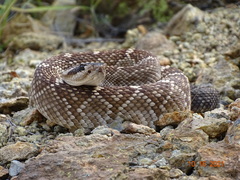
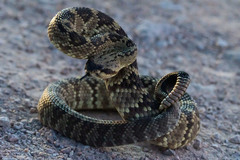
The black-tailed rattlesnake (Crotalus molossus) is a venomous pit viper species found in the southwestern United States and Mexico. Four subspecies are currently recognized, including the nominate subspecies described here.

A 2012 revision showed that eastern populations from Texas and central and eastern New Mexico form a distinct species separate from C. molossus: Crotalus ornatus Hallowell 1854. Alternate common names are green rattler, and Northern black-tailed rattlesnake.

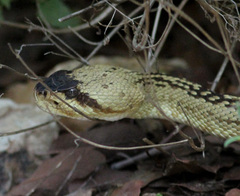
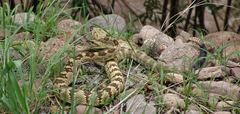
This medium-sized species averages from 76 to 107 cm (30 to 42 in) in length. The females tend to be larger than the males. They range in color from yellows and olive greens to browns and black. As their name implies, one of their most distinguishing features is, despite variations in body color, entirely black tail scales. Often, this rattlesnake has a black band across its eyes extending diagonally down to the corners of its mouth... Wikipedia →

Sounds

Recording0:10

United States · 2025

© Christian Schwarz · iNaturalist · CC BY-NC 4.0

Recording0:22

United States · 2021

© BJ Stacey · iNaturalist · CC BY-NC 4.0

Global Distribution

Parks Where Found

# Park Country Daily sighting probability
1 Saguaro National Park 🇺🇸 United States
~20%
2 Cumbres de Monterrey National Park 🇲🇽 Mexico
<5%

Cities Where Found

# City Country Daily sighting probability
1 Mexico City 🇲🇽 México
~10%
2 Mesa 🇺🇸 United States
~10%

Zoos & Centres Where Found

# Zoo / Centre Country
1 Skansen 🇸🇪 Sweden In captivity
2 Greensboro Science Center 🇺🇸 United States In captivity
3 Zoo Miami 🇺🇸 United States In captivity
4 Ecological Center of Sonora 🇲🇽 Mexico In captivity
5 Sedgwick County Zoo 🇺🇸 United States In captivity
6 Parque Zoológico de León - Zooleón 🇲🇽 Mexico In captivity
7 Phoenix Zoo 🇺🇸 United States In captivity
8 Louisville Zoo 🇺🇸 United States In captivity
9 Zoológico Benito Juárez 🇲🇽 Mexico In captivity
10 Arizona-Sonora Desert Museum 🇺🇸 United States In captivity
11 ABQ BioPark Zoo 🇺🇸 United States In captivity
12 Cameron Park Zoo 🇺🇸 United States In captivity
13 Philadelphia Zoo 🇺🇸 United States In captivity
14 Chapultepec Zoo 🇲🇽 Mexico In captivity
15 Schönbrunn Zoo 🇦🇹 Austria In captivity
16 Pittsburgh Zoo & Aquarium 🇺🇸 United States In captivity
17 Riverbanks Zoo 🇺🇸 United States In captivity
18 Reptile Gardens 🇺🇸 United States In captivity
19 Oregon Coast Aquarium 🇺🇸 United States In captivity
20 Rancho Mágico 🇲🇽 Mexico In captivity
21 Staten Island Zoo 🇺🇸 United States In captivity
22 Parque museo La Venta 🇲🇽 Mexico In captivity
23 Hatfield Visitors Center 🇺🇸 United States In captivity
24 Baltic Sea Science Center 🇸🇪 Sweden In captivity

Before you go

What are the chances of seeing a Western Black-tailed Rattlesnake in Cumbres de Monterrey National Park?

Rare

Under 5% of wildlife watchers report a Western Black-tailed Rattlesnake sighting in Cumbres de Monterrey National Park on a given day, based on 6 verified sightings from GBIF citizen-science data from 2019 to 2026. It is the 42nd most-seen of the 43 reptiles we can rate there. Over three days the chance rises to about 10%, and over a week to about 30%, if each day is a fresh chance.

When is the best time to see a Western Black-tailed Rattlesnake in Cumbres de Monterrey National Park?

April and September–October

In those months about 10% of wildlife watchers report a Western Black-tailed Rattlesnake in Cumbres de Monterrey National Park on a given day, against under 5% in May–August and November–March, the lowest months. Those are among Cumbres de Monterrey National Park's wettest months, with about 130 mm of rain a month against 20 mm in December.

What time of day is best to see a Western Black-tailed Rattlesnake?

Between 10 am and 1 pm

Across all the parks we cover, that three-hour window holds the most Western Black-tailed Rattlesnake sightings with a recorded time, and about 6 in 10 of them come between 6 am and 6 pm: it is seen both by day and at night.

Is Cumbres de Monterrey National Park the best place to see a Western Black-tailed Rattlesnake?

2nd of 2

Of the 2 parks where we can rate Western Black-tailed Rattlesnake sightings, Cumbres de Monterrey National Park ranks 2nd at under 5%. The best odds are in Saguaro National Park (United States, about 20%).

Where does the Western Black-tailed Rattlesnake sighting chance come from?

GBIF citizen-science records

It is estimated from how often the Western Black-tailed Rattlesnake is recorded against all the reptiles logged in Cumbres de Monterrey National Park (6 verified sightings from 2019 to 2026), calibrated against known sighting rates. Figures are rounded to the nearest 10% because citizen-science data supports honest approximations, not decimals, and months with records from fewer than five people show "—". How it works.

← Back to Cumbres de Monterrey National Park