Texas Coralsnake

Texas Coralsnake

Micrurus tener

Silhouette: Edwin Price · PhyloPic

LCLeast ConcernNTVUENCR
Daily sighting probability ~20% · Possible
at Cumbres de Monterrey National Park

In 3 days ~40% in a week ~70%

59 Verified sightings at Cumbres de Monterrey National Park From 2019 to 2026
59 In 1 park
May Best month
☀️🌙 Day & Night When it's spotted

About the Texas Coralsnake

Micrurus tener, commonly known as the Texas coral snake and el coralillo tejano in Mexican Spanish, is a species of venomous snake in the family Elapidae. The species is native to the southern and southwestern United States and adjacent northeastern and central Mexico. Six subspecies are recognized as being valid, including the nominotypical subspecies, Micrurus tener tener. Although originally described as a species new to science, Micrurus tener was for many years considered to be a subspecies of the eastern coral snake (Micrurus fulvius).

The Texas coral snake ranges from the southern United States south to northeastern and central Mexico. It is found in the U.S. states of Arkansas, Louisiana, and Texas; and the Mexican states of Guanajato, Morelos, Querétaro, San Luis Potosí, and Tamaulipas.

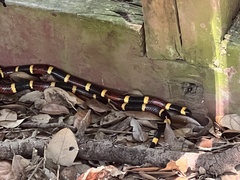
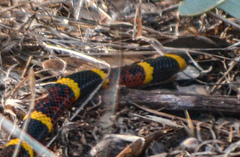
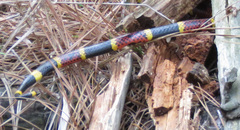
The Texas coral snake has the traditional coloration associated with coral snakes: black, yellow, and red rings. These rings extend onto the belly. It is capable of growing to 48 in (122 cm) in total length (tail included), but most are closer to 24 in (61 cm). Males are typically smaller than females. It has smooth dorsal scales, a rounded head... Wikipedia →

Sounds

Recording0:18

Mexico · 2024

© Andres Bonilla Vega · iNaturalist · CC BY-NC 4.0

Global Distribution

Parks Where Found

# Park Country Daily sighting probability
1 Cumbres de Monterrey National Park 🇲🇽 Mexico
~20%

More parks will be added in future updates.

Cities Where Found

# City Country Daily sighting probability
1 Austin 🇺🇸 United States
~10%
2 Houston 🇺🇸 United States
~10%
3 San Antonio 🇺🇸 United States
~10%
4 Monterrey 🇲🇽 México
<5%

Zoos & Centres Where Found

# Zoo / Centre Country
1 Gladys Porter Zoo 🇺🇸 United States In captivity

Closest Relatives at Cumbres de Monterrey National Park

No species of the same family or order lives in Cumbres de Monterrey National Park, so these are its closest relatives here: other reptiles.

Before you go

What are the chances of seeing a Texas Coralsnake in Cumbres de Monterrey National Park?

Possible

About 20% of wildlife watchers report a Texas Coralsnake sighting in Cumbres de Monterrey National Park on a given day, based on 59 verified sightings from GBIF citizen-science data from 2019 to 2026. It is the 7th most-seen of the 43 reptiles we can rate there. Over three days the chance rises to about 40%, and over a week to about 70%, if each day is a fresh chance.

When is the best time to see a Texas Coralsnake in Cumbres de Monterrey National Park?

May

In that month about 30% of wildlife watchers report a Texas Coralsnake in Cumbres de Monterrey National Park on a given day, against under 5% in January and February, the lowest months. That is one of Cumbres de Monterrey National Park's wettest months, with about 160 mm of rain against 20 mm in December.

What time of day is best to see a Texas Coralsnake?

Between 8 and 11 am

Across all the parks we cover, that three-hour window holds the most Texas Coralsnake sightings with a recorded time, and about 7 in 10 of them come between 6 am and 6 pm: it is seen both by day and at night.

Where else can you see a Texas Coralsnake?

Only Cumbres de Monterrey National Park, in our data

Cumbres de Monterrey National Park is the only park on Wallace's Line with enough records to rate Texas Coralsnake sightings: about 20% of wildlife watchers there report one on a given day.

Where does the Texas Coralsnake sighting chance come from?

GBIF citizen-science records

It is estimated from how often the Texas Coralsnake is recorded against all the reptiles logged in Cumbres de Monterrey National Park (59 verified sightings from 2019 to 2026), calibrated against known sighting rates. Figures are rounded to the nearest 10% because citizen-science data supports honest approximations, not decimals, and months with records from fewer than five people show "—". How it works.

← Back to Cumbres de Monterrey National Park