Mountain Keelback

Mountain Keelback

Helicops angulatus

Silhouette: Alex Slavenko · PhyloPic

LCLeast ConcernNTVUENCR
Daily sighting probability ~10% · With luck
at Cuyabeno Wildlife Reserve

In 3 days ~40% in a week ~70%

5 Verified sightings at Cuyabeno Wildlife Reserve From 2019 to 2026
38 In all 4 parks
February Best month
🌙 Nocturnal When it's spotted

About the Mountain Keelback

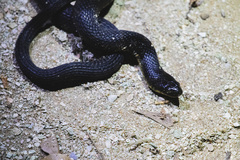
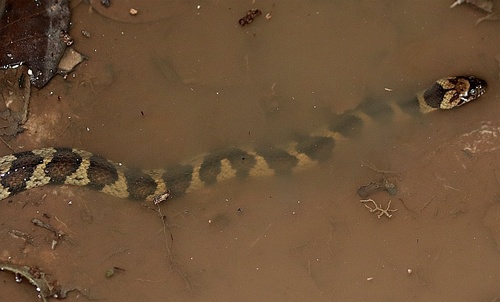
The brown-banded water snake (Helicops angulatus) is a species of aquatic snake found in tropical South America and Trinidad and Tobago. It is also known as the water mapepire. The brown-banded water snake grows to a maximum total length (including tail) of 78 cm (31 inches), although a female measuring 113 cm in has been reported in Bahia state, Brazil. Dorsally, it is olive or gray-brown, with dark brown, black-edged crossbands, which narrow at the sides, and are usually confluent with the black crossbands of the belly. There is a large dark rhomboid on the nape. Ventrally, it is yellowish (in alcohol) with black crossbands or black spots.

The dorsal scales are strongly keeled, even on the occiput and nape, and are arranged in 19 rows. Ventrals are 102–130 in number, the anal scale is divided, and the 61-94 subcaudals are paired and keeled. H. angulatus lives in fresh and brackish water, where it feeds on fish (such as freshwater eels) and possibly also frogs (such as rusty tree frogs, map tree frogs, Manaus slender-legged tree frogs, Scinax ruber, Adenomera hylaedactyla, Rhinella margaritifera, and cane toads) and their eggs, tadpoles, lizards... Wikipedia →
Global Distribution

Parks Where Found

# Park Country Daily sighting probability
1 Yasuní National Park 🇪🇨 Ecuador
~20%
2 Cuyabeno Wildlife Reserve 🇪🇨 Ecuador
~10%
3 Tambopata National Reserve 🇵🇪 Peru
~10%
4 Manu National Park 🇵🇪 Peru
~10%

Zoos & Centres Where Found

# Zoo / Centre Country
1 Bioparque Los Ocarros 🇨🇴 Colombia In captivity

Before you go

What are the chances of seeing a Mountain Keelback in Cuyabeno Wildlife Reserve?

With luck

About 10% of wildlife watchers report a Mountain Keelback sighting in Cuyabeno Wildlife Reserve on a given day, based on 5 verified sightings from GBIF citizen-science data from 2019 to 2026. It is the 18th most-seen of the 21 reptiles we can rate there. Over three days the chance rises to about 40%, and over a week to about 70%, if each day is a fresh chance.

When is the best time to see a Mountain Keelback in Cuyabeno Wildlife Reserve?

February, April and September

In those months about 30% of wildlife watchers report a Mountain Keelback in Cuyabeno Wildlife Reserve on a given day, against under 5% in March, July–August and October–January, the lowest months.

What time of day is best to see a Mountain Keelback?

Between 7 and 10 pm

Across all the parks we cover, that three-hour window holds the most Mountain Keelback sightings with a recorded time, and about 8 in 10 of them come between 6 pm and 6 am: it is mostly seen at night.

Is Cuyabeno Wildlife Reserve the best place to see a Mountain Keelback?

2nd of 4

Of the 4 parks where we can rate Mountain Keelback sightings, Cuyabeno Wildlife Reserve ranks 2nd at about 10%. The best odds are in Yasuní National Park (Ecuador, about 20%).

Which relatives of the Mountain Keelback live in Cuyabeno Wildlife Reserve?

Same family: Colubridae

The closest relatives of the Mountain Keelback that you can see in Cuyabeno Wildlife Reserve (family Colubridae, Colubrid Snakes) are Wagler's Sipo (about 30%), Blunthead Tree Snake (about 20%) and Wucherer's Ground Snake (about 10%), with each one's daily chance of a sighting.

Where does the Mountain Keelback sighting chance come from?

GBIF citizen-science records

It is estimated from how often the Mountain Keelback is recorded against all the reptiles logged in Cuyabeno Wildlife Reserve (5 verified sightings from 2019 to 2026), calibrated against known sighting rates. Figures are rounded to the nearest 10% because citizen-science data supports honest approximations, not decimals, and months with records from fewer than five people show "—". How it works.

← Back to Cuyabeno Wildlife Reserve