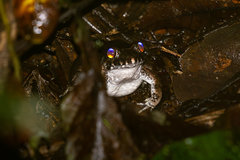
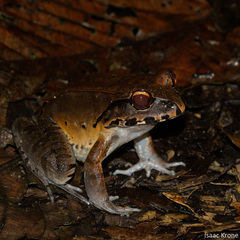
Smoky Jungle Frog

Smoky Jungle Frog

Leptodactylus pentadactylus

Silhouette: Jose Carlos Arenas-Monroy · PhyloPic

LCLeast ConcernNTVUENCR
Daily sighting probability ~30% · Possible
at Cuyabeno Wildlife Reserve

In 3 days ~70% in a week ~90%

19 Verified sightings at Cuyabeno Wildlife Reserve From 2019 to 2026
131 In all 5 parks
May Best month
🌙 Nocturnal When it's spotted

About the Smoky Jungle Frog

The smoky jungle frog (Leptodactylus pentadactylus) is a species of frog in the family Leptodactylidae. It is found in northern South America as well as parts of Central America. Its natural habitats are tropical and subtropical moist broadleaf forests, subtropical or tropical swamps, subtropical or tropical moist montane forest, rivers, freshwater marshes, intermittent freshwater marshes, and aquaculture ponds.

It is called huwa in the Kwaza language of Rondônia, Brazil. Males of this large, robust frog are slightly larger than females; they attain a maximum snout-vent length of 18.0 cm (7.1 in), whereas the maximum length in females is 17.6 cm (6.9 in).

The body is robust; the head is large with an acutely rounded snout and prominent tympanum. The skin on the dorsum and venter is smooth, and a prominent dorsolateral dermal fold extends from the orbit to the groin. The fingers and toes are long with slender tips and lack webbing. Breeding males have greatly swollen forelimbs and one large, pointed, black spine on the inner surface of the thumb and two black spines on each side of the chest. The dorsum is tan to reddish brown with broad... Wikipedia →

Sounds

Uncertain0:33

Brazil · 2026

© JAYRSON ARAUJO DE OLIVEIRA · XC1183885 · CC BY-NC-SA 4.0

Territorial call1:16

French Guiana · 2024

© Tristan Guillebot de Nerville · XC1091528 · CC BY-NC-SA 4.0

Advertisement call0:52

Ecuador · 2025

© Marc Anderson · XC986334 · CC BY-NC-ND 4.0

Global Distribution

Parks Where Found

# Park Country Daily sighting probability
1 Yasuní National Park 🇪🇨 Ecuador
~40%
2 Brownsberg Nature Park 🇸🇷 Suriname
~40%
3 Cuyabeno Wildlife Reserve 🇪🇨 Ecuador
~30%
4 Anavilhanas National Park 🇧🇷 Brazil
~20%
5 Manu National Park 🇵🇪 Peru
~10%

Cities Where Found

# City Country Daily sighting probability
1 Manaus 🇧🇷 Brazil
~20%

Zoos & Centres Where Found

# Zoo / Centre Country
1 Zoo Miami 🇺🇸 United States In captivity
2 Omaha’s Henry Doorly Zoo and Aquarium 🇺🇸 United States In captivity
3 Detroit Zoo 🇺🇸 United States In captivity
4 Fort Worth Zoo 🇺🇸 United States In captivity
5 Gladys Porter Zoo 🇺🇸 United States In captivity
6 Santa Barbara Zoo 🇺🇸 United States In captivity
7 Sacramento Zoo 🇺🇸 United States In captivity
8 The Living Planet Aquarium 🇺🇸 United States In captivity
9 Staten Island Zoo 🇺🇸 United States In captivity
10 Aquarium of the Pacific 🇺🇸 United States In captivity
11 Vancouver Aquarium 🇨🇦 Canada In captivity

Before you go

What are the chances of seeing a Smoky Jungle Frog in Cuyabeno Wildlife Reserve?

Possible

About 30% of wildlife watchers report a Smoky Jungle Frog sighting in Cuyabeno Wildlife Reserve on a given day, based on 19 verified sightings from GBIF citizen-science data from 2019 to 2026. It is the 4th most-seen of the 15 amphibians we can rate there. Over three days the chance rises to about 70%, and over a week to about 90%, if each day is a fresh chance.

When is the best time to see a Smoky Jungle Frog in Cuyabeno Wildlife Reserve?

May

In that month about 50% of wildlife watchers report a Smoky Jungle Frog in Cuyabeno Wildlife Reserve on a given day, against under 5% in February and September, the lowest months.

What time of day is best to see a Smoky Jungle Frog?

Between 7 and 10 pm

Across all the parks we cover, that three-hour window holds the most Smoky Jungle Frog sightings with a recorded time, and about 9 in 10 of them come between 6 pm and 6 am: it is mostly seen at night.

Is Cuyabeno Wildlife Reserve the best place to see a Smoky Jungle Frog?

3rd of 5

Of the 5 parks where we can rate Smoky Jungle Frog sightings, Cuyabeno Wildlife Reserve ranks 3rd at about 30%. The best odds are in Yasuní National Park (Ecuador, about 40%) and Brownsberg Nature Park (Suriname, about 40%).

Where does the Smoky Jungle Frog sighting chance come from?

GBIF citizen-science records

It is estimated from how often the Smoky Jungle Frog is recorded against all the amphibians logged in Cuyabeno Wildlife Reserve (19 verified sightings from 2019 to 2026), calibrated against known sighting rates. Figures are rounded to the nearest 10% because citizen-science data supports honest approximations, not decimals, and months with records from fewer than five people show "—". How it works.

← Back to Cuyabeno Wildlife Reserve