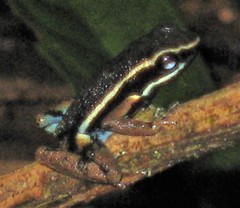
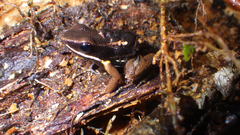
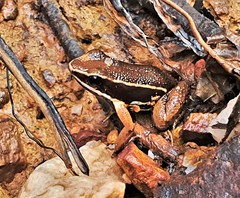
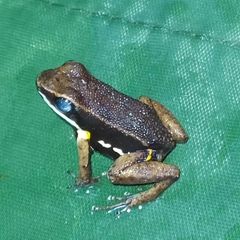

Spotted-thighed Poison Frog

Spotted-thighed Poison Frog

Allobates femoralis

Silhouette: Dmitry Bogdanov (vectorized by T. Michael Keesey) · PhyloPic

LCLeast ConcernNTVUENCR
Daily sighting probability ~10% · With luck
at Cuyabeno Wildlife Reserve

In 3 days ~40% in a week ~70%

5 Verified sightings at Cuyabeno Wildlife Reserve From 2019 to 2026
27 In all 3 parks
February Best month
☀️ Diurnal When it's spotted

About the Spotted-thighed Poison Frog

Allobates femoralis (common name brilliant-thighed poison frog, brilliant-thighed poison-arrow frog) is a species of frog in the family Aromobatidae. It is found in Bolivia, Brazil, Colombia, Ecuador, French Guiana, Guyana, Peru, and Suriname. Its natural habitat is tropical lowland forests.

Allobates femoralis is a small frog, the males growing to 28 to 33 mm (1.1 to 1.3 in) in length and the females being marginally larger. The coloration on the back is dark brown or black and the limbs are colored dark brown. The throat is black and the belly is white, marked with black. A pale brown dorso-lateral stripe runs from the snout to the base of the legs and an intermittent white ventro-lateral line runs from the snout to the arm and onwards to the leg. There is an orange-yellow patch behind the arm and a half-moon shaped orange patch on the outside of the thigh. A. femoralis resembles Lithodytes lineatus in general appearance, but L. lineatus has a dorso-lateral line encircling the back, legs barred with dark and light bands of colour, and two or more orange patches on each thigh.

Allobates femoralis is distributed in the Amazon basin and... Wikipedia →

Sounds

Territorial call0:44

French Guiana · 2024

© Tristan Guillebot de Nerville · XC1146658 · CC BY-NC-SA 4.0

Advertisement call1:01

Ecuador · 2025

© Marc Anderson · XC986335 · CC BY-NC-ND 4.0

Recording0:34

Brazil · 1988

© M.S. Hoogmoed · XC882656 · CC BY 4.0

Global Distribution

Parks Where Found

# Park Country Daily sighting probability
1 Yasuní National Park 🇪🇨 Ecuador
~20%
2 Cuyabeno Wildlife Reserve 🇪🇨 Ecuador
~10%
3 Manu National Park 🇵🇪 Peru
~10%

Before you go

What are the chances of seeing a Spotted-thighed Poison Frog in Cuyabeno Wildlife Reserve?

With luck

About 10% of wildlife watchers report a Spotted-thighed Poison Frog sighting in Cuyabeno Wildlife Reserve on a given day, based on 5 verified sightings from GBIF citizen-science data from 2019 to 2026. It is the 15th most-seen of the 15 amphibians we can rate there. Over three days the chance rises to about 40%, and over a week to about 70%, if each day is a fresh chance.

When is the best time to see a Spotted-thighed Poison Frog in Cuyabeno Wildlife Reserve?

February

In that month about 30% of wildlife watchers report a Spotted-thighed Poison Frog in Cuyabeno Wildlife Reserve on a given day, against under 5% in March–April, June and September–December, the lowest months.

What time of day is best to see a Spotted-thighed Poison Frog?

Between 9 am and noon

Across all the parks we cover, that three-hour window holds the most Spotted-thighed Poison Frog sightings with a recorded time, and about 8 in 10 of them come between 6 am and 6 pm: it is a daytime animal.

Is Cuyabeno Wildlife Reserve the best place to see a Spotted-thighed Poison Frog?

2nd of 3

Of the 3 parks where we can rate Spotted-thighed Poison Frog sightings, Cuyabeno Wildlife Reserve ranks 2nd at about 10%. The best odds are in Yasuní National Park (Ecuador, about 20%).

Which relatives of the Spotted-thighed Poison Frog live in Cuyabeno Wildlife Reserve?

Same order: Anura

The closest relatives of the Spotted-thighed Poison Frog that you can see in Cuyabeno Wildlife Reserve (order Anura, Frogs and Toads) are South American Common Toad (about 40%), Giant Broad-headed Treefrog (about 40%) and Painted Antnest Frog (about 40%), with each one's daily chance of a sighting.

Where does the Spotted-thighed Poison Frog sighting chance come from?

GBIF citizen-science records

It is estimated from how often the Spotted-thighed Poison Frog is recorded against all the amphibians logged in Cuyabeno Wildlife Reserve (5 verified sightings from 2019 to 2026), calibrated against known sighting rates. Figures are rounded to the nearest 10% because citizen-science data supports honest approximations, not decimals, and months with records from fewer than five people show "—". How it works.

← Back to Cuyabeno Wildlife Reserve