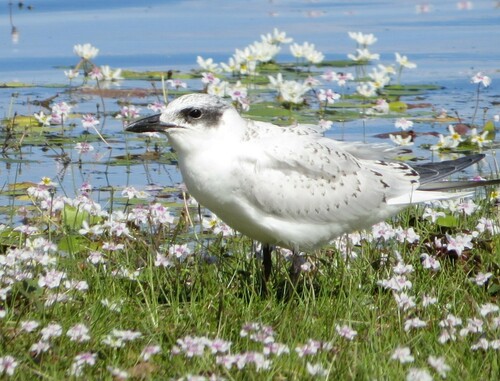
Australian Tern

Australian Tern

Gelochelidon macrotarsa

Daily sighting probability <5% · Rare
at Daintree National Park

In 3 days ~10% in a week ~20%

51 Verified sightings at Daintree National Park From 2019 to 2026
219 In all 5 parks
October Best month
☀️ Diurnal When it's spotted

About the Australian Tern

The Australian tern or Australian gull-billed tern (Gelochelidon macrotarsa) is a tern in the family Laridae, native to Australia. The genus name is from Ancient Greek gelao, "to laugh", and khelidon, "swallow". John Gould described Sterna macrotarsa from a specimen held at King's College, London in 1837. Although first described as a species, throughout most of the 20th and early 21st centuries it was generally considered to be a subspecies of the gull-billed tern, but was re-elevated to species status by the IOC World Bird List in 2019 in its Version 9.2.

This is a fairly large and powerful tern, similar in size and general appearance to a Sandwich tern, but the short thick gull-like bill, broad wings, long legs and robust body are distinctive. The summer adult has pale grey upperparts, white underparts, a black cap, strong black bill and black legs. The call is a characteristic ker-wik. It is 33–42 cm (13–17 in) in length and 76–91 cm (30–36 in) in wingspan. Its weight ranges from 150–292 g (5.3–10.3 oz). It differs from the closely related gull-billed tern in being slightly larger, paler grey above, and with an obviously larger, heavier bill.

In... Wikipedia →

Global Distribution

Parks Where Found

# Park Country Daily sighting probability
1 Cape Range 🇦🇺 Australia
~10%
2 Ningaloo Marine Park 🇦🇺 Australia
~10%
3 Noosa National Park 🇦🇺 Australia
~10%
4 Kakadu National Park 🇦🇺 Australia
~10%
5 Daintree National Park 🇦🇺 Australia
<5%

Cities Where Found

# City Country Daily sighting probability
1 Brisbane 🇦🇺 Australia
<5%

Before you go

What are the chances of seeing an Australian Tern in Daintree National Park?

Rare

Under 5% of wildlife watchers report an Australian Tern sighting in Daintree National Park on a given day, based on 51 verified sightings from GBIF citizen-science data from 2019 to 2026. It is the 111th most-seen of the 208 birds we can rate there. Over three days the chance rises to about 10%, and over a week to about 20%, if each day is a fresh chance.

When is the best time to see an Australian Tern in Daintree National Park?

October

In that month about 10% of wildlife watchers report an Australian Tern in Daintree National Park on a given day, against under 5% in November to September, the lowest months. That is one of Daintree National Park's driest months, with about 50 mm of rain against 380 mm in January.

What time of day is best to see an Australian Tern?

Between noon and 3 pm

Across all the parks we cover, that three-hour window holds the most Australian Tern sightings with a recorded time, and nearly all of them come between 6 am and 6 pm: it is a daytime animal.

Is Daintree National Park the best place to see an Australian Tern?

5th of 5

Of the 5 parks where we can rate Australian Tern sightings, Daintree National Park ranks 5th at under 5%. The best odds are in Cape Range (Australia, about 10%), Ningaloo Marine Park (Australia, about 10%) and Noosa National Park (Australia, about 10%).

Where does the Australian Tern sighting chance come from?

GBIF citizen-science records

It is estimated from how often the Australian Tern is recorded against all the birds logged in Daintree National Park (51 verified sightings from 2019 to 2026), calibrated against known sighting rates. Figures are rounded to the nearest 10% because citizen-science data supports honest approximations, not decimals, and months with records from fewer than five people show "—". How it works.

← Back to Daintree National Park