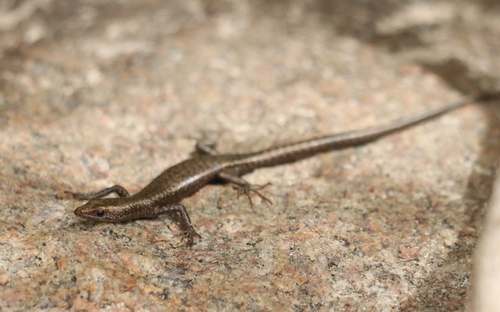
Closed-litter Rainbow Skink

Closed-litter Rainbow Skink

Carlia longipes

Silhouette: David Orr · PhyloPic

LCLeast ConcernNTVUENCR
Daily sighting probability ~40% · Likely
at Daintree National Park

In 3 days ~80% in a week >90%

94 Verified sightings at Daintree National Park From 2019 to 2026
94 In 1 park
January Best month
🌙 Nocturnal When it's spotted

About the Closed-litter Rainbow Skink

Carlia longipes is a species of skink, commonly known as closed-litter rainbow-skink, in the subfamily Eugongylinae. An Australian skink found in open forest and the edges of rainforest, from Hinchinbrook Island to Cooktown in north-east Queensland, Cape York Peninsula and eastern Arnhem Land in the Northern Territory.

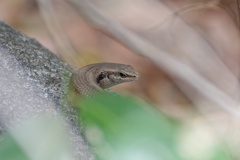
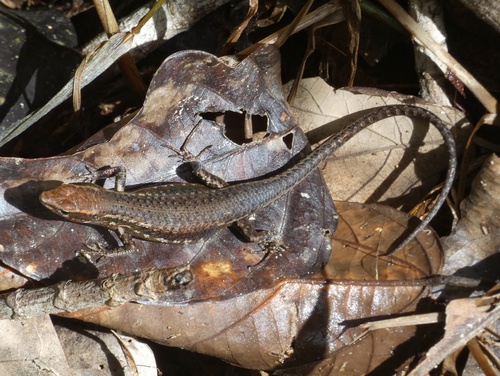
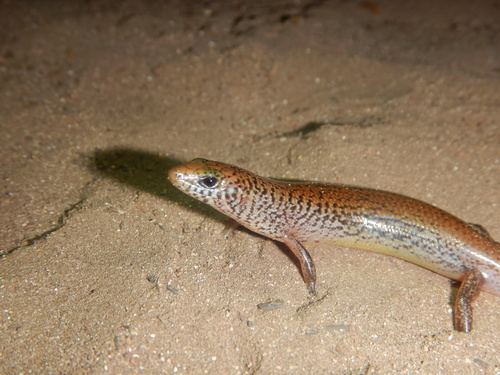
It has a snout to vent length of 55mm, with four fingers and five toes. The ear opening is vertical or circular with pointed scales on the front edge. The body is brown with bronze sides, and a black stripe runs from the nostril to behind the foreleg. The back scales have a rounded hind edge, and the breeding male has a white throat. A similar species is Carlia rostralis.

Australian Biological Resources Study Wikipedia →

Global Distribution

Parks Where Found

# Park Country Daily sighting probability
1 Daintree National Park 🇦🇺 Australia
~40%

More parks will be added in future updates.

Closest Relatives at Daintree National Park

Before you go

What are the chances of seeing a Closed-litter Rainbow Skink in Daintree National Park?

Likely

About 40% of wildlife watchers report a Closed-litter Rainbow Skink sighting in Daintree National Park on a given day, based on 94 verified sightings from GBIF citizen-science data from 2019 to 2026. It is the 8th most-seen of the 31 reptiles we can rate there. Over three days the chance rises to about 80%, and over a week to over 90%, if each day is a fresh chance.

When is the best time to see a Closed-litter Rainbow Skink in Daintree National Park?

January

In that month about 60% of wildlife watchers report a Closed-litter Rainbow Skink in Daintree National Park on a given day, against about 20% in April and June, the lowest months. That is one of Daintree National Park's wettest months, with about 380 mm of rain against 50 mm in September.

What time of day is best to see a Closed-litter Rainbow Skink?

Between 4 and 7 am

Across all the parks we cover, that three-hour window holds the most Closed-litter Rainbow Skink sightings with a recorded time, and about 8 in 10 of them come between 6 pm and 6 am: it is mostly seen at night.

Where else can you see a Closed-litter Rainbow Skink?

Only Daintree National Park, in our data

Daintree National Park is the only park on Wallace's Line with enough records to rate Closed-litter Rainbow Skink sightings: about 40% of wildlife watchers there report one on a given day.

Where does the Closed-litter Rainbow Skink sighting chance come from?

GBIF citizen-science records

It is estimated from how often the Closed-litter Rainbow Skink is recorded against all the reptiles logged in Daintree National Park (94 verified sightings from 2019 to 2026), calibrated against known sighting rates. Figures are rounded to the nearest 10% because citizen-science data supports honest approximations, not decimals, and months with records from fewer than five people show "—". How it works.

← Back to Daintree National Park