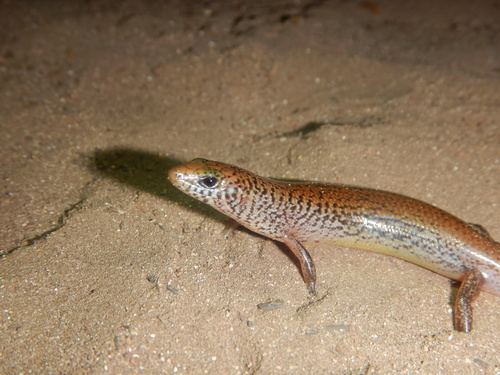
Cream-striped Shining-skink

Cream-striped Shining-skink

Cryptoblepharus virgatus

Silhouette: David Orr · PhyloPic

LCLeast ConcernNTVUENCR
Daily sighting probability ~10% · With luck
at Daintree National Park

In 3 days ~30% in a week ~50%

10 Verified sightings at Daintree National Park From 2019 to 2026
10 In 1 park
August Best month
☀️ Diurnal When it's spotted

About the Cream-striped Shining-skink

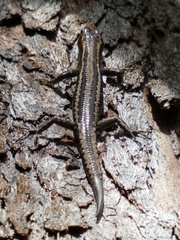
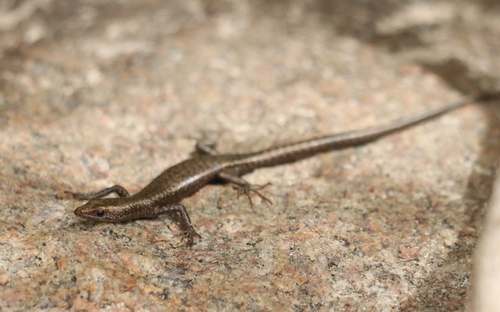
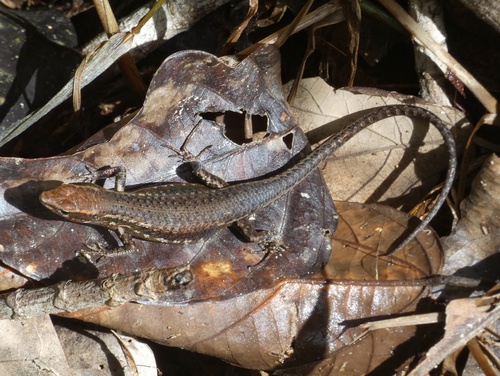
Cryptoblepharus virgatus, also commonly known as the striped snake-eyed skink, cream-striped shinning-skink, wall skink, fence skink, and snake-eyed skink, is a species of lizard in the subfamily Eugongylinae of the family Scincidae (skinks). The species is native to northeastern Queensland, Australia. It is an active little lizard, and if threatened will often play dead to confuse the attacker.

Cryptoblepharus virgatus is a relatively small, flat-bodied skink of a silver-gray coloring. It has a distinct white stripe running along the body from the eye to the base of the tail. It typically grows to a snout-to-vent length (SVL) of around 4 cm (1.6 in) and a total length (tail included) of around 10 cm (3.9 in). It is sometimes called a snake-eyed skink because it lacks eyelids, instead having a translucent layer of scales covering its eyes similar to that of snakes. C. virgatus usually has five supraciliary scales, 22 rows of scales around the body at midbody, and eight plantar scales that are rounded and pale.

The species Cryptoblepharus virgatus was first formally identified and named Ablepharus virgatus by the herpetologist Samuel Garman in 1901 as... Wikipedia →

Global Distribution

Parks Where Found

# Park Country Daily sighting probability
1 Daintree National Park 🇦🇺 Australia
~10%

More parks will be added in future updates.

Closest Relatives at Daintree National Park

Before you go

What are the chances of seeing a Cream-striped Shining-skink in Daintree National Park?

With luck

About 10% of wildlife watchers report a Cream-striped Shining-skink sighting in Daintree National Park on a given day, based on 10 verified sightings from GBIF citizen-science data from 2019 to 2026. It is the 25th most-seen of the 31 reptiles we can rate there. Over three days the chance rises to about 30%, and over a week to about 50%, if each day is a fresh chance.

When is the best time to see a Cream-striped Shining-skink in Daintree National Park?

February and August

In those months about 20% of wildlife watchers report a Cream-striped Shining-skink in Daintree National Park on a given day, against under 5% in March–April and October–January, the lowest months.

What time of day is best to see a Cream-striped Shining-skink?

Between 10 am and 1 pm

Across all the parks we cover, that three-hour window holds the most Cream-striped Shining-skink sightings with a recorded time, and about 9 in 10 of them come between 6 am and 6 pm: it is a daytime animal.

Where else can you see a Cream-striped Shining-skink?

Only Daintree National Park, in our data

Daintree National Park is the only park on Wallace's Line with enough records to rate Cream-striped Shining-skink sightings: about 10% of wildlife watchers there report one on a given day.

Where does the Cream-striped Shining-skink sighting chance come from?

GBIF citizen-science records

It is estimated from how often the Cream-striped Shining-skink is recorded against all the reptiles logged in Daintree National Park (10 verified sightings from 2019 to 2026), calibrated against known sighting rates. Figures are rounded to the nearest 10% because citizen-science data supports honest approximations, not decimals, and months with records from fewer than five people show "—". How it works.

← Back to Daintree National Park