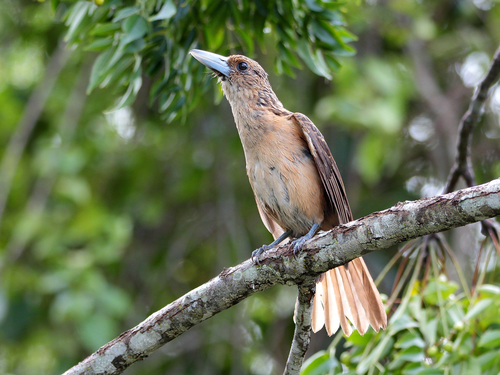
Red-necked Crake

Red-necked Crake

Rallina tricolor

Silhouette: Sheatherius · PhyloPic

LCLeast ConcernNTVUENCR
Daily sighting probability <5% · Rare
at Daintree National Park

In 3 days ~10% in a week ~20%

41 Verified sightings at Daintree National Park From 2019 to 2026
71 In all 2 parks
March Best month
🌅 Crepuscular When it's spotted

About the Red-necked Crake

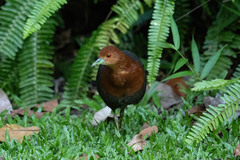
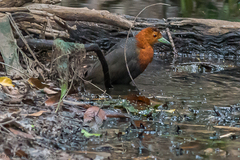
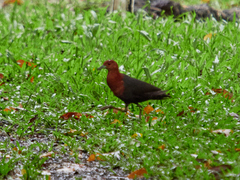
The red-necked crake (Rallina tricolor) is a waterbird in the rail and crake family, Rallidae. The red-necked crake is a large crake (length 25 cm, wingspan 40 cm, weight 200 g). Its head, neck and breast are red-brown, with a paler version of that color on the throat. The upperparts are grey-brown, while the underparts are grey-brown with pale barring. The underwing is barred black and white, the bill green, and the legs grey-brown.

Red-necked crakes live in the Moluccas, Lesser Sundas, New Guinea lowlands and adjacent islands, and north-eastern Australia. They are found in tropical rainforests and dense vegetation close to permanent wetlands. The bird's diet consists of amphibians, aquatic invertebrates, crustaceans and molluscs.

The bird rests on or close to ground in dense vegetation. It lays clutches of 3-5 dull-white eggs, the incubation periods of which are around 20 days. The chicks emerge covered in black down, precocial and nidifugous. The crake makes repetitive clicking calls and soft grunts.

With a large range and no evidence of significant decline, this... Wikipedia →

Sounds

Call0:22

Australia · 2025

© Peter Boesman · XC1066904 · CC BY-NC-ND 4.0

Song0:14

Papua New Guinea · 2017

© Iain Woxvold · XC558628 · CC BY-NC-SA 4.0

Call0:07

Australia · 2022

© Marc Anderson · XC816167 · CC BY-NC-ND 4.0

Global Distribution

Parks Where Found

# Park Country Daily sighting probability
1 Raja Ampat 🇮🇩 Indonesia
<5%
2 Daintree National Park 🇦🇺 Australia
<5%

Before you go

What are the chances of seeing a Red-necked Crake in Daintree National Park?

Rare

Under 5% of wildlife watchers report a Red-necked Crake sighting in Daintree National Park on a given day, based on 41 verified sightings from GBIF citizen-science data from 2019 to 2026. It is the 121st most-seen of the 208 birds we can rate there. Over three days the chance rises to about 10%, and over a week to about 20%, if each day is a fresh chance.

When is the best time to see a Red-necked Crake in Daintree National Park?

March and December

In those months about 10% of wildlife watchers report a Red-necked Crake in Daintree National Park on a given day, against under 5% in January–February and April–November, the lowest months. Those are among Daintree National Park's wettest months, with about 320 mm of rain a month against 50 mm in September.

What time of day is best to see a Red-necked Crake?

Between 5 and 8 pm

Across all the parks we cover, that three-hour window holds the most Red-necked Crake sightings with a recorded time, and about 6 in 10 of them come between 6 am and 6 pm: it is most active around dawn and dusk.

Is Daintree National Park the best place to see a Red-necked Crake?

Among the best

Of the 2 parks where we can rate Red-necked Crake sightings, Daintree National Park ranks 2nd at under 5%, level with the leaders once rounded. The best odds are in Raja Ampat (Indonesia, under 5%).

Where does the Red-necked Crake sighting chance come from?

GBIF citizen-science records

It is estimated from how often the Red-necked Crake is recorded against all the birds logged in Daintree National Park (41 verified sightings from 2019 to 2026), calibrated against known sighting rates. Figures are rounded to the nearest 10% because citizen-science data supports honest approximations, not decimals, and months with records from fewer than five people show "—". How it works.

← Back to Daintree National Park