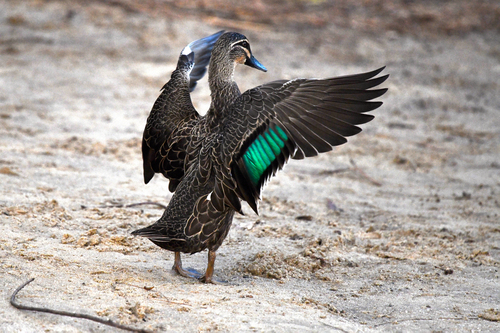
Wandering Whistling Duck

Wandering Whistling Duck

Dendrocygna arcuata

Silhouette: Sheatherius · PhyloPic

LCLeast ConcernNTVUENCR
Daily sighting probability <5% · Rare
at Daintree National Park

In 3 days <5% in a week ~10%

22 Verified sightings at Daintree National Park From 2019 to 2026
848 In all 4 parks
December Best month
☀️ Diurnal When it's spotted

About the Wandering Whistling Duck

The wandering whistling duck (Dendrocygna arcuata) is a species of whistling duck. They inhabit tropical and subtropical Australia, the Philippines, Borneo, Indonesia, Papua New Guinea, Timor-Leste, and the Pacific Islands.

Formerly named tree ducks, the wandering whistling duck has its new name because of their loud whistling calls and the whistling noise their wings make during flight. They have long necks and legs and look like a cross between a goose and a duck. They have a strong head and neck with a darker crown and hindneck. The breast contains black spotting and the feathers are mostly dark brown. They range in size from 54–60 cm in height and weigh on average 750 grams. They mainly feed on grasses, waterlilies, water plants and occasionally insects and aquatic vertebrae.

The wandering whistling duck lives in deep lagoons, flooded grasslands or dams. They enjoy the water and rarely leave the shore. They can swim... Wikipedia →

Sounds

Call0:58

Australia · 2025

© Peter Boesman · XC1066526 · CC BY-NC-ND 4.0

Flight call0:31

Australia · 2021

© James Lambert · XC673069 · CC BY-NC-ND 4.0

Uncertain0:15

Australia · 2022

© nick talbot · XC760751 · CC BY-NC-SA 4.0

Global Distribution

Parks Where Found

# Park Country Daily sighting probability
1 Kakadu National Park 🇦🇺 Australia
~40%
2 Litchfield National Park 🇦🇺 Australia
~10%
3 Kinabatangan Wildlife Sanctuary 🇲🇾 Malaysia
<5%
4 Daintree National Park 🇦🇺 Australia
<5%

Cities Where Found

# City Country Daily sighting probability
1 Semarang 🇮🇩 Indonesia
~10%
2 Perth 🇦🇺 Australia
~10%
3 Brisbane 🇦🇺 Australia
~10%
4 Manila 🇵🇭 Philippines
<5%
5 Jakarta 🇮🇩 Indonesia
<5%

Zoos & Centres Where Found

# Zoo / Centre Country
1 Natural Bridge Wildlife Ranch 🇺🇸 United States In captivity
2 Living Desert Zoo and Gardens 🇺🇸 United States In captivity
3 Fort Worth Zoo 🇺🇸 United States In captivity
4 Taronga Zoo 🇦🇺 Australia In captivity
5 Centro Cicogne e Anatidi 🇮🇹 Italy In captivity
6 Gembira Loka Zoo 🇮🇩 Indonesia In captivity
7 Adelaide Zoo 🇦🇺 Australia In captivity
8 Mogo Wildlife Park 🇦🇺 Australia In captivity
9 Mogo Zoo 🇦🇺 Australia In captivity
10 Albay Park and Wildlife 🇵🇭 Philippines In captivity
11 Bali Bird Park 🇮🇩 Indonesia In captivity
12 Birdworld Kuranda 🇦🇺 Australia In captivity
13 Kuranda Koala Gardens 🇦🇺 Australia In captivity
14 Wildlife Habitat Port Douglas 🇦🇺 Australia In captivity

Before you go

What are the chances of seeing a Wandering Whistling Duck in Daintree National Park?

Rare

Under 5% of wildlife watchers report a Wandering Whistling Duck sighting in Daintree National Park on a given day, based on 22 verified sightings from GBIF citizen-science data from 2019 to 2026. It is the 151st most-seen of the 208 birds we can rate there. Over three days the chance rises to under 5%, and over a week to about 10%, if each day is a fresh chance.

When is the best time to see a Wandering Whistling Duck in Daintree National Park?

December

In that month about 10% of wildlife watchers report a Wandering Whistling Duck in Daintree National Park on a given day, against under 5% in January to November, the lowest months. That is one of Daintree National Park's wettest months, with about 300 mm of rain against 50 mm in September.

What time of day is best to see a Wandering Whistling Duck?

Between 7 and 10 am

Across all the parks we cover, that three-hour window holds the most Wandering Whistling Duck sightings with a recorded time, and about 9 in 10 of them come between 6 am and 6 pm: it is a daytime animal.

Where does the Wandering Whistling Duck sighting chance come from?

GBIF citizen-science records

It is estimated from how often the Wandering Whistling Duck is recorded against all the birds logged in Daintree National Park (22 verified sightings from 2019 to 2026), calibrated against known sighting rates. Figures are rounded to the nearest 10% because citizen-science data supports honest approximations, not decimals, and months with records from fewer than five people show "—". How it works.

← Back to Daintree National Park