Water Python

Water Python

Liasis fuscus

Silhouette: SeismicShrimp · PhyloPic

LCLeast ConcernNTVUENCR
Daily sighting probability ~20% · Possible
at Daintree National Park

In 3 days ~50% in a week ~80%

35 Verified sightings at Daintree National Park From 2019 to 2026
62 In all 2 parks
January Best month
🌙 Nocturnal When it's spotted

About the Water Python

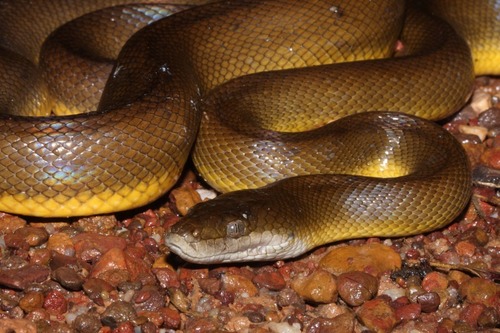
The water python (Liasis fuscus) is a python species found in Australia and Papua New Guinea. No subspecies are currently recognized. Like all other pythons, it is not venomous. German naturalist Wilhelm Peters described the water python in 1873. It is also known as the brown water python.

Adults average about 6–8 feet (2+ meters) in length, but may reach 10 feet (3.0 meters). Robustly built, it has a long head that is slightly distinct from the neck. The anterior supralabials have thermosensitive pits. Scalation includes a pair of undivided parietal scales and a single loreal scale on either side of the head. On the body, the dorsal scales number 45-55 at midbody, the ventral scales 270-300, the anal scale is single, with 60-90 paired subcaudal scales.

The color pattern consists of a uniform, iridescent dark blackish brown dorsal color. The belly is a dull to bright yellow that includes the first few rows of dorsal scales. The throat is cream colored, while the upper labials are light gray-brown with dark brown or black spots.

They are found in Australia in the Kimberley district of northern Western Australia from around... Wikipedia →
Global Distribution

Parks Where Found

# Park Country Daily sighting probability
1 Kakadu National Park 🇦🇺 Australia
~30%
2 Daintree National Park 🇦🇺 Australia
~20%

Zoos & Centres Where Found

# Zoo / Centre Country
1 Prague Zoo 🇨🇿 Czechia In captivity
2 Berlin Zoological Garden 🇩🇪 Germany In captivity
3 Perth Zoo 🇦🇺 Australia In captivity
4 Hartley’s Crocodile Adventures 🇦🇺 Australia In captivity
5 Zagreb Zoo 🇭🇷 Croatia In captivity
6 Featherdale Sydney Wildlife Park 🇦🇺 Australia In captivity
7 Cairns Aquarium 🇦🇺 Australia In captivity
8 Aquarium Berlin 🇩🇪 Germany In captivity
9 National Aquarium 🇺🇸 United States In captivity
10 Rákosův pavilon 🇨🇿 Czechia In captivity
11 Velemlokárium 🇨🇿 Czechia In captivity
12 Caversham Wildlife Park 🇦🇺 Australia In captivity

Before you go

What are the chances of seeing a Water Python in Daintree National Park?

Possible

About 20% of wildlife watchers report a Water Python sighting in Daintree National Park on a given day, based on 35 verified sightings from GBIF citizen-science data from 2019 to 2026. It is the 18th most-seen of the 31 reptiles we can rate there. Over three days the chance rises to about 50%, and over a week to about 80%, if each day is a fresh chance.

When is the best time to see a Water Python in Daintree National Park?

January

In that month about 40% of wildlife watchers report a Water Python in Daintree National Park on a given day, against under 5% in February to April, the lowest months. That is one of Daintree National Park's wettest months, with about 380 mm of rain against 50 mm in September.

What time of day is best to see a Water Python?

Between 7 and 10 pm

Across all the parks we cover, that three-hour window holds the most Water Python sightings with a recorded time, and about 8 in 10 of them come between 6 pm and 6 am: it is mostly seen at night.

Is Daintree National Park the best place to see a Water Python?

2nd of 2

Of the 2 parks where we can rate Water Python sightings, Daintree National Park ranks 2nd at about 20%. The best odds are in Kakadu National Park (Australia, about 30%).

Which relatives of the Water Python live in Daintree National Park?

Same family: Pythonidae

The closest relatives of the Water Python that you can see in Daintree National Park (family Pythonidae, Pythons) are Australian Scrub Python (about 50%) and Carpet Python (about 30%), with each one's daily chance of a sighting.

Where does the Water Python sighting chance come from?

GBIF citizen-science records

It is estimated from how often the Water Python is recorded against all the reptiles logged in Daintree National Park (35 verified sightings from 2019 to 2026), calibrated against known sighting rates. Figures are rounded to the nearest 10% because citizen-science data supports honest approximations, not decimals, and months with records from fewer than five people show "—". How it works.

← Back to Daintree National Park