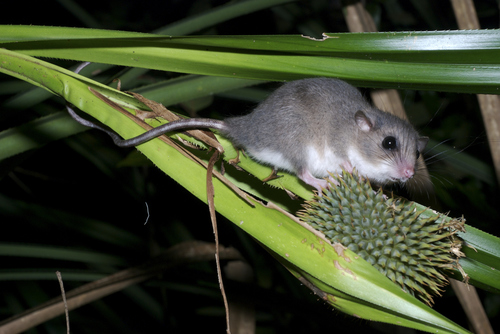
White-tailed Giant Rat

White-tailed Giant Rat

Uromys caudimaculatus

Silhouette: T. Michael Keesey · PhyloPic

LCLeast ConcernNTVUENCR
Daily sighting probability ~20% · Possible
at Daintree National Park

In 3 days ~60% in a week ~90%

38 Verified sightings at Daintree National Park From 2019 to 2026
38 In 1 park
February Best month
☀️ Diurnal When it's spotted

About the White-tailed Giant Rat

The giant white-tailed rat (Uromys caudimaculatus) is an Australian rodent native to tropical rainforest of north Queensland, Australia with subspecies occurring in New Guinea and the Aru Islands. It is one of the largest rodents in Australia, reaching up to 1 kg in weight. It is grey-brown above, cream to white below, and has a long, naked tail of which the distal section is white (Moore 1995).

Breeding commences in September or October, peaking in December and January at the height of the wet season. After a gestation of 36 days, a litter of two to three (rarely four) young are born, and remain with the mother for approximately three months (Moore 1995).

The common name of this species has long been white-tailed rat or giant white-tailed rat. During the 1990s there was a push for such descriptive English common names to be replaced with indigenous Australian names, and accordingly, in 1995 the Australian Nature Conservation Agency published recommendations for the common names of rodents. They compiled six indigenous names for this species: the Yidiny name Durrgim; the Jaabugay name Durrkin; the Gnog names Jikoy, Koojang and Parrongkai; and the Kuuku Ya'u name... Wikipedia →

Global Distribution

Parks Where Found

# Park Country Daily sighting probability
1 Daintree National Park 🇦🇺 Australia
~20%

More parks will be added in future updates.

Before you go

What are the chances of seeing a White-tailed Giant Rat in Daintree National Park?

Possible

About 20% of wildlife watchers report a White-tailed Giant Rat sighting in Daintree National Park on a given day, based on 38 verified sightings from GBIF citizen-science data from 2019 to 2026. It is the 4th most-seen of the 19 mammals we can rate there. Over three days the chance rises to about 60%, and over a week to about 90%, if each day is a fresh chance.

When is the best time to see a White-tailed Giant Rat in Daintree National Park?

February, May–June, September and November–December

In those months about 30% of wildlife watchers report a White-tailed Giant Rat in Daintree National Park on a given day, against under 5% in March, the lowest month.

What time of day is best to see a White-tailed Giant Rat?

Between 11 am and 2 pm

Across all the parks we cover, that three-hour window holds the most White-tailed Giant Rat sightings with a recorded time, and about 8 in 10 of them come between 6 am and 6 pm: it is a daytime animal.

Where else can you see a White-tailed Giant Rat?

Only Daintree National Park, in our data

Daintree National Park is the only park on Wallace's Line with enough records to rate White-tailed Giant Rat sightings: about 20% of wildlife watchers there report one on a given day.

Which relatives of the White-tailed Giant Rat live in Daintree National Park?

Same family: Muridae

The closest relatives of the White-tailed Giant Rat that you can see in Daintree National Park (family Muridae, Old World Mice and Rats) are Fawn-footed Melomys (about 20%), Chestnut Tree Mouse (about 10%) and Rakali (about 10%), with each one's daily chance of a sighting.

Where does the White-tailed Giant Rat sighting chance come from?

GBIF citizen-science records

It is estimated from how often the White-tailed Giant Rat is recorded against all the mammals logged in Daintree National Park (38 verified sightings from 2019 to 2026), calibrated against known sighting rates. Figures are rounded to the nearest 10% because citizen-science data supports honest approximations, not decimals, and months with records from fewer than five people show "—". How it works.

← Back to Daintree National Park