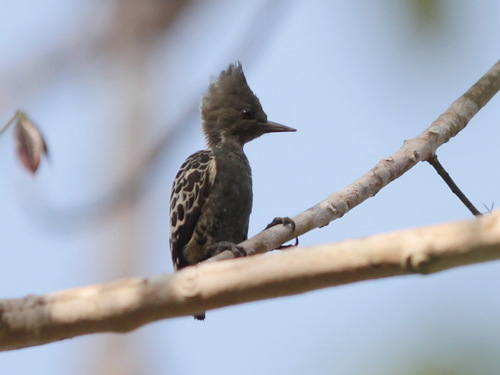
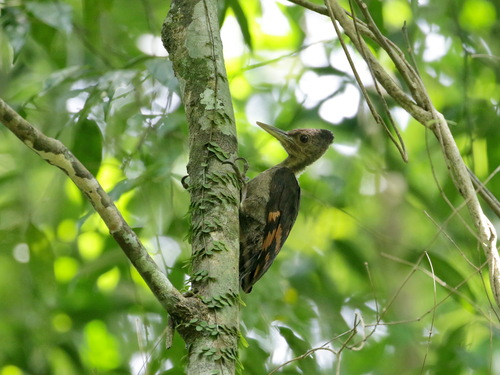
Buff-necked Woodpecker

Buff-necked Woodpecker

Meiglyptes tukki

Silhouette: Pepe Reigada · PhyloPic

LCNTNear ThreatenedVUENCR
Daily sighting probability ~20% · Possible
at Danum Valley Conservation Area

In 3 days ~40% in a week ~70%

252 Verified sightings at Danum Valley Conservation Area From 2019 to 2026
1,082 In all 8 parks
October Best month
🌅 Crepuscular When it's spotted

About the Buff-necked Woodpecker

The buff-necked woodpecker (Meiglyptes tukki) is a species of bird in the family Picidae. Meiglyptes tukki was first described by the French ornithologist René Primevère Lesson in 1839 as Picus tukki. It has four subspecies: Meiglyptes tukki tukki, Meiglyptes tukki percnerpes, Meiglyptes tukki batu, and Meiglyptes tukki pulonis.

Meiglyptes tukki is small and dark brown with pale wing barring and a dirty-cream stripe on the neck. It has a pointed bill which is curved along the culmen. It is slightly heavier than its close relative Meiglyptes tristis and has a significantly longer tail. M. tukki is distinguished from its closest relatives by the lack of a nuchal crest.

A 1978 survey of fourteen individuals recorded mean body mass of 53g and a mean wing length of 101mm. The mean bill length, width, and depth noted in the 1978 survey were 22.68mm, 8.66mm, and 7.98mm, respectively. M. tukki is found in Brunei, Indonesia, Malaysia, Myanmar, Singapore, and Thailand.

It inhabits primary evergreen and semi-evergreen lowland forests and peat swamp forests. M. tukki primarily forages by surface gleaning and probing... Wikipedia →

Sounds

Drumming0:49

Malaysia · 2026

© Ding Li Yong · XC1153888 · CC BY-NC-ND 4.0

Call1:16

Malaysia · 2023

© Joshua Chong · XC808244 · CC BY-NC-SA 4.0

Song0:16

Malaysia · 2015

© Marc Anderson · XC269850 · CC BY-NC-ND 4.0

Global Distribution

Parks Where Found

# Park Country Daily sighting probability
1 Way Kambas National Park 🇮🇩 Indonesia
~40%
2 Taman Negara National Park 🇲🇾 Malaysia
~20%
3 Danum Valley Conservation Area 🇲🇾 Malaysia
~20%
4 Sepilok 🇲🇾 Malaysia
~10%
5 Khao Luang National Park 🇹🇭 Thailand
~10%
6 Kinabatangan Wildlife Sanctuary 🇲🇾 Malaysia
<5%
7 Gunung Leuser National Park 🇮🇩 Indonesia
<5%
8 Kinabalu Park 🇲🇾 Malaysia
<5%

Cities Where Found

# City Country Daily sighting probability
1 Kuala Lumpur 🇲🇾 Malaysia
<5%

Before you go

What are the chances of seeing a Buff-necked Woodpecker in Danum Valley Conservation Area?

Possible

About 20% of wildlife watchers report a Buff-necked Woodpecker sighting in Danum Valley Conservation Area on a given day, based on 252 verified sightings from GBIF citizen-science data from 2019 to 2026. It is the 86th most-seen of the 258 birds we can rate there. Over three days the chance rises to about 40%, and over a week to about 70%, if each day is a fresh chance.

When is the best time to see a Buff-necked Woodpecker in Danum Valley Conservation Area?

October

In that month about 30% of wildlife watchers report a Buff-necked Woodpecker in Danum Valley Conservation Area on a given day, against about 10% in February, April, June–July and November–December, the lowest months.

What time of day is best to see a Buff-necked Woodpecker?

Between 2 and 5 am

Across all the parks we cover, that three-hour window holds the most Buff-necked Woodpecker sightings with a recorded time, and about 6 in 10 of them come between 6 pm and 6 am: it is most active around dawn and dusk.

Is Danum Valley Conservation Area the best place to see a Buff-necked Woodpecker?

3rd of 8

Of the 8 parks where we can rate Buff-necked Woodpecker sightings, Danum Valley Conservation Area ranks 3rd at about 20%. The best odds are in Way Kambas National Park (Indonesia, about 40%) and Taman Negara National Park (Malaysia, about 20%).

Where does the Buff-necked Woodpecker sighting chance come from?

GBIF citizen-science records

It is estimated from how often the Buff-necked Woodpecker is recorded against all the birds logged in Danum Valley Conservation Area (252 verified sightings from 2019 to 2026), calibrated against known sighting rates. Figures are rounded to the nearest 10% because citizen-science data supports honest approximations, not decimals, and months with records from fewer than five people show "—". How it works.

← Back to Danum Valley Conservation Area