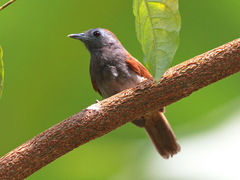
Chestnut-winged Babbler

Chestnut-winged Babbler

Stachyris erythroptera

Silhouette: Jiekun He · PhyloPic

Daily sighting probability ~40% · Likely
at Danum Valley Conservation Area

In 3 days ~70% in a week >90%

565 Verified sightings at Danum Valley Conservation Area From 2019 to 2026
2,743 In all 10 parks
October Best month
🌅 Crepuscular When it's spotted

About the Chestnut-winged Babbler

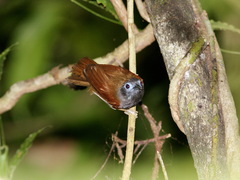
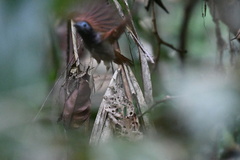
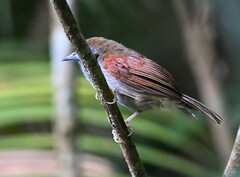
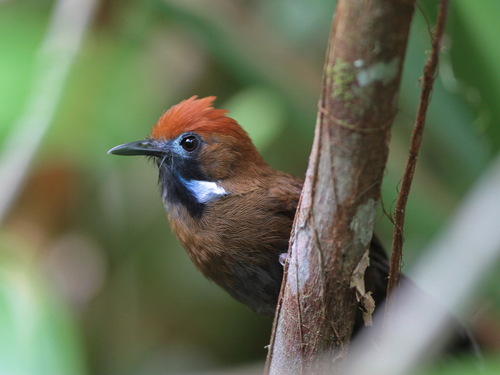
The chestnut-winged babbler (Cyanoderma erythropterum) is a babbler species in the family Timaliidae. The chestnut-winged babbler is chestnut-brown with a greyish face and underparts, and is 12.5–13.5 cm (4.9–5.3 in) long. It feeds on small Coleoptera beetles, Phasmida insects, ants, and Hemiptera bugs. Its foraging strategy is gleaning.

Timalia erythroptera was the scientific name proposed by Edward Blyth in 1842 for an olive-brown babbler from Nepal. It was later placed in the genus Stachyris, but since 2020 is recognised as a Cyanoderma species. The grey-hooded babbler (C. bicolor) of Borneo was formerly considered conspecific.

The chestnut-winged babbler occurs in the Malay Peninsula from southern Thailand to Singapore, and in Sumatra. It inhabits forests and shrublands up to an elevation of 800 m (2,600 ft). It is listed as Least Concern on the IUCN Red List.

BirdLife International (2019). "Chestnut-winged Babbler Cyanoderma erythropterum". "Photos of Chestnut-winged Babbler Cyanoderma erythropterum". The Internet Bird Collection. Wikipedia →

Sounds

Recording0:19

Malaysia · 2011

© dbeadle · iNaturalist · CC BY-NC 4.0

Recording0:20

Singapore · 2021

© David Tan · iNaturalist · CC BY-NC 4.0

Recording0:40

Malaysia · 2018

© Tom Visbeek · Observation.org, Nature data from around the World · CC BY-NC-ND 4.0

Global Distribution

Parks Where Found

# Park Country Daily sighting probability
1 Khao Luang National Park 🇹🇭 Thailand
~60%
2 Taman Negara National Park 🇲🇾 Malaysia
~40%
3 Danum Valley Conservation Area 🇲🇾 Malaysia
~40%
4 Sepilok 🇲🇾 Malaysia
~30%
5 Way Kambas National Park 🇮🇩 Indonesia
~30%
6 Khao Sok National Park 🇹🇭 Thailand
~20%
7 Bako National Park 🇲🇾 Malaysia
~10%
8 Gunung Leuser National Park 🇮🇩 Indonesia
~10%
9 Kinabatangan Wildlife Sanctuary 🇲🇾 Malaysia
~10%
10 Kinabalu Park 🇲🇾 Malaysia
<5%

Cities Where Found

# City Country Daily sighting probability
1 Singapore 🇸🇬 Singapore
<5%

Before you go

What are the chances of seeing a Chestnut-winged Babbler in Danum Valley Conservation Area?

Likely

About 40% of wildlife watchers report a Chestnut-winged Babbler sighting in Danum Valley Conservation Area on a given day, based on 565 verified sightings from GBIF citizen-science data from 2019 to 2026. It is the 24th most-seen of the 258 birds we can rate there. Over three days the chance rises to about 70%, and over a week to over 90%, if each day is a fresh chance.

When is the best time to see a Chestnut-winged Babbler in Danum Valley Conservation Area?

October

In that month about 50% of wildlife watchers report a Chestnut-winged Babbler in Danum Valley Conservation Area on a given day, against about 30% in March, May–August and December–January, the lowest months.

What time of day is best to see a Chestnut-winged Babbler?

Between 3 and 6 am

Across all the parks we cover, that three-hour window holds the most Chestnut-winged Babbler sightings with a recorded time, and about 6 in 10 of them come between 6 pm and 6 am: it is most active around dawn and dusk.

Is Danum Valley Conservation Area the best place to see a Chestnut-winged Babbler?

3rd of 10

Of the 10 parks where we can rate Chestnut-winged Babbler sightings, Danum Valley Conservation Area ranks 3rd at about 40%. The best odds are in Khao Luang National Park (Thailand, about 60%) and Taman Negara National Park (Malaysia, about 40%). All parks ranked.

Which relatives of the Chestnut-winged Babbler live in Danum Valley Conservation Area?

Same genus: Stachyris

The closest relatives of the Chestnut-winged Babbler that you can see in Danum Valley Conservation Area (genus Stachyris, Typical Tree-Babblers) are Chestnut-rumped Babbler (about 20%) and Gray-headed Babbler (about 10%), with each one's daily chance of a sighting.

Where does the Chestnut-winged Babbler sighting chance come from?

GBIF citizen-science records

It is estimated from how often the Chestnut-winged Babbler is recorded against all the birds logged in Danum Valley Conservation Area (565 verified sightings from 2019 to 2026), calibrated against known sighting rates. Figures are rounded to the nearest 10% because citizen-science data supports honest approximations, not decimals, and months with records from fewer than five people show "—". How it works.

← Back to Danum Valley Conservation Area