Horned Toad

Horned Toad

Megophrys nasuta

Silhouette: Jose Carlos Arenas-Monroy · PhyloPic

LCLeast ConcernNTVUENCR
Daily sighting probability ~30% · Possible
at Danum Valley Conservation Area

In 3 days ~60% in a week ~90%

14 Verified sightings at Danum Valley Conservation Area From 2019 to 2026
154 In all 3 parks
December Best month
☀️ Diurnal When it's spotted

About the Horned Toad

The long-nosed horned frog (Pelobatrachus nasutus), also known as the Malayan horned frog or Malayan leaf frog, is a species of frog restricted to the rainforest areas of southern Thailand and Peninsular Malaysia to Singapore, Sumatra, and Borneo. However, records from Thailand to the Sunda Shelf may apply to another, possibly unnamed species.

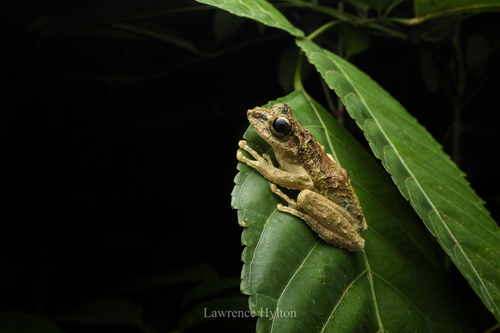
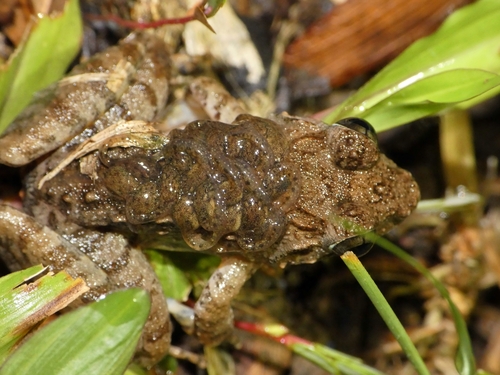
Formerly placed in the genus Megophrys, it was reclassified into the genus Pelobatrachus in 2021. This species is a large frog ranging from 100–120 mm in length. They are light to dark brown on the dorsal surface with varying patterns and camouflage very well with the forest floor. The throat is black-dark brown and diffuses into cream-yellow halfway along the ventral surface. The upper eyelids and snout are drawn out into long triangular projections, forming what looks like "horns", giving them their common name. There are two pairs of dorsolateral skin folds running down this species back. One pair starts behind the eye and ends near the groin, the other pair starts at corner of the eye and ends roughly halfway between the armpit and groin. The dorsum has randomly scattered, enlarged tubercles. Arms and legs... Wikipedia →

Sounds

Recording4:31

2023

© Averroes Oktaliza · iNaturalist · CC BY-NC 4.0

Recording

Malaysia · 2011

© Marc Anderson · Xeno · CC BY-NC-ND 4.0

Global Distribution

Parks Where Found

# Park Country Daily sighting probability
1 Kinabalu Park 🇲🇾 Malaysia
~50%
2 Danum Valley Conservation Area 🇲🇾 Malaysia
~30%
3 Gunung Leuser National Park 🇮🇩 Indonesia
~20%

Before you go

What are the chances of seeing a Horned Toad in Danum Valley Conservation Area?

Possible

About 30% of wildlife watchers report a Horned Toad sighting in Danum Valley Conservation Area on a given day, based on 14 verified sightings from GBIF citizen-science data from 2019 to 2026. It is the 11th most-seen of the 23 amphibians we can rate there. Over three days the chance rises to about 60%, and over a week to about 90%, if each day is a fresh chance.

When is the best time to see a Horned Toad in Danum Valley Conservation Area?

December

In that month about 60% of wildlife watchers report a Horned Toad in Danum Valley Conservation Area on a given day, against under 5% in January, April, June, August–September and November, the lowest months.

What time of day is best to see a Horned Toad?

Between 1 and 4 pm

Across all the parks we cover, that three-hour window holds the most Horned Toad sightings with a recorded time, and about 9 in 10 of them come between 6 am and 6 pm: it is a daytime animal.

Is Danum Valley Conservation Area the best place to see a Horned Toad?

2nd of 3

Of the 3 parks where we can rate Horned Toad sightings, Danum Valley Conservation Area ranks 2nd at about 30%. The best odds are in Kinabalu Park (Malaysia, about 50%).

Which relatives of the Horned Toad live in Danum Valley Conservation Area?

Same family: Megophryidae

The closest relatives of the Horned Toad that you can see in Danum Valley Conservation Area (family Megophryidae, Asian Toads) are Lowland Litter Frog (about 20%) and Twittering Slender Litter Frog (about 10%), with each one's daily chance of a sighting.

Where does the Horned Toad sighting chance come from?

GBIF citizen-science records

It is estimated from how often the Horned Toad is recorded against all the amphibians logged in Danum Valley Conservation Area (14 verified sightings from 2019 to 2026), calibrated against known sighting rates. Figures are rounded to the nearest 10% because citizen-science data supports honest approximations, not decimals, and months with records from fewer than five people show "—". How it works.

← Back to Danum Valley Conservation Area