


Completed


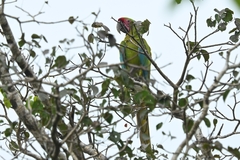

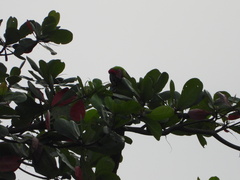

Great Green Macaw
Ara ambiguus
Silhouette: Myriam_Ramirez · PhyloPic
- KingdomAnimalia (Animals)
- PhylumChordata (Chordates)
- ClassAves (Birds)
- OrderPsittaciformes (Parrots)
- FamilyPsittacidae (New World and African Parrots)
- GenusAra
- SpeciesAra ambiguus (Great Green Macaw)
In 3 days ~30% in a week ~60%
16 Verified sightings at Darién National Park From 2019 to 2026
643 In all 6 parks
October Best month
☀️ Diurnal When it's spotted
About the Great Green Macaw
The great green macaw (Ara ambiguus), also known as Buffon's macaw or the great military macaw, is a critically endangered Central and South America parrot found in Nicaragua, Honduras, Costa Rica, Panama, Colombia and Ecuador. Two allopatric subspecies are recognized; the nominate subspecies, Ara ambiguus ssp. ambiguus, occurs from Honduras to Colombia, while Ara ambiguus ssp. guayaquilensis appears to be endemic to remnants of dry forests on the southern Pacific coast of Ecuador. The nominate subspecies lives in the canopy of wet tropical forests and in Costa Rica is usually associated with the almendro tree, Dipteryx oleifera.
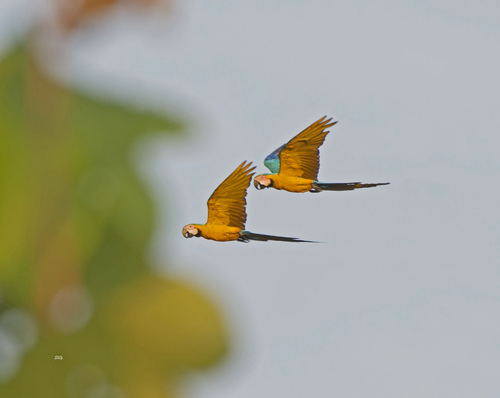
The great green macaw belongs to the genus Ara, which includes other large parrots, such as the scarlet macaw, the military macaw, and the blue-and-yellow macaw. This bird was first described and illustrated in 1801 by the French naturalist François Le Vaillant for his Histoire Naturelle Des Perroquets under the name "le grand Ara militaire", using a skin deposited at the Muséum national d'histoire naturelle in Paris. Le Vaillant states that it is not certain if the bird is truly a distinct species of parrot, or, as he thinks more likely, it... Wikipedia →
Sounds
Recording0:18
Costa Rica · 2025
© Lena Struwe · iNaturalist · CC BY-NC 4.0
Recording0:15
Costa Rica · 2026
© Martin W · iNaturalist · CC BY-NC 4.0
Recording0:10
Costa Rica · 2026
© Luis · iNaturalist · CC BY-NC 4.0
Recent sightings of Great Green Macaw in Darién National Park
LIVEiNaturalistGlobal Distribution
Parks Where Found
| # | Park | Country | Daily sighting probability |
|---|---|---|---|
| 1 | Tortuguero National Park | 🇨🇷 Costa Rica | |
| 2 | Gandoca-Manzanillo Wildlife Refuge | 🇨🇷 Costa Rica | |
| 3 | Cahuita National Park | 🇨🇷 Costa Rica | |
| 4 | Braulio Carrillo National Park | 🇨🇷 Costa Rica | |
| 5 | Darién National Park | 🇵🇦 Panama | |
| 6 | La Amistad International Park (Panama) | 🇵🇦 Panama |
Zoos & Centres Where Found
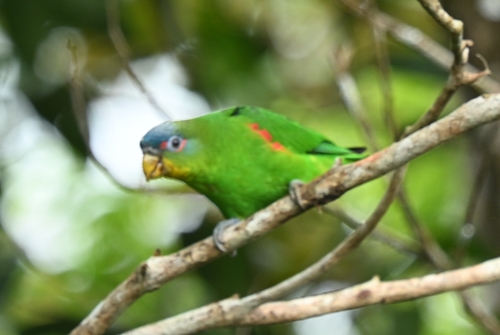
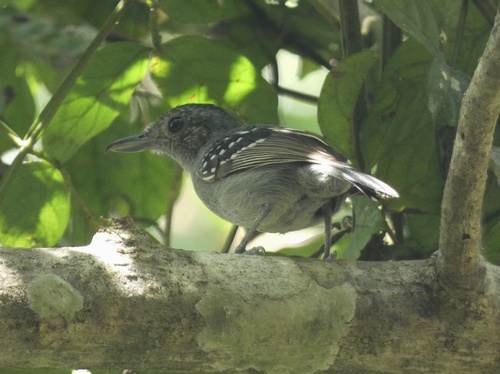
Closest Relatives at Darién National Park







Before you go
What are the chances of seeing a Great Green Macaw in Darién National Park?
With luck
About 10% of wildlife watchers report a Great Green Macaw sighting in Darién National Park on a given day, based on 16 verified sightings from GBIF citizen-science data from 2019 to 2026. It is the 97th most-seen of the 397 birds we can rate there. Over three days the chance rises to about 30%, and over a week to about 60%, if each day is a fresh chance.
When is the best time to see a Great Green Macaw in Darién National Park?
October
In that month about 30% of wildlife watchers report a Great Green Macaw in Darién National Park on a given day, against under 5% in April–June and August–September, the lowest months.
What time of day is best to see a Great Green Macaw?
Between 3 and 6 pm
Across all the parks we cover, that three-hour window holds the most Great Green Macaw sightings with a recorded time, and about 9 in 10 of them come between 6 am and 6 pm: it is a daytime animal.
Is Darién National Park the best place to see a Great Green Macaw?
5th of 6
Of the 6 parks where we can rate Great Green Macaw sightings, Darién National Park ranks 5th at about 10%. The best odds are in Tortuguero National Park (Costa Rica, about 60%), Gandoca-Manzanillo Wildlife Refuge (Costa Rica, about 30%) and Cahuita National Park (Costa Rica, about 30%).
Where does the Great Green Macaw sighting chance come from?
GBIF citizen-science records
It is estimated from how often the Great Green Macaw is recorded against all the birds logged in Darién National Park (16 verified sightings from 2019 to 2026), calibrated against known sighting rates. Figures are rounded to the nearest 10% because citizen-science data supports honest approximations, not decimals, and months with records from fewer than five people show "—". How it works.
