


Completed

Cape Griffon
Gyps coprotheres
Silhouette: Shyamal · PhyloPic
- KingdomAnimalia (Animals)
- PhylumChordata (Chordates)
- ClassAves (Birds)
- OrderAccipitriformes (Hawks, Eagles, Kites, and Allies)
- FamilyAccipitridae (Hawks, Eagles, and Kites)
- GenusGyps (Griffon Vultures)
- SpeciesGyps coprotheres (Cape Griffon)
In 3 days ~70% in a week ~90%
251 Verified sightings at De Hoop Nature Reserve From 2019 to 2026
700 In all 4 parks
September Best month
☀️ Diurnal When it's spotted
About the Cape Griffon
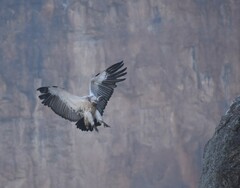
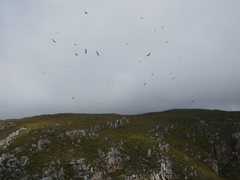
The Cape vulture (Gyps coprotheres), also known as Cape griffon and Kolbe's vulture, is an Old World vulture in the family Accipitridae. It is endemic to southern Africa, and lives mainly in South Africa, Lesotho, Botswana, and in some parts of northern Namibia. It nests on cliffs and lays one egg per year. In 2015, it had been classified as Endangered on the IUCN Red List, but was down-listed to Vulnerable in 2021 as some populations increased and have been stable since about 2016.
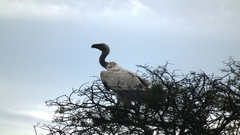
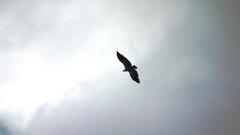
This large vulture is of a creamy-buff colour, with contrasting dark flight and tail feathers. The adult is paler than the juvenile, and its underwing coverts can appear almost white at a distance. The head and neck are near-naked. The eyes are yellowish, and the bill is black. Juveniles and immatures are generally darker and more streaked, with brown to orange eyes and red necks. It closely resembles the white-backed vulture, however it is larger and has yellow irises.
The average length of adult vultures is about 96–115 cm (38–45 in) with a wingspan of 2.26–2.6 m (7 ft 5 in – 8 ft 6 in) and a body weight of 7–11 kg (15–24 lb). The two prominent bare skin patches at the base of the neck... Wikipedia →
Recent sightings of Cape Griffon in De Hoop Nature Reserve
LIVEiNaturalistGlobal Distribution
Parks Where Found
| # | Park | Country | Daily sighting probability |
|---|---|---|---|
| 1 | Golden Gate Highlands National Park | 🇿🇦 South Africa | |
| 2 | De Hoop Nature Reserve | 🇿🇦 South Africa | |
| 3 | Hluhluwe-Imfolozi Park | 🇿🇦 South Africa | |
| 4 | Kruger National Park | 🇿🇦 South Africa |
Zoos & Centres Where Found
| # | Zoo / Centre | Country | |
|---|---|---|---|
| 1 | Kaliningrad Zoo | 🇷🇺 Russia | |
| 2 | Beijing Wildlife Park | 🇨🇳 China | |
| 3 | Living Desert Zoo and Gardens | 🇺🇸 United States | |
| 4 | Cheyenne Mountain Zoo | 🇺🇸 United States | |
| 5 | Yerevan Zoo | 🇦🇲 Armenia | |
| 6 | ABQ BioPark: Zoo, Aquarium, Botanic Garden | 🇺🇸 United States | |
| 7 | Fort Worth Zoo | 🇺🇸 United States | |
| 8 | Crocworld Conservation Centre | 🇿🇦 South Africa | |
| 9 | Dullstroom Bird Of Prey & Rehabilitation Centre | 🇿🇦 South Africa | |
| 10 | Dierenpark Zie-ZOO | 🇳🇱 Netherlands | |
| 11 | World of Birds Wildlife Sanctuary and Monkey Park | 🇿🇦 South Africa | |
| 12 | St. Augustine Alligator Farm Zoological Park | 🇺🇸 United States | |
| 13 | Umgeni River Bird Park | 🇿🇦 South Africa | |
| 14 | Hartbeespoort Dam Snake and Animal Park | 🇿🇦 South Africa | |
| 15 | Cango Wildlife Ranch | 🇿🇦 South Africa | |
| 16 | Gauntlet Birds of Prey | 🇬🇧 United Kingdom | |
| 17 | Moholoholo Wildlife Rehabilitation Centre | 🇿🇦 South Africa |
Closest Relatives at De Hoop Nature Reserve


Before you go
What are the chances of seeing a Cape Griffon in De Hoop Nature Reserve?
Possible
About 30% of wildlife watchers report a Cape Griffon sighting in De Hoop Nature Reserve on a given day, based on 251 verified sightings from GBIF citizen-science data from 2019 to 2026. It is the 48th most-seen of the 189 birds we can rate there. Over three days the chance rises to about 70%, and over a week to about 90%, if each day is a fresh chance.
When is the best time to see a Cape Griffon in De Hoop Nature Reserve?
September
In that month about 50% of wildlife watchers report a Cape Griffon in De Hoop Nature Reserve on a given day, against about 20% in February, April–May and December, the lowest months. June has too few records to rate.
What time of day is best to see a Cape Griffon?
Between 9 am and noon
Across all the parks we cover, that three-hour window holds the most Cape Griffon sightings with a recorded time, and nearly all of them come between 6 am and 6 pm: it is a daytime animal.
Is De Hoop Nature Reserve the best place to see a Cape Griffon?
2nd of 4
Of the 4 parks where we can rate Cape Griffon sightings, De Hoop Nature Reserve ranks 2nd at about 30%. The best odds are in Golden Gate Highlands National Park (South Africa, about 40%).
Which relatives of the Cape Griffon live in De Hoop Nature Reserve?
Same family: Accipitridae
The closest relatives of the Cape Griffon that you can see in De Hoop Nature Reserve (family Accipitridae, Hawks, Eagles, and Kites) are Jackal Buzzard (about 30%), African Fish-Eagle (about 20%) and Black Harrier (about 20%), with each one's daily chance of a sighting.
Where does the Cape Griffon sighting chance come from?
GBIF citizen-science records
It is estimated from how often the Cape Griffon is recorded against all the birds logged in De Hoop Nature Reserve (251 verified sightings from 2019 to 2026), calibrated against known sighting rates. Figures are rounded to the nearest 10% because citizen-science data supports honest approximations, not decimals, and months with records from fewer than five people show "—". How it works.
