


Completed

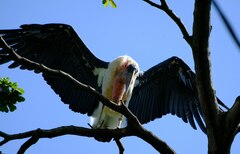


Marabou Stork
Leptoptilos crumenifer
Silhouette: Mike Keesey (vectorization) and Vaibhavcho (photography) · PhyloPic
- KingdomAnimalia (Animals)
- PhylumChordata (Chordates)
- ClassAves (Birds)
- OrderCiconiiformes (Storks)
- FamilyCiconiidae (Storks)
- GenusLeptoptilos (Adjutants and Marabou)
- SpeciesLeptoptilos crumenifer (Marabou Stork)
In 3 days >90%
843 Verified sightings at Lake Nakuru National Park From 2019 to 2026
15,464 In all 39 parks
April Best month
☀️ Diurnal When it's spotted
About the Marabou Stork
The marabou stork (Leptoptilos crumenifer) is a large wading bird in the stork family Ciconiidae native to sub-Saharan Africa. It breeds in both wet and arid habitats, often near human habitation, especially landfill sites. It is sometimes called the "undertaker bird" due to its shape from behind: cloak-like wings and back, skinny white legs, and sometimes a large white mass of "hair". It has often been credited with the largest wingspan of any land bird, with an average of 2.6 metres (8.5 ft) and some recorded examples of up to 3.2 metres (10 ft).
The marabou stork was formally described in 1831 by the French naturalist René Lesson. He placed it in the stork genus Ciconia and coined the binomial name Ciconia crumenifera. He specified that locality as Senegal. The species epithet means "carrying a purse around the neck". The species is now placed with the lesser adjutant and the greater adjutant in the genus Leptoptilos that Lesson had introduced at the same time he described the marabou stork. The species is monotypic: no subspecies are recognised.
The common name marabou is thought to be derived from the Arabic word murābit meaning quiet or hermit-like. The species... Wikipedia →
Recent sightings of Marabou Stork in Lake Nakuru National Park
LIVEiNaturalistGlobal Distribution
Parks Where Found
Zoos & Centres Where Found
Closest Relatives at Lake Nakuru National Park



Before you go
What are the chances of seeing a Marabou Stork in Lake Nakuru National Park?
Very likely
About 70% of wildlife watchers report a Marabou Stork sighting in Lake Nakuru National Park on a given day, based on 843 verified sightings from GBIF citizen-science data from 2019 to 2026. It is the 6th most-seen of the 369 birds we can rate there. Over three days the chance rises to over 90%, if each day is a fresh chance.
When is the best time to see a Marabou Stork in Lake Nakuru National Park?
April to June
In those months about 80% of wildlife watchers report a Marabou Stork in Lake Nakuru National Park on a given day, against about 60% in October and December–January, the lowest months. Those are among Lake Nakuru National Park's wettest months, with about 90 mm of rain a month against 20 mm in February.
What time of day is best to see a Marabou Stork?
Between 2 and 5 pm
Across all the parks we cover, that three-hour window holds the most Marabou Stork sightings with a recorded time, and about 9 in 10 of them come between 6 am and 6 pm: it is a daytime animal.
Is Lake Nakuru National Park the best place to see a Marabou Stork?
Yes
Of the 39 parks where we can rate Marabou Stork sightings, Lake Nakuru National Park has the highest daily chance: about 70%. Next come Nairobi National Park (Kenya, about 50%) and Serengeti National Park (Tanzania, about 50%). All parks ranked.
Which relatives of the Marabou Stork live in Lake Nakuru National Park?
Same family: Ciconiidae
The closest relatives of the Marabou Stork that you can see in Lake Nakuru National Park (family Ciconiidae, Storks) are Yellow-billed Stork (about 70%), Saddle-billed Stork (about 10%) and White Stork (about 10%), with each one's daily chance of a sighting.
Where does the Marabou Stork sighting chance come from?
GBIF citizen-science records
It is estimated from how often the Marabou Stork is recorded against all the birds logged in Lake Nakuru National Park (843 verified sightings from 2019 to 2026), calibrated against known sighting rates. Figures are rounded to the nearest 10% because citizen-science data supports honest approximations, not decimals, and months with records from fewer than five people show "—". How it works.
